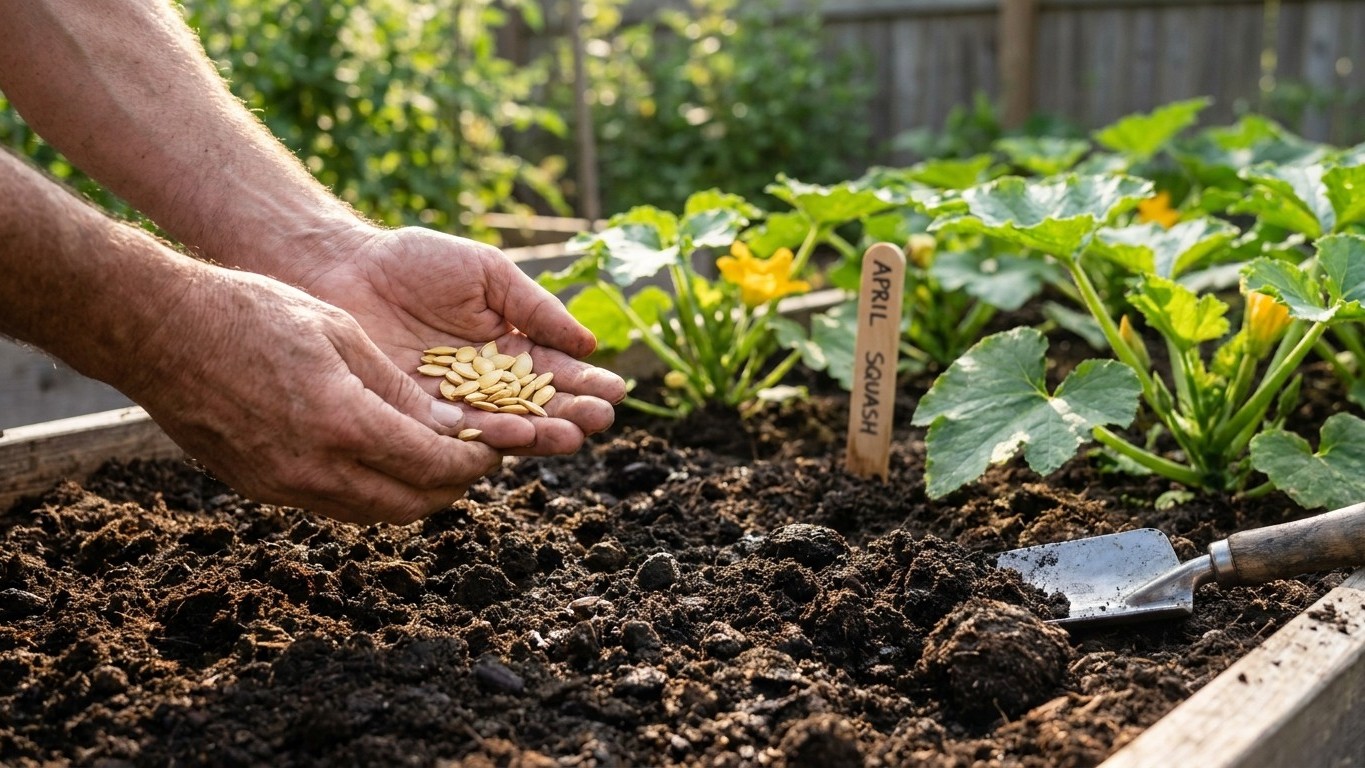

Summer Squash in Alberta goes into the ground after the average last spring frost, around May 21, and needs to finish before the average first fall frost, around September 16. That gives a mean frost-free stretch of roughly 118 days, but the word “average” is doing heavy lifting here: it’s a midpoint, not a promise, and the actual planting decision depends on how much of that window you’re willing to gamble.
The short answer for Alberta
Environment and Climate Change Canada puts the last spring frost at Calgary Int’l A, averaged over 1981-2010, at May 21. The first fall frost averages September 16. Those two dates are means calculated from thirty years of record, which means in one year out of two the actual last frost lands later than May 21, and in one year out of two the first fall frost arrives before September 16. Treat both dates as the center of a window, not the edges of a safe zone.
That framing matters more for summer squash than for most vegetables, because squash is frost-tender in every stage of growth. A seedling that pokes through the soil on May 22 has no cushion if the frost that year decides to show up on June 2 instead. The safer read of the data is to treat late May as the earliest reasonable direct-seeding date, with early June as a more conservative target for gardeners who don’t want to replant.
Days above 90F average zero for the season at the reference station, which tells you something useful: Alberta summers don’t punish squash with heat stress the way a Texas or Kansas summer might. Fruit set and vine growth here are limited by season length and by soil warming, not by scorching afternoons. That reframes the whole calendar. The question isn’t “how do I protect squash from heat” but “how do I make the most of a frost-free window that, on paper, runs about 118 days and in a bad year runs shorter.”
Given that, the workable approach for most Alberta gardens is to start seed indoors three to four weeks before the expected transplant date, moving hardened-off seedlings outside once the soil has warmed and the frost risk has genuinely passed in your area, rather than direct-seeding cold soil the day the calendar says May 21. Direct seeding is still possible, but it eats into an already tight season, and squash seed sits and sulks in soil colder than about 60F.
What will not work here
The first thing that fails in Alberta is timing squash to the mean frost date as if it were a guarantee. Because May 21 is an average, not a boundary, a gardener who direct-seeds on that exact date is betting on a coin flip. If frost lands later that year, as it statistically will about half the time, tender seedlings get hit and the whole planting has to start over, burning two or three weeks that a short growing season can’t spare.
The second failure is watering on autopilot. Alberta’s summer rainfall averages about 8.5 inches across June, July, and August, and it isn’t spread evenly:
| Month | Average rainfall |
|---|---|
| June | 3.7 in. |
| July | 2.58 in. |
| August | 2.24 in. |
Summer squash, with its broad leaves and shallow, spreading roots, typically wants closer to an inch of water a week during fruiting. August’s 2.24 inches works out to roughly half an inch a week on average, in the exact month when plants are usually loaded with fruit and drawing hardest on soil moisture. A gardener who waters once a week “because that’s what the packet says” is very likely under-watering through the driest stretch of the Alberta summer, especially on sandy soil that drains fast.
The third failure is borrowing a days-to-maturity number from a seed packet grown and tested somewhere with a longer, hotter season and expecting it to hold here. Alberta sits at Canadian hardiness zone 4a at the reference station, a zone built from seven climate variables rather than the single minimum-temperature measure the USDA system uses. That zone number does not translate cleanly into a US zone, and it certainly doesn’t tell you how many warm days a variety will actually get to ripen fruit. A squash that “needs 55 days” on paper needs 55 warm-enough days, and with zero days above 90F in the local average, growth here runs slower than the same variety would run in a hotter climate, even inside a similar frost-free window.
What doesn’t apply here, worth flagging since it trips up gardeners reading generic advice, is the tight-spacing-causes-fungus problem common in humid regions. Alberta’s summers aren’t humid, so that particular failure mode isn’t the local risk. The local risk is cold soil and a compressed season, not mildew from crowding.
What changes across Alberta
Every figure above comes from one reference station, Calgary Int’l A, and Alberta is not one climate. The province runs from prairie in the south to boreal forest and foothills in the north and west, and Natural Resources Canada’s own hardiness mapping shows the province spanning a wide band of zones, not a single number. Calgary’s 4a is the zone of that one city, not of Grande Prairie, not of the Peace Country, not of a garden at elevation in the foothills.
What that means in practice: a gardener north of Calgary, or at meaningfully higher elevation, should expect the last spring frost to average later than May 21 and the first fall frost to average earlier than September 16, which shrinks the already-tight 118-day window from both ends. In those areas, the case for starting seed indoors and transplanting out, rather than direct-seeding, gets stronger, and season-extension tools like row cover or cold frames stop being optional extras and start being the difference between a harvest and none.
South of Calgary, and in sheltered valley locations, the frost-free window can run a bit longer than the reference station’s average, which gives slightly more room for direct seeding and for varieties on the longer end of the maturity spectrum.
None of that tells an individual reader which zone their own yard sits in, and this page isn’t the tool for that. Natural Resources Canada’s Plant Hardiness site maps zones down to the municipality level using the 1991-2020 normals, and that’s the place to look up where a specific address falls before adjusting the dates on this page.
Where to check this for your own county
Alberta’s provincial agriculture ministry, reachable at alberta.ca/agriculture-and-irrigation, is the starting point for anything more specific than the province-wide averages used here. This page works from a single reference station in Calgary, and Alberta is a large enough province that a regional or county-level source will beat it every time.
Two things are worth hunting for once there. First, any regional planting calendar the ministry or a local agricultural service board publishes for your part of the province, since those are typically built from frost records closer to your actual garden than Calgary Int’l A. Second, any list of squash or cucurbit varieties that have been trialled in your specific region, because a variety that performs well in the Chinook-influenced south may behave differently in the Peace Country or in a foothills microclimate.
Local agricultural service boards and county or municipal district offices, which exist across most of rural Alberta, often hold frost records and variety trial results that never make it into a province-wide bulletin. A master gardener program or a local horticultural society, where one operates in your area, is another practical source, since those groups tend to track first and last frost dates for their own town year over year, not just the thirty-year average from an airport station.
Say it plainly: this page gives you the state-level, or in Alberta’s case the provincial-level, picture. A county or municipal recommendation, built from local records, is always going to be more accurate for your actual garden than an average pulled from one station in Calgary.
Checking this against your own garden
Every date on this page is a regional average. Your own garden will tell you something more precise, and it costs nothing but attention. Three signs are worth tracking before trusting the calendar over your own observation.
Soil warmth by feel is the first and most direct check. Summer squash seed and transplants both stall in cold soil, and a simple hand test, pushing your fingers a few inches into the bed in the morning, tells you more about germination odds than any calendar date. Soil that still feels cold and damp in late May, even after the average last frost has passed, is telling you your particular spot warms slower than the regional norm, whether from shade, clay content, or exposure to wind.
The first flush of male flowers is the second signal. Summer squash typically produces male flowers before female ones, and their timing is a rough gauge of how much heat and light the plant has actually banked, independent of the calendar date. Female flowers, recognizable by the small swelling at the base that will become the fruit, following a week or two behind male flowers is a healthy pattern; a long gap can mean the plant is still catching up from a cool or late start.
The first true leaves, the second set that appears after the rounded seed leaves, mark the point where a seedling is genuinely established rather than just surviving. Seedlings that sit at the seed-leaf stage for an unusually long stretch are signaling a cooler-than-average microclimate, which is useful information for next year’s timing regardless of what the regional average frost dates say.