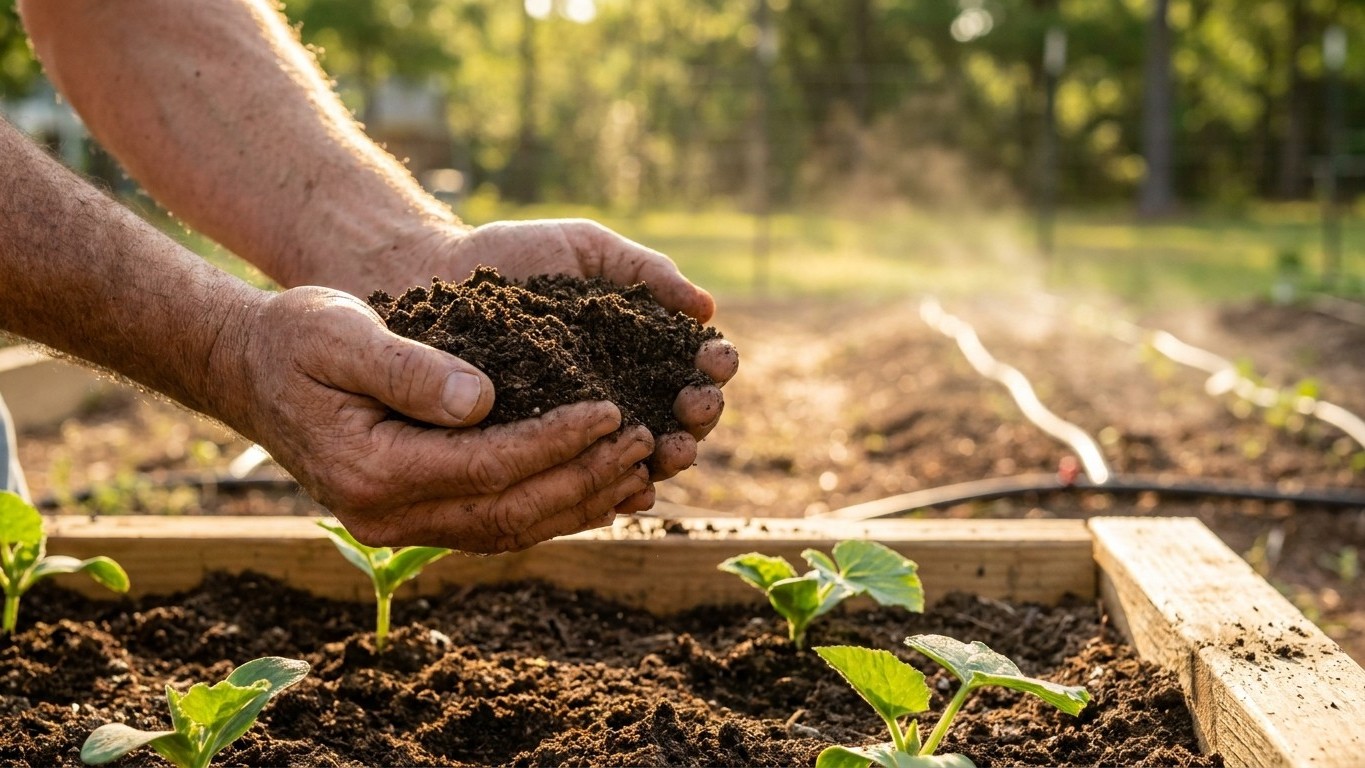

Wait for the soil, not the calendar. In southern Wisconsin that generally means planting summer squash around Memorial Day; in the north, closer to the second week of June. The frost-free window then runs roughly five and a half to six and a half months, long enough for one solid harvest and, in the south, often a second sowing. Wisconsin summers stay moderate, so heat rarely stresses the plants, but rain and humidity decide whether mildew shows up before the zucchini does.
When the soil is warm enough in Wisconsin
So when exactly can you put Summer Squash in the ground? At the reference station in the NOAA network (USW00014839), the last spring frost lands somewhere between April 16 and April 29, based on the 1991-2020 Climate Normals and the 30-70 percent probability band for a 32°F freeze. That’s a two-week spread, not a single date. And a frost date is a probability, not a promise: half the years inside that band still see frost land after the midpoint of it.
Why the soil matters more than the calendar
Squash doesn’t actually track frost risk on a calendar. It tracks soil temperature, and soil temperature lags behind the retreat of frost by a couple of weeks across most Wisconsin ground. A patch of soil can sit in the low 50s on a day with zero frost risk left, and squash seed dropped into it will rot or sulk rather than germinate. That’s the real reason gardeners get told to wait past the frost date instead of planting right on it: the frost date marks when the air stops threatening the plant, not when the ground is ready to feed it.
In practice, treat late April as the earliest theoretical marker in southern Wisconsin, then give the soil another two to three weeks of consistent sun before direct-seeding. A soil thermometer pushed a few inches down on a sunny afternoon tells you more than any regional average, since a raised bed, a south-facing slope, or a patch of dark mulch all warm faster than open clay ground nearby.
Lakeshore, inland, and transplants
Gardeners along the Lake Michigan shoreline get a different rhythm on both ends of the season. The lake delays the first fall freeze right at the shoreline, and it tends to slow spring soil warming too, since cool offshore water keeps spring air temperatures down longer than inland sites experience. Inland southern Wisconsin typically warms faster and reaches safe, workable soil earlier than the lakeshore counties do.
Transplants shift the math slightly, since a hardened-off seedling can go into the ground a little earlier than direct-seeded squash would tolerate, because it isn’t waiting on soil warmth to germinate, only to grow without stalling. But summer squash resents root disturbance more than most vegetables in its family, so any transplant needs to go in with its root ball intact, not bare-root and not root-bound from sitting too long in a small pot.
How long the season lasts here
Subtract one frost date from the other and you get the frost-free window, at least in theory. Wisconsin’s last spring frost falls between April 16 and April 29, and the first fall frost between October 17 and October 29, both from the same NOAA station and the same 1991-2020 Normals. Run the math across those ranges and the frost-free season lands somewhere between about 171 days, if spring frost lingers to April 29 and fall frost arrives early on October 17, and about 196 days, if spring frost clears out by April 16 and fall frost holds off until October 29.
What a six-month window allows
Split the difference and Wisconsin gardeners are generally looking at five and a half to six and a half months of frost-free growing, depending on exactly where a site falls in each probability band and how close it sits to Lake Michigan’s moderating effect. That’s a meaningful stretch for summer squash, which needs only a couple of months from seed to first harvest. It’s long enough that one planting isn’t the only option in most of the state, especially in the southern counties where the window runs closer to its longer end.
A season this length opens the door to succession sowing: a second round of seed going into the ground in early to midsummer, timed to mature well before October’s fall frost risk arrives. That second sowing replaces plants slowed by midsummer humidity, and it stretches the harvest into early fall instead of letting it collapse once the first planting is spent. Our guide to succession sowing summer squash walks through the timing in more detail, since the calculation depends on how many weeks a type needs before harvest and how much buffer you want before frost.
Where the window runs shorter
Closer to the 171-day end, especially in northern Wisconsin where fall frost risk climbs earlier and the growing zone shifts toward the cooler side of the state’s 3b-6a hardiness range, a second sowing gets riskier. In that case the first planting effectively is the only shot, which raises the stakes on timing it well and on choosing transplants over direct seed, since a transplant already carries a few weeks of growth before it goes into open ground. Transplanting buys time in a short season, but it also means checking the root ball carefully, since a plant that’s been root-bound in a small pot won’t recover well once it’s out under open sky.
Heat and water in Wisconsin
Milwaukee’s reference station reports an average of just 7.0 days a year at or above 90°F, based on the 1991-2020 Climate Normals. That’s a low heat load compared with summer squash’s real stress threshold: pollen turns short-lived and fruit set falters once temperatures push into the high 90s for stretches at a time. Seven scattered days a year rarely gets a Wisconsin garden anywhere near that failure point, so the afternoon shade and heat-driven irrigation a grower in a hotter state leans on matter far less here.
Moisture is the real variable
What replaces heat as the season’s real concern is moisture, and Wisconsin gets a fair amount of it. Summer rainfall averages about 11.4 inches across June, July and August combined, broken down as 4.38 inches in June, 3.4 in July (the driest of the three), and 3.65 in August, all from the same reference station’s Normals. That’s enough water most summers that a squash bed rarely goes truly dry, but it comes with a cost: rain that falls as a handful of summer thunderstorms rather than steady drizzle leaves leaves wet for hours, and a squash canopy holds humidity right at soil level where powdery and downy mildew get their start.
Managing a cool, damp summer
A cool, damp Wisconsin summer is a different management problem than a hot, dry one. Instead of watching for wilted leaves at midday, the practical concern becomes airflow: spacing plants wide enough that a canopy doesn’t stay wet from morning dew through midafternoon, and watering at the soil rather than overhead so leaves dry faster. Slow ripening is the other quiet cost of a cool summer; fruit that would size up during a hot week can sit longer on the vine through a stretch of overcast, mild days, which is more a patience issue than a crop failure.
None of this means Wisconsin gardens never need supplemental water. July’s 3.4 inches is an average, not a guarantee in any given year, and a sandy garden bed sheds that rain within a day where a clay bed holds it for a week. The Normals figure says what the region can typically expect over a season; a rain gauge on your own plot, checked through July especially, is what actually tells you whether the squash need a hose that week.
Which summer squash suit Wisconsin
None of the facts above point to one single “best” summer squash for Wisconsin, because the trade-off that matters most changes with the piece of ground, and that’s a decision best made by type rather than by chasing a specific variety name. Four broad types cover almost everything sold as summer squash: bush-type zucchini, yellow crookneck and straightneck squash, scallop or patty pan types, and a smaller group of vining forms that need more room to sprawl.
Matching type to season length
Wisconsin’s frost-free window, running from roughly 171 to 196 days depending on location, sits in a moderate range: not short enough to demand only the fastest-maturing type available, but not long enough in the northern counties to waste time on late types that need a long stretch of warm weather before harvest even starts. Toward the shorter end of that window, especially north of the hardiness zone’s warmer pockets, an earlier-maturing bush type gives more margin against an early fall frost than a sprawling vining type that takes longer to start producing.
The state’s humid, thunderstorm-driven rainfall pattern, especially the wetter bookends of June and August, makes disease resistance the first filter worth applying regardless of type. Powdery and downy mildew both find a foothold in a canopy that stays damp, so a variety selected for resistance to those diseases holds up better through a Wisconsin August than one chosen purely for yield. Bush types, given real spacing rather than crowded together, also dry out faster after a thunderstorm than a tangle of vining plants would, independent of which specific variety goes in the ground.
Why this page won’t name a variety
This is exactly where a general growing guide stops being useful and a different resource takes over. The varieties actually trialled in Wisconsin conditions, tested against the state’s own disease pressure and season length, are tracked by the University of Wisconsin’s extension service, not by a page like this one. Its address is extension.wisc.edu, and checking its trial data before buying seed matters more than picking a name off a seed rack, because a variety bred for a hot southern state may carry none of the mildew resistance that actually counts here. Naming a cultivar on this page would be a guess dressed up as advice; the extension service’s field trials aren’t.