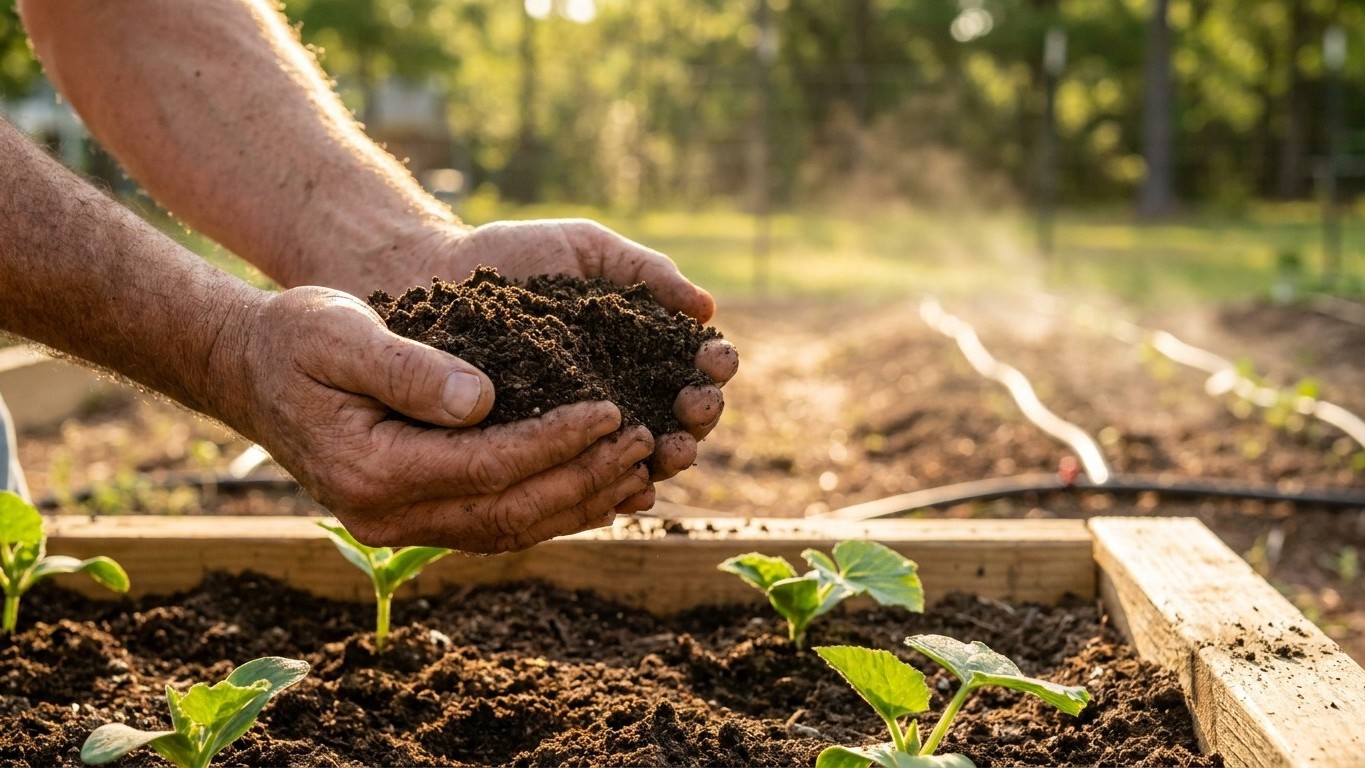

Summer squash needs consistently warm soil, not just a frost-free calendar date, and in Wyoming that soil warms late and cools early. Between the state’s short window, its cool nights, and its dry summers, the plant that thrives in Georgia struggles here unless a gardener adjusts timing, water, and variety type to match the mountain-state climate.
When the soil is warm enough in Wyoming
The question every Wyoming gardener asks in spring is simple: when can I put squash in the ground? The honest answer starts with the last spring frost, which for the reference station USW00024018 falls somewhere between May 7 and May 18, according to NOAA’s 1991-2020 Climate Normals. That’s a probability window, not a guarantee, built from three decades of freeze data, and it shifts year to year depending on the specific spring.
But frost date is only a proxy. Summer squash germinates and grows from warm soil, not from the absence of ice on a thermometer. Soil at 6 inches deep typically needs to sit above 60°F before seed will germinate reliably, and that threshold is usually reached one to three weeks after the last frost risk has passed, depending on soil type, sun exposure, and whether the bed has been covered. A gardener who plants on the calendar date alone, ignoring the ground itself, often ends up with rotted seed and a frustrating replant.
Why elevation changes the math
At roughly 6,000 feet, Wyoming works with about 130 frost-free days in a typical year, and frost is possible in any month at the higher elevations across the state. That single fact reshapes how gardeners here should think about squash. Season extension isn’t a bonus technique, it’s close to mandatory for a plant that wants heat and hates cold soil. Black plastic mulch laid two to three weeks before the intended planting date raises soil temperature measurably. Floating row cover, propped on hoops so it doesn’t crush young leaves, buys another layer of protection against a late cold snap without blocking the pollinators the plant will eventually need.
Raised beds help too, since they drain faster and warm quicker than flat ground, which matters most in the clay-heavy soils found in parts of the state. Starting seed indoors under lights three to four weeks before the projected transplant date, then hardening off the seedlings gradually over about a week of increasing outdoor exposure, gives squash a head start the open ground can’t offer on its own. Direct-seeding remains an option for gardeners at lower elevations with lighter soil, but it should wait until the soil itself, checked with a simple soil thermometer, confirms readiness rather than the wall calendar.
Whatever method is chosen, the University of Wyoming Extension tracks local soil temperature guidance and frost patterns specific to individual counties, which matters given how much the state’s terrain varies from the high plains around Cheyenne to the mountain valleys further west.
How long the season lasts here
Subtracting the frost dates gives a real number to plan around. Using the earliest last frost (May 7) against the latest first fall frost (October 5) produces a growing window of about 151 days. Flip it the other way, using the latest last frost (May 18) against the earliest first fall frost (September 24), and the window shrinks to roughly 129 days. That spread, 129 to 151 days depending on the year and the specific spot in the state, lines up closely with the roughly 130 frost-free days typical at 6,000 feet elevation.
What does that length actually allow? A window in the 150-day range gives enough room for a second sowing of summer squash, planted about six to eight weeks after the first, to reach harvest before fall frost shuts things down. A window closer to 129 days does not offer that same margin. In a short-window year, the first sowing is effectively the only sowing, and every week saved at the start of the season through transplants or soil warming translates directly into more harvest weeks at the other end.
This distinction also changes whether Transplanting is worth the root disturbance it causes. Squash resents having its roots handled, and a plant started indoors can suffer transplant shock that costs it a week of stalled growth. In a long-window year, that week barely registers. In a short-window year, it can be the difference between a second flush of fruit and a garden that quits producing right as the first frost warning appears. Gardeners working the shorter end of Wyoming’s range should weigh direct-seeding more seriously, accepting a later start in exchange for a plant that never has to recover from a move.
Anyone considering that second planting, or trying to squeeze more harvest out of a favorable year, should look at the site’s succession sowing guide for the specific spacing and timing that makes a second round worthwhile rather than a race against the first frost.
Heat and water in Wyoming
Summer squash has a reputation as a heat lover, but the plant actually struggles once daytime temperatures push into the high 90s, because its pollen loses viability within hours under that kind of heat stress, and flowers can drop before they ever set fruit. That’s not the story in Wyoming. At the Cheyenne reference station, the state averages just 10.4 days a year at or above 90°F, based on NOAA’s 1991-2020 Climate Normals. That’s a modest heat load compared to the summer squash growing regions further south, and it means pollen failure from extreme heat is rarely the limiting factor here.
The bigger constraint is dryness, not heat. Summer rainfall across June, July, and August totals about 5.8 inches, with August running the driest at just 1.52 inches, June at 2.16, and July at 2.11. That’s a modest amount spread over the three months when squash is actively flowering and filling out fruit, and it rarely arrives in the gentle, steady pattern the plant prefers. Squash carries enormous leaves relative to its root system, and those leaves lose water fast, especially with the wind that’s common across Wyoming’s open plains and elevated terrain. A shallow root plate simply can’t keep pace with that evaporative demand during a dry stretch, even when the air temperature itself isn’t extreme.
This is not the hot, humid climate where afternoon shade cloth becomes the priority. It’s closer to the opposite problem: cool nights and dry air that together slow fruit set and can leave the plant looking stressed even without a single 95°F afternoon. Consistent watering, not shade, is the practice that matters most here. A deep soak two or three times a week, delivered at the soil line rather than overhead, does more for a Wyoming squash bed than any amount of misting or midday shading. Mulching around the base helps hold what rain does fall, cutting evaporation from wind and dry air alike.
A gardener relying only on the regional averages should also keep a rain gauge on their own plot. Wyoming’s terrain includes rain shadows, slopes, and localized microclimates that can push actual rainfall well below or above the station figures cited here, and that gap is exactly what decides whether a given week needs supplemental water or not.
Which summer squash suit Wyoming
Given a short growing window, modest heat, and dry summers, the type of summer squash that suits Wyoming best is an early-maturing type bred to set fruit and finish before the window closes, rather than one that needs a long, steady heat stretch to reach its peak. Early types also give a buffer against a late spring or an early fall frost, both of which are common enough here to plan around rather than hope against.
Airflow matters more in Wyoming than shade does. Because the region’s dry air and wind can still allow powdery mildew to take hold on crowded squash leaves, especially where irrigation wets the foliage, spacing plants generously and watering at the soil rather than overhead reduces disease pressure more effectively than any spray program. For gardeners dealing with wetter microclimates within the state, disease resistance becomes a more useful first criterion when choosing which squash type to grow, since a resistant type tolerates the occasional damp week without losing the whole planting to mildew.
This page won’t name a specific variety, and that’s a deliberate choice, not an oversight. Cultivar performance shifts from one part of Wyoming to another depending on elevation, soil, and local microclimate, and a variety that thrives in a Cheyenne backyard may underperform in a mountain valley two hours away. The University of Wyoming Extension maintains trial data and county-specific recommendations built from actual local performance, not averages, and that’s the source worth checking before buying seed. Their guidance accounts for the real variation across a state that spans plains, foothills, and mountain terrain, something a general list of cultivar names never could.
The larger point stands regardless of which type ends up in the ground: match the plant’s timeline to the state’s short window, protect it from cold soil at the start, and water it deliberately through a dry summer rather than counting on rainfall to do the job alone.