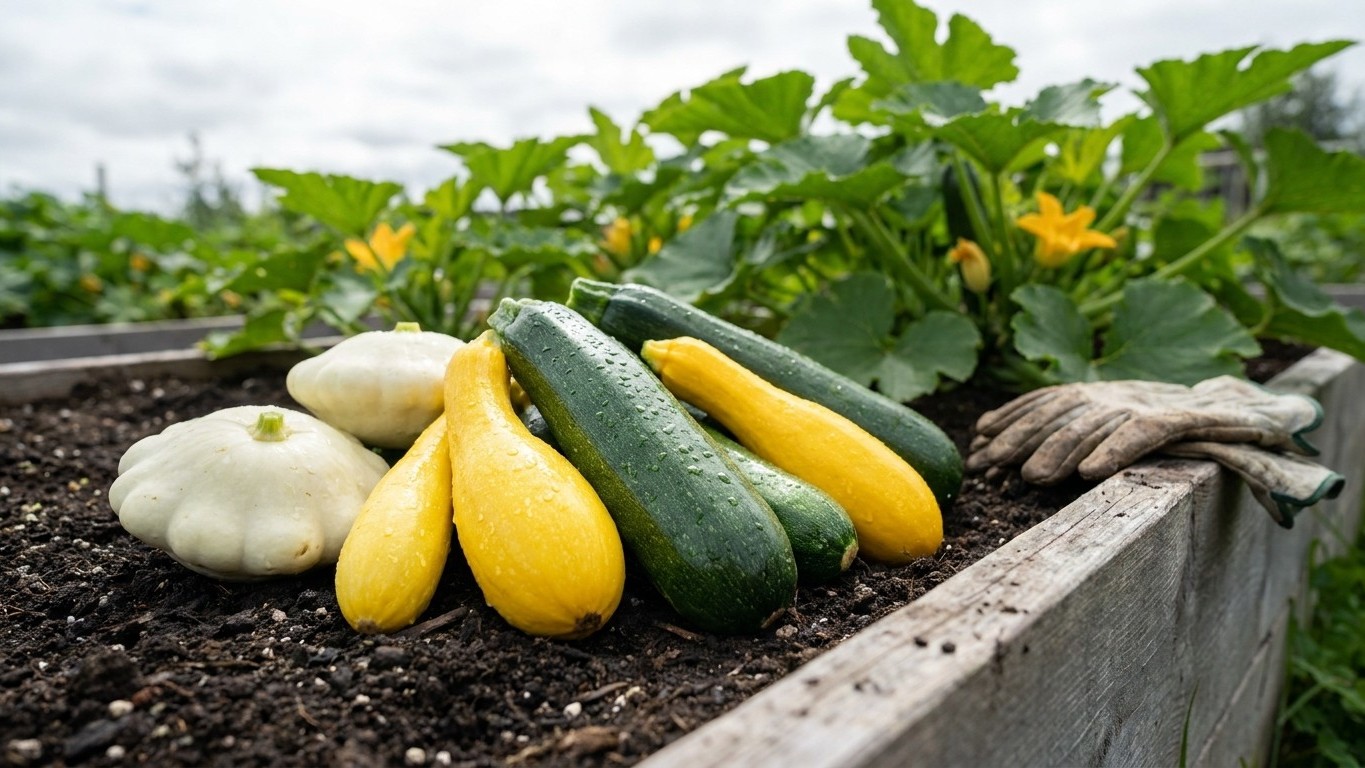

California‘s growing conditions favor summer squash almost everywhere the state isn’t shivering at elevation. Along the coast and through the south, the constraint is water, not frost or cold, so heat-tolerant, drought-forgiving types like zucchini, yellow crookneck, and cousa squash carry the season. Inland and at altitude, the calculation changes with the ground itself.
The short answer for California
Pick by type, not by variety name, and let the climate decide which type. Along the coast and through Southern California, where the reference station shows zero days at or below 32F across 30 years of records, the season simply doesn’t end on its own. That means nearly every type of summer squash, zucchini, yellow crookneck, straightneck, pattypan, scallop, and cousa, can complete its full run of fruit without a frost cutting it short. The deciding factor there isn’t days-to-maturity. It’s water.
At that same reference station (Los Angeles), the summer heat load is milder than most gardeners assume: an average of just 2.4 days a year reaching 90F or higher. That’s a modest number. It means heat-stress failures, blossoms scorching, fruit set stalling in the worst of summer, are less of a threat near the coast than the state’s reputation suggests. What’s genuinely severe is rainfall: about 0.1 inch total across June, July, and August, with August itself averaging 0.0 inches. Every drop a squash plant gets in summer there comes from a hose, not the sky.
So the short answer for that part of the state is straightforward: choose types for flavor and use, since the climate won’t eliminate any of them, and build irrigation around the fact that rain contributes almost nothing for three straight months.
Farther inland, that answer stops applying. California’s hardiness zones run from 5a to 11a, a spread that covers nearly the full range of the USDA system inside one state’s borders, and the Central Valley’s summer heat load runs well past what the coastal reference station records. This page doesn’t have verified heat or frost figures for the Central Valley or the Sierra foothills, and it won’t borrow the coastal station’s numbers to fill that gap. If your county sits away from the coast, treat the guidance above as a coastal-climate baseline, not a statewide one, and use the county check in the sections below before committing a full row to any single type.
What will not work here
Near the coast and through the south, the plant most likely to disappoint isn’t a squash bred for the wrong heat. It’s one grown on a watering schedule built for a rainier place. With summer rainfall averaging around 0.1 inch total across three months, and August landing at 0.0, a garden watered once a week on the assumption that “it’ll rain eventually” is a garden that will lose blossoms, drop small fruit, and turn bitter under stress. Summer squash carries a shallow, wide-spreading root system that dries out fast in bare soil with no rainfall buffer; skipping even one irrigation cycle during a dry August at this station is not a minor miss, it’s the difference between a productive plant and a stalled one.
Close spacing is a second, quieter failure point. Humid-climate growing guides often recommend tight rows to shade the soil and conserve moisture, advice that makes sense where rain keeps foliage wet and airflow prevents disease. In a summer with essentially no rain, that same tight spacing traps still, dry air around the leaves, and powdery mildew, which doesn’t need rain to spread, thrives on crowded plants just as readily as on wet ones. Wider spacing than a humid-region seed packet suggests is the safer bet here.
What isn’t a major threat, at least at the coastal reference station, is frost cutting the season short. With zero recorded freeze days over 30 years, gardeners there don’t need to race a first-fall-frost date the way growers in most of the country do. That’s a real advantage, but it doesn’t erase the water math above.
The one failure this page won’t speculate about is heat death in the Central Valley or desert interior. Those regions almost certainly push past the coastal station’s mild 2.4-day average above 90F, but without a verified figure for those specific counties, the honest answer is that this page doesn’t have the number, and a grower there needs to check locally rather than assume the coastal climate applies.
What changes across California
A hardiness range of 5a to 11a is not a rounding error, it’s nearly the entire USDA scale compressed into one state. Zone 5a describes winters cold enough to test hardy perennial shrubs; zone 11a describes conditions that barely dip below freezing at all. That gap means a single answer for “when does the growing season start” or “how much water does a squash plant need” cannot exist statewide, no matter how tidy that would be for a gardening calendar.
The reference figures cited above, the frost-free record, the mild 2.4-day heat average, the near-zero summer rain, describe conditions closer to the 10a/11a end of that range: coastal and Southern California. A gardener working land at higher elevation, in the northern part of the state, or well inland faces a materially different set of pressures. Winter cold becomes a real planning factor there in a way it simply isn’t near the coast, and the growing season, rather than running all year, has defined start and end points driven by actual frost.
The heat side shifts too, though in the opposite direction from what many assume. Interior valleys tend to run hotter in summer than the mild coastal normal recorded here, which changes watering frequency and can push fruit set problems that the coastal figures don’t predict at all.
None of this can be resolved by reading a general California average, because there isn’t one that means much across a 5a-to-11a spread. The right move is checking the USDA Plant Hardiness Zone Map for the specific location in question, rather than assuming either the coastal reference conditions or a Central Valley pattern applies by default.
Where to check this for your own county
Everything above comes from a single reference station and a statewide hardiness range, useful for understanding the pattern but not a substitute for local data. The University of California’s Cooperative Extension network, reachable through ucanr.edu, publishes the kind of county-level detail this page can’t provide: planting calendars built around local frost and heat records, and lists of summer squash varieties actually trialled by extension staff or master gardeners in that specific county.
Two things are worth looking for once there. First, a county-specific planting calendar, which will reflect actual local frost risk (or its absence) and local heat timing rather than the coastal reference figures used throughout this page. Second, any variety trial results or recommended-cultivar lists for summer squash, which carry more weight than a general “best varieties” list because they reflect performance in that county’s actual soil, water, and pest pressure, not a statewide average.
A county recommendation beats a state one every time, and that’s worth saying plainly rather than glossing over. This page works at the level of California as a whole, useful for understanding why coastal conditions differ so much from inland ones, but it cannot tell a reader in Fresno County what a reader in Marin County should do, and it shouldn’t try. The extension office covering the county in question has almost certainly already done that work, often with decades of local trial data behind it, and it’s free to access.
If the local extension office’s calendar and this page’s coastal-reference figures disagree, the local calendar wins. That’s not a hedge, it’s how the system is supposed to work: state and territory pages establish the pattern, county-level extension data fills in the specifics no statewide figure can capture.
Checking this against your own garden
None of the figures above, not the frost record, not the heat average, not the rainfall normal, replace what a gardener’s own plot is doing right now. Three signs matter more than any date on a calendar.
Soil warmth by feel is the first. Summer squash seed germinates poorly in cold soil regardless of what the calendar says; if a handful of soil from planting depth still feels cool and slightly damp rather than warm and slightly dry, the ground hasn’t caught up to the air temperature yet, and seed sown into it will sit and rot rather than sprout.
The first flush of male flowers is the second. Squash plants typically produce male blossoms before female ones, and a plant that pushes out male flowers early but slowly is signaling stress, often water stress given how little summer rain this region receives. A quick, heavy first flush suggests the plant has what it needs; a sparse, delayed one is worth investigating before assuming it’s just the variety.
The first true leaves, the ones that appear after the rounded seed leaves and actually look like squash foliage, mark the point where a plant has moved past its most fragile stage. Slow, pale true-leaf development in a bed that’s had consistent water usually points to a microclimate issue, a cooler pocket, more shade than expected, or wind exposure, that no regional average could have predicted.