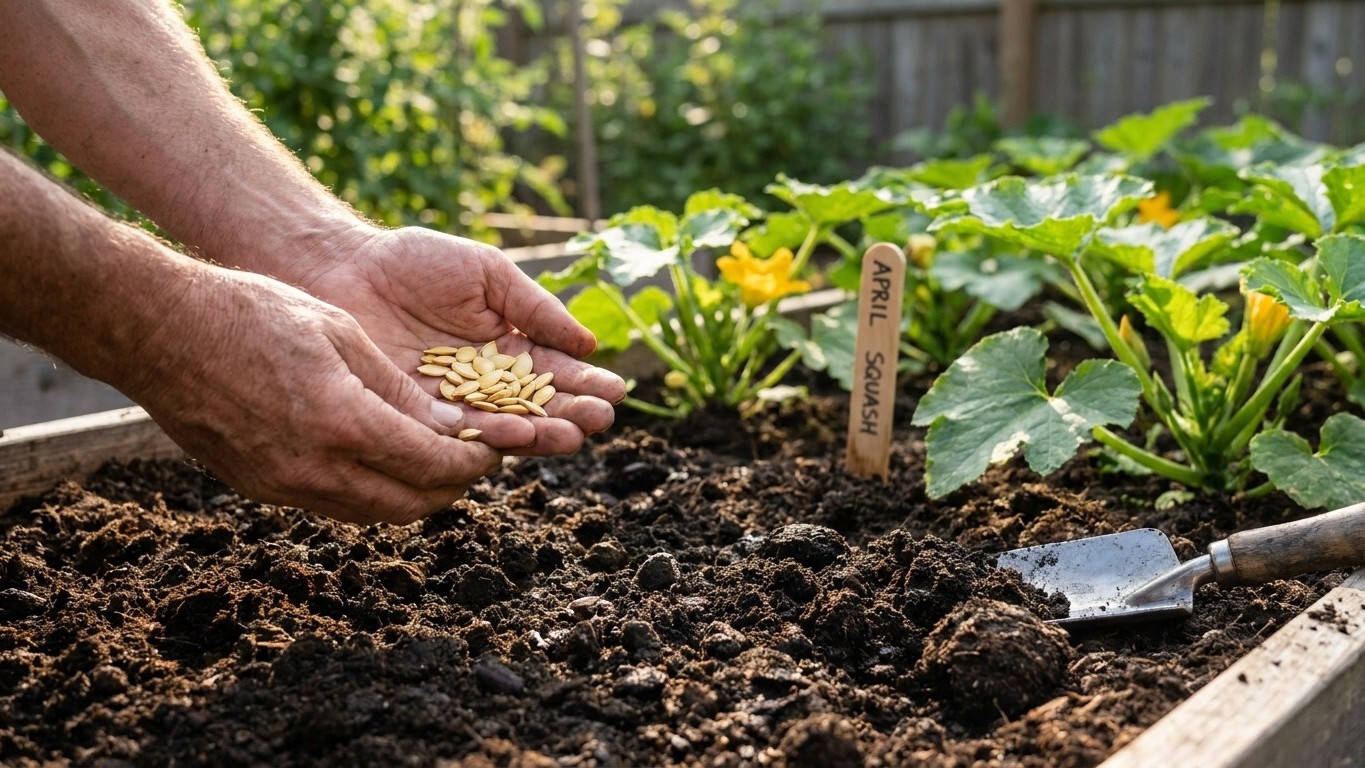

In Delaware, direct-sow summer squash outdoors between late April and early August, once soil has warmed past the frost risk that lingers into mid-April at the reference weather station. That’s the short version. The rest of this page explains why that window moves depending on where in the state your garden sits, and what actually kills a squash crop here even when the calendar looks right.
The short answer for Delaware
At the reference station near Wilmington (USW00013781), the last spring frost falls somewhere between April 3 and April 14, and the first fall frost lands between October 26 and November 7. Those dates aren’t fixed events, they’re a probability band: NOAA’s 1991-2020 Climate Normals put a 30 to 70 percent chance of a 32°F freeze inside that range. In practice, that means you’re gambling if you set squash out before April 14, and you’re pushing your luck if you expect a September sowing to finish before late October.
Summer squash is a warm-season crop that sulks in cold soil and dies outright in frost, so the safe direct-sow window opens after that spring band closes, call it late April at the earliest for most home gardens, and runs until roughly ten to twelve weeks before the fall band opens. Since summer squash typically matures in 45 to 60 days from seed, that gives Delaware gardeners room for at least two, often three, staggered sowings between late April and early August.
The state’s hardiness zone spread, 7a to 8a per the USDA Plant Hardiness Zone Map, tells you about winter extreme minimums, not planting dates directly, but it’s a useful shorthand for how much the state varies. A garden at the warmer end of that range can often push both ends of the sowing window a bit further than one at the cooler end. More on that below.
What this page does not have is a frost date specific to your county. The figures above come from one airport-based station. If your garden sits inland, in a low spot, or away from the coast’s moderating effect, treat these dates as a starting reference, not a guarantee.
What will not work here
Delaware’s growing season is long enough that a short window isn’t really the threat summer squash faces here. What trips people up instead is heat and moisture management during the stretch when the crop is actually growing.
The reference station averages 17.6 days a year at or above 90°F, mostly clustered in July and August. That heat load doesn’t kill summer squash outright, but it accelerates water loss fast enough that a once-a-week watering schedule, which might get by in a cooler climate, leaves plants visibly stressed here: wilted leaves at midday, stunted fruit, blossom drop. Squash grown on light, sandy soil in this heat can dry out within a day or two of rain, so treating a wet week as a reason to skip watering for ten days is a common way to lose a crop to stress rather than disease.
Rainfall works against gardeners in a different way. Summer rain here totals about 13.1 inches across June, July and August, with June the wettest at 4.67 inches and August the driest at 3.98 inches. That’s a decent amount of water on paper, but Mid-Atlantic summer rain tends to arrive as short, heavy thunderstorms rather than steady soaking rain. Combined with the humidity that typically rides along with those storms, dense summer squash plantings that don’t get enough airflow between plants are prone to foliar disease late in the season, powdery mildew being the one most gardeners in this region eventually see on the leaves by August. Crowding plants to squeeze more into a bed, a tempting move given how much room squash vines take up, works against you here more than it would in a drier climate.
The other predictable failure is timing the last sowing too late. Setting seed in mid-August and expecting a harvest before the first fall frost band opens on October 26 is cutting it close for anything that runs past a 60-day maturity, especially once cooling nights in October slow growth regardless of the calendar.
What changes across Delaware
Delaware is small, but it isn’t a single garden. The 7a to 8a hardiness range spanning the state reflects a real difference in winter extreme minimums between the northern part of the state, near Wilmington, and the southern counties toward the Maryland line and the coast. There is no single answer for the whole state, and this page can’t tell you which side of that line your own yard falls on.
What the spread suggests in practical terms: a garden at the warmer end of the range, generally toward the southern part of the state, tends to see its last spring frost arrive slightly earlier and its first fall frost slightly later than the reference station figures above, stretching the safe sowing window on both ends. A garden at the cooler end, more typical of inland or northern spots, should treat the April 14 end of the spring frost band and the October 26 end of the fall band as the more cautious figures to plan around, not the midpoint.
Elevation and local terrain matter more than distance north-south in a lot of cases. Low-lying areas where cold air pools, even in the southern part of the state, can see frost linger later into spring than the zone map alone would suggest. Coastal proximity, meanwhile, tends to buffer temperature swings in both directions, which is part of why the reference station used for these dates, sitting inland from the bay, likely runs a bit cooler on both frost dates than a garden closer to the water.
None of this is something you can resolve from a state-level page. It’s the reason the next section exists.
Where to check this for your own county
The University of Delaware’s Cooperative Extension is the source built for exactly this problem, a county-specific answer that a statewide page like this one can’t provide. You can find it at https://www.udel.edu/academics/colleges/canr/cooperative-extension/.
Once there, look specifically for two things. First, a county or regional planting calendar, if one is published for your area, that reflects actual local frost records rather than the single airport station cited throughout this page. Second, look for variety trial results or recommendations specific to Delaware growing conditions, since summer squash varieties differ in how well they tolerate the state’s summer humidity and disease pressure, and Extension trials are usually the most locally grounded source for that kind of comparison.
A county-level recommendation from Extension will beat anything on this page, plainly. This is the state-level view, useful for understanding the overall shape of the season, but built from one weather station’s thirty-year averages rather than what’s actually happening in your specific soil and microclimate this year. If your county Extension office publishes something more specific, that source should override the dates given here.
Checking this against your own garden
Every date above is a normal built from decades of past weather, not a forecast for this particular spring. Your own garden will tell you more than any calendar once you know what to look for.
Soil warmth, checked simply by feel, matters more than the calendar date for summer squash. Press a hand into the top few inches of soil in the bed you’re planning to use. If it still feels cold and damp rather than warmed by the sun, wait, even if the date on this page has already passed. Squash seed sitting in cold soil is more likely to rot than to germinate slowly.
The first flush of male flowers on an established plant is a useful signal too, though it comes a bit later in the season. Summer squash typically produces male flowers before females, and a burst of males with no females yet isn’t a problem, it’s normal sequencing. What it tells you is that the plant has reached reproductive maturity for its conditions, a milestone that can arrive earlier or later than the seed packet’s average depending on how warm your particular spot has run that season.
Watch the first true leaves as well, the ones that appear after the initial rounded seed leaves. Slow, pale, or stunted true-leaf growth after a warm, sunny stretch usually points to a nutrient or watering issue specific to that bed, not a timing problem, and it’s worth checking before assuming the planting date was wrong.