
North Florida gets a defined squash season bounded by real frost dates. Central and south Florida barely freeze at all, which flips the whole calendar: winter becomes the main growing window and summer turns into the season to survive. The best variety pick depends on which Florida you’re gardening in.
The short answer for Florida
Start with the type, not the brand name on the seed packet. Florida’s summer squash decision comes down to two numbers: a frost-free stretch that runs from roughly late February to late November in the north (using Jacksonville’s station data, last spring frost February 16 to March 7, first fall frost November 26 to December 13), and a heat load of 73.2 days a year at 90F or hotter. That combination rules out slow, sprawling types and rewards fast, compact, disease-resistant bush varieties.
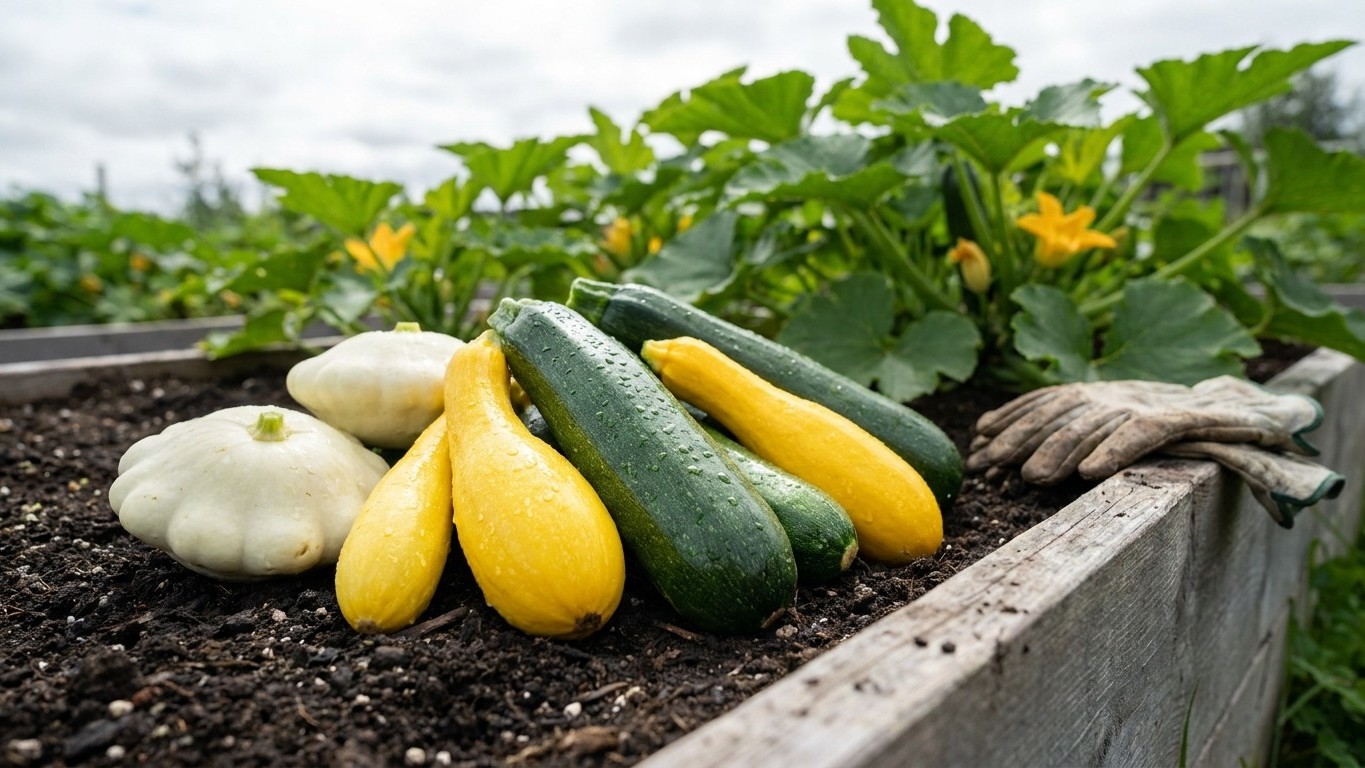
Bush-type yellow crookneck and straightneck squash are the traditional Southern choice for a reason. They mature quickly, they take up less garden real estate than vining zucchini, and their upright habit sheds humidity better than a plant sprawling flat across wet ground. Pattypan and scallop types work on the same logic: compact, quick to bear, and easy to pick before the fruit turns woody in the heat.
Zucchini varieties are not off the table, but they need a harder look at disease resistance on the label. With 21.2 inches of rain falling across June, July and August, powdery and downy mildew show up fast on any cucurbit, and zucchini’s broad leaves hold moisture longer than a crookneck’s more upright foliage. Look for varieties bred with intermediate or high resistance to powdery mildew before choosing a zucchini for a Florida bed.
The bigger strategic call, though, is succession rather than variety alone. Given 73.2 days a year above 90F, no single planting of any summer squash variety is built to produce all season. The realistic plan is picking one or two reliable bush types and replanting every three to four weeks through the frost-free window, treating each planting as a six-to-eight-week crop rather than a season-long vine. That approach matters more to yield than which specific cultivar goes in the ground.
In central and south Florida, where frost essentially does not apply, the same varieties work, but the timing shifts entirely, a point covered below.
What will not work here
Treating one squash planting as a season-long crop is the single most common failure here. Even a heat-tolerant bush variety declines under sustained exposure to 90-plus-degree days, and Florida racks up 73.2 of them a year on average. Squash vine borer and pickleworm pressure both climb as the season heats up, and a plant that has been in the ground for ten weeks straight is a much easier target than one that’s six weeks old. Gardeners who plant once in spring and expect that same stand to carry them through August are working against the climate, not with it.
Weekly watering schedules fail for a different reason. Summer rainfall averages about 21.2 inches over June, July and August, with July actually the driest of the three months at 6.77 inches against June’s 7.6 and August’s 6.88. That sounds like plenty of water, but Florida rain typically arrives as a single afternoon thunderstorm rather than a steady soak, and on the sandy soils common across much of the state, that water drains through within hours. A garden can sit under real summer rainfall totals and still be bone dry three days later. Watering by the calendar instead of by the feel of the soil is a mistake in this climate specifically.
Tight spacing is the third trap. Cucurbit foliage crowded together traps humidity at the leaf level, and with that much summer rain plus heat driving evaporation and regrowth, the air around closely spaced plants stays damp longer after every storm. That’s the exact condition powdery and downy mildew need. Wider spacing than the seed packet’s minimum, plus some attention to airflow between rows, does more to prevent disease here than any fungicide schedule.
Finally, applying the north Florida frost dates to the whole state is its own kind of failure, and a common one for a state this shaped. Those dates come from a station near Jacksonville. Three of the thirty years in that record saw no freeze at all even there, which shows how much year-to-year variation exists just in the north. Further south, the dates simply don’t apply.
What changes across Florida
Florida spans USDA hardiness zones 8b through 11b, one of the widest ranges of any state in the country, and that spread is built entirely on one measurement: average annual extreme minimum temperature. It says nothing about summer heat, rainfall or the length of a practical squash season, but it’s a useful marker of just how different one end of the state is from the other.
In the 8b-9a range near the Jacksonville reference station, frost is a real annual event with the dates already given, and the growing season for summer squash runs from that last frost through the fall frost, essentially a single long stretch from late winter through late fall with summer heat as the main obstacle inside it. Moving south into zone 9b and 10a, frost becomes rare rather than reliable, and the calendar starts to loosen at both ends. By the time a garden sits in zone 10b or 11b, in the southern part of the state, frost effectively doesn’t happen. There, the logic inverts: the productive squash season runs through the cooler, drier winter months, and summer, with its heat and humidity, becomes the period gardeners work around rather than through.
That range means there is no single planting window that covers the whole state honestly. A recommendation built for the Jacksonville area will run backwards for a reader near Miami. The hardiness zone map is the tool for placing a given county inside that spread, not this page, since a state-level article can describe the pattern but can’t responsibly assign an individual reader to one end of it or the other.
Where to check this for your own county
UF/IFAS Extension is Florida’s land-grant service, and it publishes the kind of county-level detail this page can’t. Start at sfyl.ifas.ufl.edu and find the office covering your county. Every county extension office maintains its own vegetable planting calendar, and because Florida’s climate varies so much between the panhandle and the Keys, those calendars differ from one office to the next in ways that matter for exact planting dates.
Two things are worth asking the county office for specifically. First, the local planting calendar for summer squash, which will give planting windows tuned to that county’s actual frost pattern (or lack of one) rather than a statewide average. Second, the list of varieties that county’s extension agents have trialed locally. UF/IFAS runs variety trials across different parts of the state, and a squash that performed well against local disease pressure and heat in one county’s trial plots is a better bet than a name recognized from a seed catalog with no Florida-specific data behind it.
A county recommendation beats a state one every time, and that’s worth saying plainly: this page describes patterns that hold across Florida in general, using data from a single reference station and a statewide hardiness zone range. It was built to explain the mechanics behind the state’s squash-growing conditions, not to replace the specific, locally trialed guidance a county office can hand a gardener directly. Treat what’s here as the framework and the county office as the fine print.
Checking this against your own garden
None of the dates or averages above outrank what’s actually happening in a specific plot of ground. Three simple observations tell a gardener more about their own microclimate than any regional data point.
Soil warmth by feel is the first. Summer squash seed germinates poorly in cold soil regardless of what the calendar says. Pushing a finger a couple of inches into the bed at midday and feeling real warmth, not just surface heat from direct sun, is a better sign that the soil has caught up with the season than any date on a chart.
The first flush of male flowers is the second thing to watch, and it catches out a lot of first-time squash growers. Summer squash plants typically produce several rounds of male flowers before the female flowers, the ones with a tiny swollen squash shape at the base, start opening. A garden with plenty of male flowers and no fruit set yet isn’t failing. It’s just running through its normal early sequence, and that timing varies by several days between one yard and the next depending on heat and light.
The appearance of true leaves, the second set that shows up after the initial rounded seed leaves, is the third marker. How quickly those true leaves show up after germination is a rough gauge of how warm and how well-lit that particular spot is compared to a neighbor’s garden a few streets over, even within the same county and the same week.