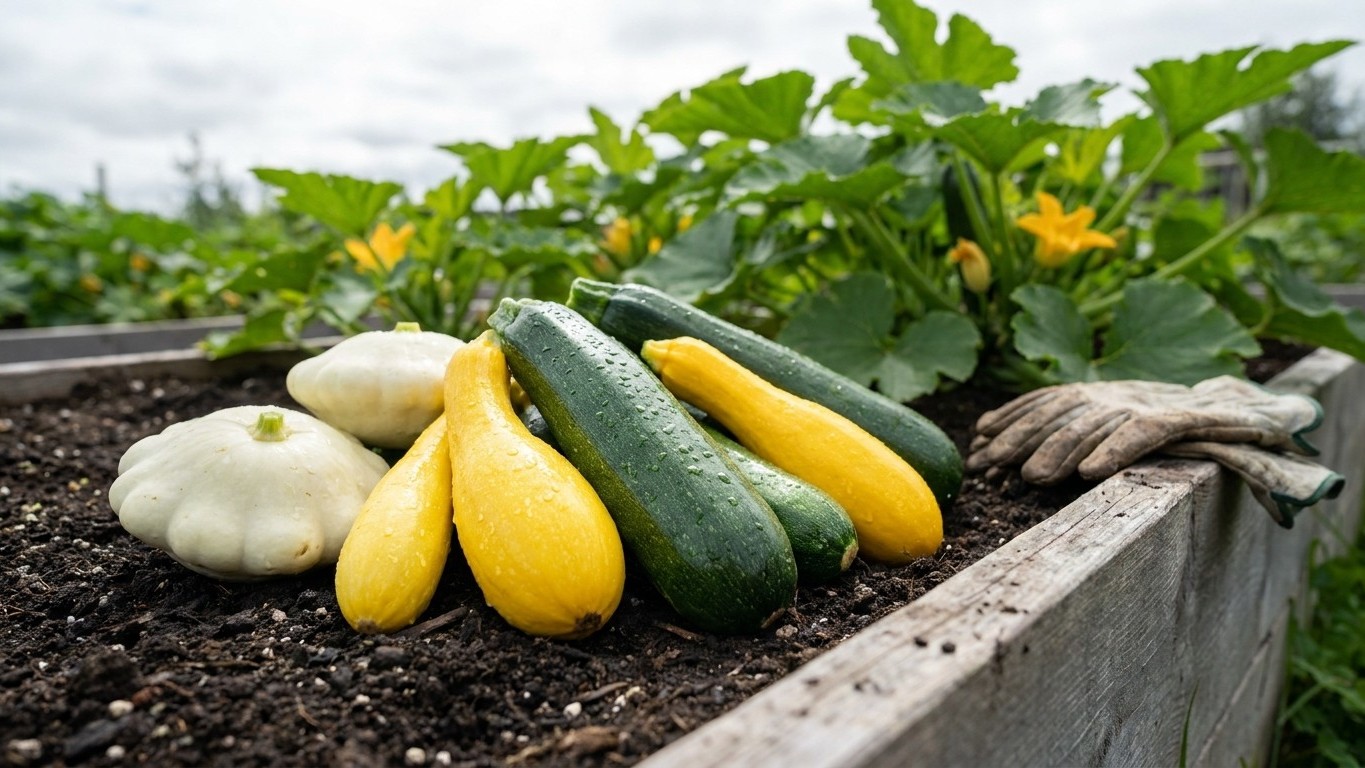

Zucchini and yellow crookneck (bush-type Cucurbita pepo) grow fastest and dodge disease pressure best in Hawaii’s leeward, drier spots. In wetter windward areas, tromboncino and other Cucurbita moschata types resist powdery mildew far better. There’s no frost-based planting calendar here at all: rainfall, elevation and which side of an island you’re on decide everything.
The short answer for Hawaii
Hawaii has no winter to plan around, so the usual “days to frost” math that governs summer squash choice on the mainland simply doesn’t apply. What decides the variety instead is heat load and moisture. The reference station for these normals logs 18.7 days a year at or above 90F, and summer rainfall runs thin, about 1.9 inches total across June, July and August, with June the driest month at just 0.5 inches. That combination of steady heat and a dry core summer, layered against the fact that some parts of the islands get soaked constantly while others stay bone dry, is the real decision point.
In leeward, drier locations, classic bush-type zucchini and yellow crookneck or straightneck squash are the safer pick. They mature in roughly 40 to 50 days, which matters a lot in a place with no off-season: a fast cycle means you can pull a planting before pest and disease pressure has time to build, and replant behind it. Succession planting every few weeks, rather than one long-season sowing, is the practical habit that works with Hawaii’s year-round growing window.
In windward or higher-rainfall pockets, that same fast bush habit becomes a liability, because dense, tender growth sitting in humid air is exactly what powdery mildew wants. That’s where moschata types like tromboncino earn their keep. They’re vining rather than bushy, they carry noticeably better natural resistance to powdery mildew, and their tougher, more open growth habit sheds moisture faster after a rain event than a compact zucchini plant does.
So the honest short answer isn’t one variety, it’s a split by climate zone within the state: fast bush squash where it’s dry and hot, moschata vining types where it’s wet. Nothing on this page is built around a frost date, because in the areas where people actually garden in Hawaii, one never occurs.
What will not work here
Varieties bred and marketed for mainland summers carry assumptions that don’t survive contact with Hawaii’s climate. The first mismatch is watering rhythm. A lot of general planting guidance assumes a weekly deep watering is enough to carry summer squash through the season, an assumption built around regions that get regular rain events through July and August. Hawaii’s core summer months don’t work that way: June averages just 0.5 inches of rain at the reference station, July 0.52 inches, August a slightly better 0.84 inches. A weekly watering schedule leaves squash roots dry for days at a stretch in a dry-season leeward garden, especially once daytime highs are pushing past 90F on close to 19 days a year and pulling moisture out of the soil fast.
The second mismatch runs the opposite direction. Spacing and airflow recommendations written for humid mainland regions sometimes get applied loosely in windward Hawaii gardens, where rainfall is heavier and more constant than the state average suggests. Planting bush zucchini at tight, space-saving spacing in a wet windward yard invites powdery mildew and blossom rot fast, because the leaves stay damp longer and airflow between plants is already compromised by the moisture in the air itself, not just the soil.
Heat-sensitive varieties struggle to set fruit
Some crookneck and pattypan varieties bred with cooler coastal summers in mind are prone to dropping blossoms or failing to set fruit once daytime heat runs consistently high. With Hawaii’s reference station logging nearly 19 days a year at 90F or above, and lowland leeward areas running warmer still, a variety that struggles above 85F in its breeding background is a poor match for the hottest, driest parts of the islands, even though the same variety might perform fine at higher elevation.
The pattern across all of this is the same: it’s not that any particular squash type is “wrong” for Hawaii in general, it’s that a variety chosen without matching it to local rainfall and heat, rather than to a mainland-style calendar, is the thing most likely to fail here.
What changes across Hawaii
The USDA Plant Hardiness Zone Map places Hawaii across an unusually wide span, from 9a up to 13a. That’s not a typo and not a rounding error, it reflects how much elevation changes conditions across a small landmass. The hardiness zone system is built on one variable only, the average annual extreme minimum temperature, so it’s really measuring how cold it gets on the coldest night of the year in a given spot, not rainfall or humidity. Even so, a spread from 9a to 13a inside one state means there is no single “Hawaii answer” to which summer squash variety performs best. A garden near sea level and one at meaningful elevation are, climatically, closer to different countries than to the same state.
At the cooler end of that range, higher-elevation gardens see slower squash growth, cooler nights that can slow fruit set, and often more persistent dampness in the air, conditions that favor the disease-resistant moschata types over fast bush zucchini. At the warmer, lower end of the range, heat load becomes the dominant factor, and the fast-cycle bush types paired with reliable irrigation tend to outperform anything slower.
Windward versus leeward exposure layers on top of elevation rather than replacing it. Two gardens at similar elevation on opposite sides of the same island can see very different rainfall totals, because trade winds drop moisture on the windward slopes and leave the leeward side comparatively dry. That’s part of why a state-level rainfall average, even a real, measured one, only describes what the reference station experienced, not what any individual garden gets.
None of this is a reason to guess. It’s a reason to use the USDA Plant Hardiness Zone Map to find where a specific garden actually sits within that 9a to 13a range before picking a variety, rather than assuming the state figure applies evenly everywhere.
Where to check this for your own county
The University of Hawaii’s College of Tropical Agriculture and Human Resources runs the state’s Cooperative Extension Service, and it’s the right next stop for anything more specific than what a state-level page like this one can responsibly say. The extension directory lists contacts and resources for local offices.
Two things are worth looking for there specifically. First, a local planting calendar for the reader’s own island or region, since a calendar built around Oahu’s leeward side won’t necessarily match conditions on the Big Island’s windward Hilo side or in upcountry Maui. Second, look for variety trial results or recommendations tied to the reader’s own county, since CTAHR’s local offices track which zucchini, crookneck and moschata varieties have actually performed well in field trials under real local rainfall and pest pressure, not just under general climate assumptions.
A county-level recommendation from local extension staff, working from trial plots and grower feedback in that specific area, is always going to outrank a state-wide page like this one. This article works from statewide climate normals and a hardiness zone range that spans four full zone categories. It can tell a reader what generally holds true across leeward versus windward Hawaii and across low versus high elevation, but it can’t tell someone in a specific valley on a specific island exactly what pest pressure or rainfall pattern their own plot will see this season. That’s precisely the gap the extension service is built to fill.
Checking this against your own garden
Every figure on this page is a normal, an average built from years of data at one reference station. A reader’s own garden, watched closely for a few weeks, will tell them more about their specific microclimate than any statewide number can.
Soil warmth by feel is the first check. Summer squash seed germinates poorly in cold, soggy soil, so before sowing, pressing a hand a few inches into the bed and feeling for a comfortable, not-cold, not-waterlogged texture is a better test than any calendar date. A bed that feels cool and heavy days after a windward rain event is telling the gardener that drainage, not the calendar, is the limiting factor there.
The first flush of male flowers is the second signal worth watching. Summer squash typically produces male flowers before female ones, and a strong early flush followed a week or two later by female flowers with a small swelling at the base is a sign the plant has found conditions it likes. A long gap with no female flowers at all often points to heat stress or inconsistent watering rather than anything wrong with the variety itself.
The first true leaves, the ones that show the distinctive squash-leaf shape rather than the rounder seed leaves, mark the point where the plant has moved past its most vulnerable stage. How fast they appear, and how healthy and unblemished they look, is a direct read on whether that particular spot, with its own soil, sun exposure and rainfall pattern, suits summer squash better or worse than the general zone it sits in.