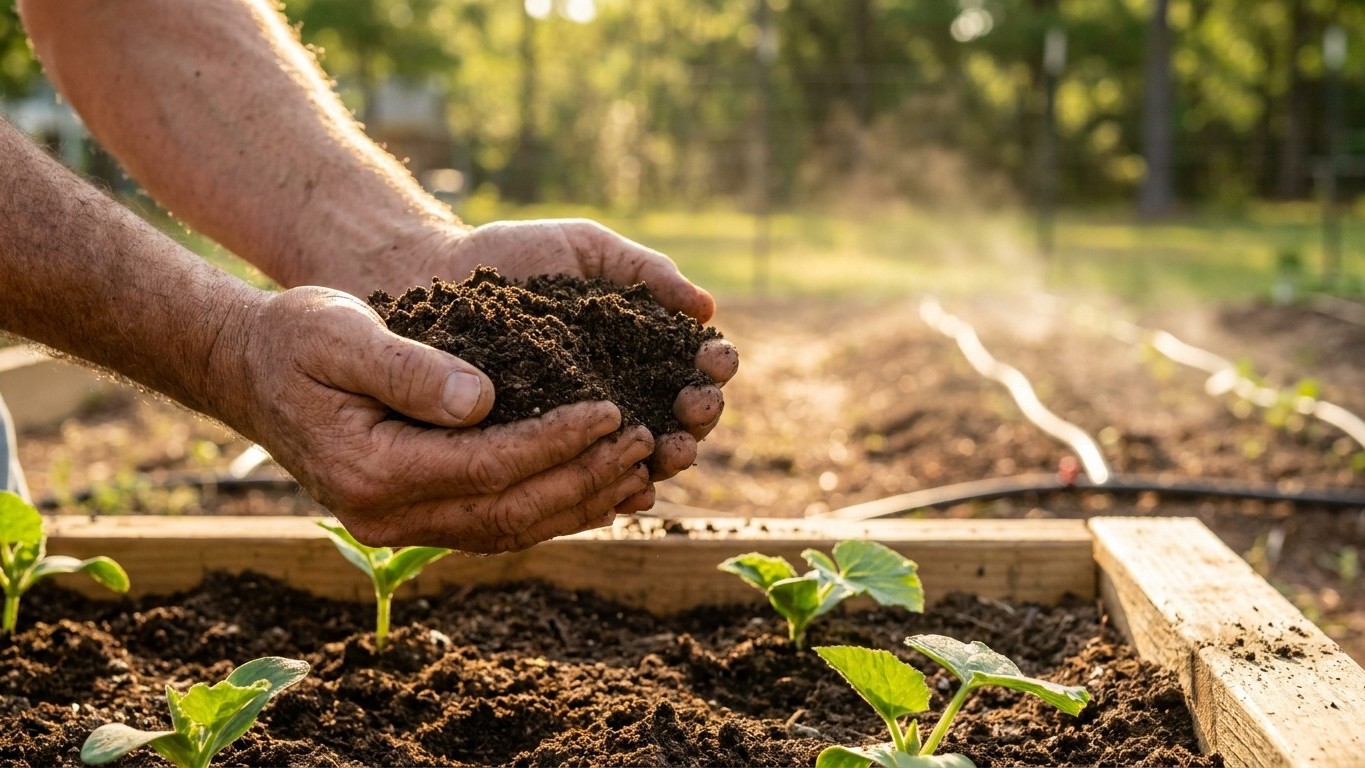

Summer squash doesn’t wait for a thaw in Hawaii, because there isn’t one to wait for. Lowland gardens here run on a rainfall and elevation calendar instead of a frost calendar, and that single fact changes almost every planting decision a mainland gardening guide would tell you to make.
When the soil is warm enough in Hawaii
Ask “when’s the last frost?” anywhere else in the country and you get a date. Ask it here, and the honest answer from NOAA’s own climate normals is that the question doesn’t apply. The National Centers for Environmental Information ran the standard 1991-2020 freeze calculations for station USW00022521 and returned a not-computable flag at every threshold, 32°F and 36°F alike, because the station logs zero days per year at or below freezing. That’s not a rounding of “very rare” down to “never.” It’s a station record with no freeze event to calculate from.
Frost dates matter to gardeners because they’re a stand-in for something else: soil temperature. Seeds and transplants don’t care about air frost directly, they care whether the ground is warm enough to keep roots active. On the mainland, the last frost date is a reasonable proxy for that moment because the two track together fairly closely. In lowland Hawaii the proxy breaks down completely, since soil warmth here is governed by elevation and rainfall pattern rather than by any seasonal cold snap that never arrives.
That leaves three variables doing the work a frost date would normally do elsewhere:
- Elevation — soil at sea level stays consistently warm year-round, while gardens climbing into the upcountry zones cool measurably with height
- Windward versus leeward exposure — windward slopes catch more moisture and run cooler and damper; leeward sides run drier and hotter
- Rainfall timing — a soggy stretch keeps soil cooler and slower to work than a dry one, even without any temperature swing
The USDA Plant Hardiness Zone Map, built on 1991-2020 normals, places the territory across an unusually wide 9a-13a range, using average annual extreme minimum temperature as its only variable. That spread is a warning against treating “Hawaii” as one garden. A reference city like Honolulu sits at the milder end of that range, but a garden a few hundred feet higher up a windward valley is a genuinely different growing environment, and the state’s own extension service is the place to check what that means for a specific address, not a general hardiness number.
Practically, this means summer squash can go into lowland soil at almost any point in the year once a bed is prepped and the season’s rain pattern is read. There’s no calendar wall to wait behind. The limiting factor becomes water management and pest pressure, which show up in the next two sections, not a soil that needs to thaw.
How long the season lasts here
Subtracting a first fall frost from a last spring frost is how most of the country measures its growing window. That subtraction can’t be done here, and that’s the point worth sitting with rather than rushing past. Both dates in the NOAA record for this station return the same result: no freeze occurs in inhabited areas, at either 32°F or 36°F, across the full 1991-2020 normals period. There’s no numeric gap to calculate because there’s no seasonal boundary marking either end of it.
What that actually delivers is a growing window that functions as continuous rather than bounded. Lowland Hawaiian gardens aren’t squeezed into a 90-day or 140-day summer slot the way a northern-tier state’s are. Summer squash can be sown, grown to harvest, and followed by another sowing of the same crop, more or less whenever the gardener has cleared bed space and the current rain pattern cooperates.
That changes the transplant-versus-direct-seed calculation too. In a short-window territory, starting seedlings indoors and transplanting them out buys precious extra weeks before the season closes, and the standard root-check advice, easing a transplant out of its cell without disturbing the taproot, matters because there’s no time to recover from setback. Here, with no hard closing date pressing on the calendar, direct seeding loses much of its urgency disadvantage. A gardener can afford to let a batch fail and simply sow again.
The practical upside is a second, third, or even rolling series of sowings through the year rather than one shot. That’s exactly the territory-neutral mechanics covered in this site’s succession sowing guide, and it applies with more force in a place like this than almost anywhere else in the country, precisely because there’s no frost-driven cutoff forcing every planting into a single window. The constraint that replaces the calendar is water and heat, which is where the next section picks up.
Heat and water in Hawaii
Summer squash sets fruit poorly once temperatures push into the high 90s, because pollen loses viability fast in extreme heat and flowers can drop before pollination even completes. At the Honolulu reference station, NOAA’s 1991-2020 normals put the count at 18.7 days a year reaching 90°F or above. That’s a moderate figure, not the punishing three-figure heat-day count of a desert Southwest garden, and it means Hawaii’s summer squash aren’t fighting the pollen-failure problem nearly as often as a grower in a hotter mainland territory.
Rainfall is the sharper edge here. Summer months average about 1.9 inches of rain combined across June, July and August, against 16.4 inches for the full year, meaning the wet season sits elsewhere on the calendar and summer runs comparatively dry. Broken down by month, the same station logs 0.5 inches in June, 0.52 in July, and 0.84 in August, June being the driest month of the three. That’s a modest total to carry a crop with the sprawling, water-hungry leaf canopy summer squash grows.
Why the combination matters more than either number alone
Squash leaves are large and lose water fast through transpiration, while the plant’s root system stays comparatively shallow. Pair that with a summer that isn’t dangerously hot but also isn’t generously wet, and irrigation becomes the deciding factor in yield rather than temperature extremes. A single thunderstorm delivering an inch of rain in one sitting mostly runs off a dry surface rather than soaking down to root depth, so the monthly totals above can overstate how much water actually reaches the plant.
| Month | Average rainfall |
|---|---|
| June | 0.5 in |
| July | 0.52 in |
| August | 0.84 in |
This isn’t a cool, damp-summer territory where the concern runs toward powdery mildew and slow ripening from lack of sun. It’s closer to the opposite problem: moderate heat load paired with a dry summer stretch, where afternoon shade and a consistent watering schedule matter more than any disease-prevention routine built for humidity. And because Hawaii’s terrain runs windward-to-leeward within short distances, a garden on the wet side of an island can see a noticeably different picture than these territory-wide normals suggest, another reason a rain gauge on the actual plot settles more than any regional average can.
Which summer squash suit Hawaii
None of the summer squash types get named here by cultivar, and that’s a deliberate choice rather than an oversight. Variety trials run by land-grant universities test specific seed lines against local pest pressure, local humidity, and local soil, and what performs in one testing station tells a gardener almost nothing reliable about performance three thousand miles away. Naming a cultivar on a page that hasn’t seen those trial results would be a guess dressed up as advice, and readers who’ve grown food long enough tend to catch that immediately.
What this territory’s own facts do support is reasoning by type. With no frost-bounded season forcing a race to the earliest-maturing plants, there’s little pressure here to chase the fastest type purely to beat a closing window, the way a short-season northern garden would. The more relevant filter, given a dry summer and a moderate but real heat load, is airflow around the plant and consistent moisture at the root zone: types and growing setups that keep leaves from sitting in stagnant, humid air while still getting steady water tend to hold up better through a dry, warm stretch than ones that don’t.
Disease resistance still belongs on the checklist, even in a summer that runs dry by Hawaiian standards. Rainfall shifts through the year here, and a bed that was dry in June can sit in wetter conditions once the pattern turns, so resistance bred against powdery mildew and other common squash pathogens is worth prioritizing regardless of which month a gardener starts in.
The one recommendation that actually transfers is where to look. The University of Hawai’i’s CTAHR extension service, part of the USDA’s land-grant network, maintains locally trialled variety data at ctahr.hawaii.edu, and that’s the source that can name a specific cultivar with the trial data to back it up, something a general territory guide never should attempt on its own.