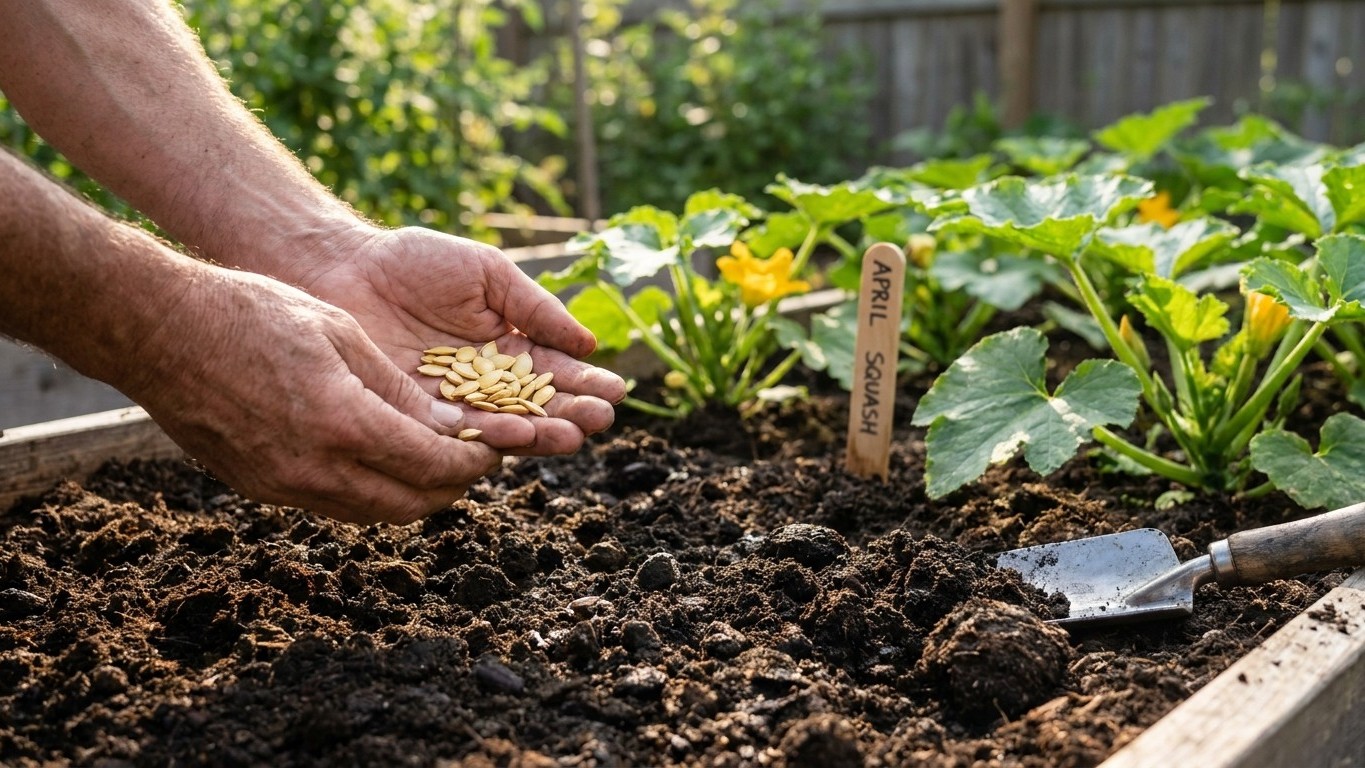

Summer squash doesn’t follow a calendar in Hawaii the way it does on the mainland. There’s no frost to build a planting window around, so the real question is elevation and rainfall: in most lowland gardens, seed goes in nearly any month, but June through August (the driest stretch) gives the fewest fungal headaches.
The short answer for Hawaii
Start with what isn’t here: NOAA’s 30-year climate normals for the reference station show zero days per year at or below 32F, and every freeze percentile comes back “not computable.” That’s not a rounding error. It means frost simply doesn’t factor into a Hawaii planting calendar, because it doesn’t happen where people garden. The only place freeze occurs is above roughly 13,000 feet on Mauna Kea, Mauna Loa and Haleakala, summits no one is planting squash on.
So what actually decides the window? Three things: rainfall, heat load and elevation. The reference station averages just 0.5 inches of rain in June, 0.52 in July and 0.84 in August, against 16.4 inches for the whole year. That’s a genuinely dry summer by island standards, and it matters because summer squash rots fast in standing water and struggles with fungal disease in constant humidity. A dry June-through-August stretch is, paradoxically, the easiest window for a crop that hates wet leaves and wet soil more than it minds heat.
Heat itself isn’t the limiting factor. The station averages 18.7 days a year at or above 90F, which drives up water demand but rarely stresses a heat-loving vine like summer squash outright. The bigger constraint is the state’s hardiness zone spread: USDA lists Hawaii at 9a to 13a, a range wide enough to cover a chilly upland pasture and a near-frost-free coastal flat in the same island chain. That range alone tells you a single statewide sowing date doesn’t exist here, and any calendar that promises one is oversimplifying.
The practical answer, then: in lowland and coastal gardens (roughly zone 11 and up), summer squash can go in almost any month, with the dry summer months offering the cleanest run against disease. In cooler upland gardens sitting lower in the 9a-10a end of that range, growth slows and the safe window narrows toward the warmer, drier part of the year. Neither end of that spread is wrong. They’re just different gardens inside the same state.
What will not work here
A frost-based calendar is the first thing that fails. Any planting schedule built around a last-frost or first-frost date is importing a mainland assumption into a place where that date doesn’t exist. If a seed packet or an old gardening guide tells you to count backward from frost, that instruction is simply void in Hawaii’s inhabited elevations.
Weekly watering is the second failure, and it’s a subtler one. Summer rainfall here isn’t generous: 0.5 inches in June, barely more in July, under an inch in August. On a sandy volcanic soil that drains fast, that rain is gone within a day, and a squash bed watered only once a week during those months will be bone dry for most of that gap. Combine that with 18.7 days a year pushing past 90F, and evaporation does the rest. A once-a-week watering habit, common enough in wetter mainland states, leaves Hawaii squash vines wilting by midweek in the driest summer months.
The reverse mistake shows up on the windward side of any island, where rainfall runs well above that dry-station average. There, the failure isn’t drought, it’s crowding. Summer squash planted at the spacing recommended for a dry leeward garden traps humidity between leaves on a wet windward slope, and powdery mildew or bacterial wilt moves through a dense planting fast. The same spacing chart can be right in Kona and wrong in Hilo, because the two sit on opposite sides of the same rainfall problem.
Elevation trips people up a third way. A gardener at higher elevation, closer to the 9a end of the state’s range, who plants on a leeward-garden timeline expecting fast fruit set, will watch growth stall in cooler night temperatures that a coastal grower never experiences. Summer squash isn’t a fussy plant, but it does want warm nights to set fruit reliably, and “warm” means something different a few thousand feet up than it does at sea level. None of these are exotic failures. They’re the ordinary result of applying one number, one calendar, one spacing rule, to a state that genuinely doesn’t have just one growing climate.
What changes across Hawaii
USDA’s hardiness zone range for the state, 9a to 13a, is one of the widest spans assigned to any single state in the country, and it exists precisely because Hawaii’s islands stack a full climate gradient into a small footprint. That range is built on a single measurement, the average annual extreme minimum temperature, so it says nothing directly about rainfall or humidity. But it’s a useful proxy for how much a garden’s growing conditions shift with elevation and exposure, even within one island.
A coastal leeward garden sitting at the warm end of that range behaves like a near-tropical lowland: heat load is steady, frost is a non-issue at any time of year, and the limiting factor is almost always water management, since the dry summer months bring so little rain. Move upslope, and the picture changes gradually rather than suddenly. Nights cool, growth slows, and a gardener there is working closer to the 9a-10a end of the spread, where summer squash still grows well but takes longer to reach harvest and benefits from the extra warmth of the driest months rather than fighting through a cooler, wetter stretch.
Windward versus leeward matters just as much as elevation, sometimes more. Two gardens at the same elevation on opposite sides of the same island can see very different rainfall totals, because trade winds push moisture into windward slopes and leave the leeward side comparatively dry. That’s a distinction the state’s rainfall figures for the reference station can’t capture on their own, since they represent one location, not the whole island chain.
There’s no single sowing date that covers all of that. A reader gardening near the coast on a leeward island can generally plant across most of the year; a reader higher up or on a windward slope needs to shift toward the drier season and expect a slower crop. Figuring out which end of that spread applies means checking a hardiness zone map for the actual coordinates of the garden, not guessing from the island’s general reputation.
Where to check this for your own county
This page describes Hawaii as a whole, and that’s exactly its limit. A state-level answer averages together a coastal Oahu garden and an upland Big Island one, and the gap between those two can be the difference between planting in March and planting in October. A county-level recommendation, built from actual local trials, beats a state-level one every time, because it accounts for the elevation and rainfall pattern of that specific place rather than a statewide range.
Hawaii’s land-grant extension service, the College of Tropical Agriculture and Human Resources (CTAHR) at the University of Hawaii, publishes exactly that kind of local guidance. It’s reachable at ctahr.hawaii.edu/site/extension.aspx. Two things are worth looking for there specifically: a local planting calendar for vegetables that reflects the rainfall pattern of the reader’s own island or district, and any variety trial results for summer squash conducted in that district. Extension trials matter more in Hawaii than in most states, because a squash variety that thrives in a dry Kona garden isn’t necessarily the one recommended for a wetter Hilo plot, and CTAHR’s district offices tend to track that difference directly.
Worth remembering: this page works from statewide climate normals, useful for understanding the general shape of the growing year, but not a substitute for a county office that has watched actual plantings fail or succeed on local soil. If the CTAHR site or a local extension agent gives a different window than the one described here, that local number should win. It reflects a smaller, more accurate sample than any statewide average can.
Checking this against your own garden
None of the numbers above beat a hand in the dirt. Soil warmth is the first thing to check, and it doesn’t need a thermometer: press a bare hand a couple of inches into the bed in the morning. If it feels cool rather than merely damp, summer squash seed will sit and sulk rather than germinate, no matter what month the calendar says it should sprout.
The second signal is the first flush of male flowers. Summer squash reliably produces male blooms before female ones, sometimes weeks before, and that’s normal rather than a sign of trouble. What that first flush tells a gardener is that the plant has settled into its spot and is building toward fruit set. A slow arrival of those first male flowers, especially in an upland or unusually cool garden, is a fair signal that the local microclimate is running cooler than the state’s general pattern would suggest, and that fruit will take longer to show up than a lowland neighbor’s crop.
The third is the pace of the first true leaves after germination, the second set that appears once the seedling’s initial round leaves unfold. Fast, sturdy true leaves within a week or two of sprouting point to warm soil and steady moisture, matching what the dry-season numbers would predict. Slow, pale true leaves, especially paired with soggy soil, usually point to a windward or rainy-season planting fighting more water than the plant wants.
Any one of these three, felt or watched directly in the actual bed, tells a gardener more about that specific plot than a statewide rainfall average ever will.