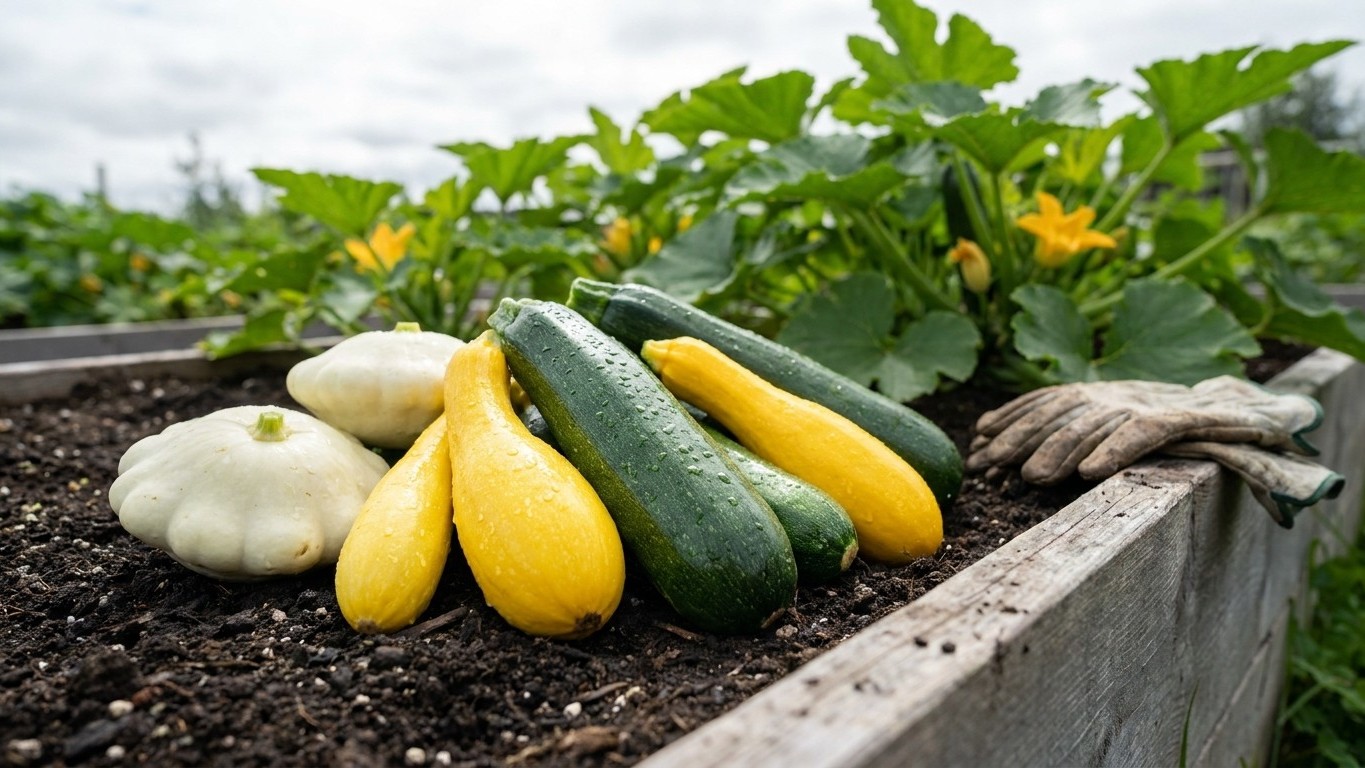

For most of Idaho, the safest bet is a fast bush-type squash, zucchini or yellow crookneck, maturing in 45 to 55 days. The Boise valley’s longer, hotter season can carry a vining variety to harvest, but almost nowhere else in the state can count on that.
The short answer for Idaho
Start with the numbers for the reference station, Boise (USW00024131). Last spring frost there falls between April 23 and May 7, first fall frost between October 7 and October 21. That gives the valley a frost-free window of roughly five to six months, generous by Idaho standards, and one that most of the state simply does not get.
Layer on the heat: Boise averages 47.5 days a year at or above 90°F. That is a real heat load, the kind that pushes squash to flower and fruit quickly once soil warms, but it also means a plant needs steady water to keep setting fruit through July and August rather than shutting down.
Put those two facts together and the decision by type becomes straightforward. In the Boise valley and similarly low, warm pockets, a grower has enough season to run either a bush or a vining summer squash, bush zucchini, yellow crookneck, patty pan, or a sprawling vining type, through to a full harvest before the mid-October frost line arrives. The margin is not huge, but it is real.
Everywhere else in Idaho, and that is most of the state, the hardiness zone range of 3b to 7b tells the real story: huge swaths of the state sit far colder and higher than the Boise reference station, with seasons that close weeks or months earlier. In those gardens, the only sensible choice is a bush-type squash bred to finish in 45 to 55 days. A vining variety rated at 60 days or more is a gamble that a short-season Idaho garden usually loses.
This page cannot tell a reader which of those two Idahos their own garden sits in. That is the job of the next two sections. But the type decision itself, bush over vining unless a grower is working with the Boise valley’s specific frost dates, holds for the state as a whole.
What will not work here
The clearest failure mode in Idaho is a slow-maturing vining summer squash planted outside the Boise valley’s longer window. A variety that needs 65 or 70 days from transplant, plus the week or two most squash need to size up once it starts fruiting, is racing a frost date that in much of the state arrives long before mid-October. Lose that race and the harvest is whatever set before the first hard freeze, nothing more.
The second failure is watering by habit rather than by the numbers. Idaho’s summer rainfall totals only about 1.1 inches across June, July and August combined, and the driest of those months, August, averages just 0.17 inches. That is barely a trace of moisture landing during exactly the stretch when 47.5 days a year of 90°F-plus heat is pulling water out of the soil fastest. A gardener who waters once a week on the assumption that “it rained a little” is watering on a schedule built for a wetter state, not this one. Summer squash has shallow, thirsty roots, and in a summer this dry, once-a-week irrigation on the reference station’s rainfall pattern is not enough to keep fruit set going.
Why this matters more on sandy soil
The rainfall figure above never reads alone. On clay, the little rain that does fall in June (0.75 inches, the wettest of the three summer months) lingers longer in the root zone. On sandy soil, common across much of southern Idaho’s benches and valleys, that same rain drains through within a day, leaving squash roots dry again almost immediately. A sandy-soil garden in a dry Idaho summer can need water every second day even when a neighbor on heavier ground is managing on a longer interval. There is no fact here that fixes a single watering schedule for the whole state; soil texture decides it as much as the rainfall total does.
One thing that does not typically fail Squash in Idaho is crowding-driven disease. The same dryness that punishes irregular watering keeps humidity low enough that the fungal problems that plague tightly spaced squash in wetter states are less of a default risk here, though a grower still gains an edge from watering the soil rather than the leaves.
What changes across Idaho
Idaho is not one climate, and the hardiness zone range on the USDA map, 3b to 7b, is the plainest evidence of that. That is a five-and-a-half-zone spread inside a single state’s borders, driven by elevation and latitude rather than any one factor a gardener can eyeball from a highway sign. There is no single “Idaho zone” to plant by, and any recommendation that pretends otherwise is quietly assuming the Boise valley for everyone.
A grower gardening in the state’s colder and higher pockets, zone 3b or 4 territory, is working with a season that can be a month or more shorter on both ends than the Boise valley’s April-to-October window used above. For that reader, the fast-bush-only rule from the first section is not a suggestion, it is close to the only workable path: 45-day varieties, started from transplant rather than direct seed where the season allows it, and harvested young and often rather than left to size up.
A grower in the warmer, lower end of that range, closer to 6b or 7b, has more room to experiment, including with a vining type or a longer-season heirloom summer squash, and can lean on the Boise frost dates as a rough proxy rather than a strict short-season plan.
Altitude complicates this further even within the same latitude: a garden a few thousand feet up a valley wall can run a meaningfully shorter frost-free season than one on the valley floor a few miles away, regardless of what the state-level zone range suggests. None of this is something to guess at from a zip code. The USDA Plant Hardiness Zone Map, built on 1991-2020 average annual extreme minimum temperatures, is the tool that resolves it for a specific address, and it is the right next stop before choosing a variety off this page alone.
Where to check this for your own county
This page gives Idaho’s state-level picture, built mostly from one reference station in Boise. A county recommendation will always beat that, because it comes from trials and frost records specific to the ground a reader is actually planting in.
The University of Idaho Extension is the place to find it. Two things are worth looking for once there. First, a local or county-level planting calendar, which will translate the statewide frost-date range used in this article into dates anchored to a specific county’s actual weather station rather than Boise’s. Second, any list of summer squash varieties the extension office has trialled or recommended for that county specifically, since local trial data accounts for soil, elevation and microclimate in a way a state-level article cannot.
Extension offices also tend to know which varieties have performed reliably against local pressures, whether that is squash bugs, a particular soil type, or a shorter growing window than the state average, information that does not show up in national seed catalogs or general climate normals. A phone call or visit to the county office is often faster than searching the website, particularly during planting season when local staff are already fielding these exact questions.
Treat this article as the starting frame, the state-wide version of the answer, and the county extension office as the version that actually applies to one garden.
Checking this against your own garden
Every date and average on this page describes what the region can usually expect. A reader’s own garden, checked directly, outranks all of it, and three simple observations do most of the work.
Soil warmth by feel is the first. Summer squash seed germinates poorly in cold soil, whatever the calendar says. If the soil a few inches down still feels cool to the back of a hand in late morning, the ground has not caught up to the season yet, regardless of what the frost-date window suggests.
The first flush of male flowers is the second signal worth tracking. Squash plants typically produce male flowers before female ones, and their appearance marks the point where the plant has shifted into active growth. A garden that is running warmer or cooler than the regional normal will show this earlier or later than a neighbor’s plot might, and that gap is real information about a specific microclimate.
The first true leaves, the second set that appears after the initial seed leaves, are the third marker. Slow, delayed true-leaf growth after germination usually points to soil that is still too cool or too wet, both of which matter more in a state where rainfall is scarce but uneven and elevation shifts the season by weeks over short distances. Watching for these three things in a specific plot says more about that garden’s real timing than any state-wide average can.