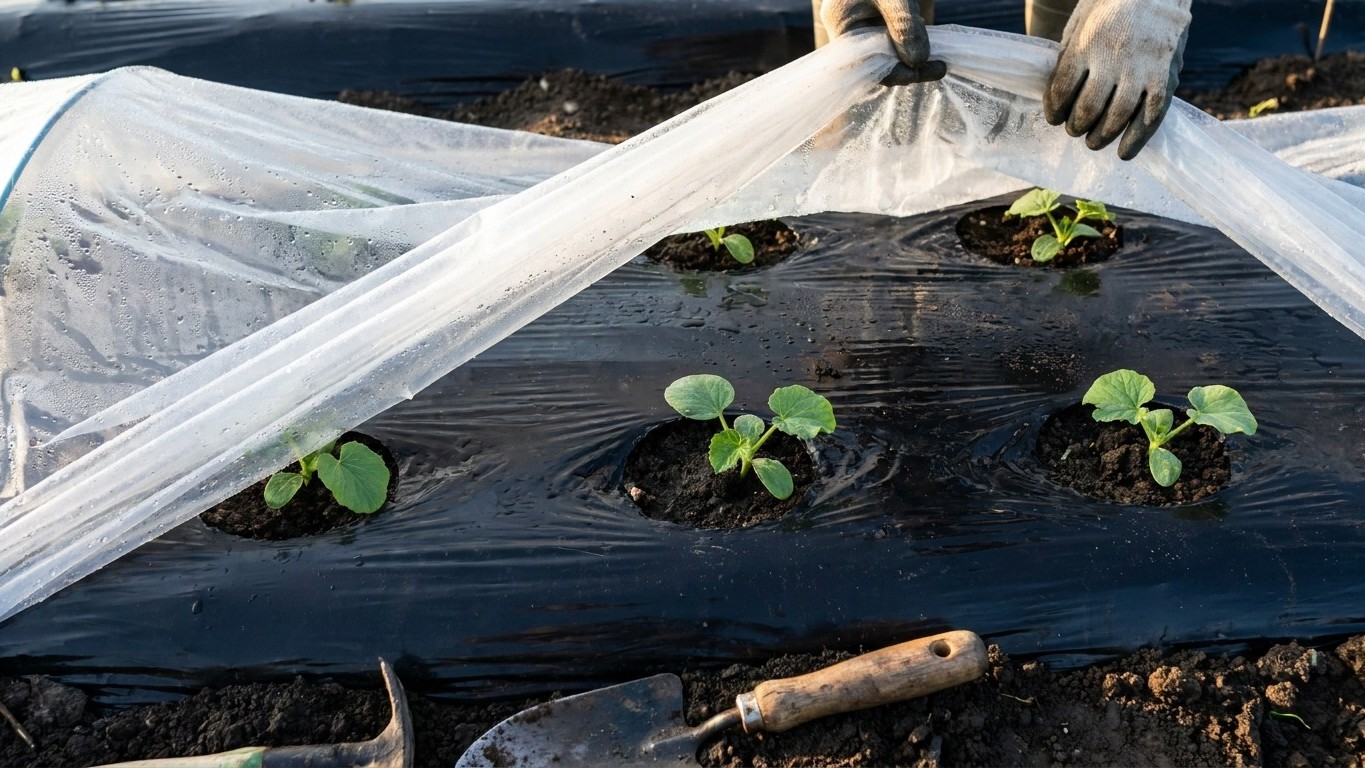

Soil temperature, not air temperature, decides when melon roots can actually grow. Below roughly 60°F at root depth, seedlings sit and sulk no matter how warm the afternoons feel. Black plastic mulch and row covers push that number up several degrees, buying growers in short-season and marginal climates two to three extra weeks of productive growing time before the vines even flower.
What is actually going on
Melon roots are lazy in cold ground. Not because the plant is weak, but because the enzymes that drive root growth and nutrient uptake slow down sharply once soil temperature drops below the mid-60s Fahrenheit. Air temperature can hit 75°F on a sunny spring afternoon while the soil four inches down still sits at 52°F, especially in clay-heavy ground that holds winter cold. A melon planted into that soil does not die outright. It stalls. And a stalled melon in June is a melon that runs out of season before it ever sets fruit worth eating.
This is where heat accumulation becomes the real subject, more than variety selection or fertilizer timing. Melons, like most vining cucurbits, respond to the total warmth they experience over their life, not to a single ideal temperature. Growers and researchers track this as growing degree days, a running tally of how much heat has built up above a baseline threshold. Two gardens at the same calendar date can be weeks apart in real plant development if one soil has been consistently five degrees warmer than the other since transplant.
Black plastic mulch works by absorbing solar radiation and transferring that heat directly into the top few inches of soil, right where new roots are trying to establish. Row covers work differently: they trap a layer of warmer air just above the plant, protecting foliage from cold snaps and wind while doing less for the root zone itself. Used together, the two techniques attack the problem from both directions, warming the ground below and the air above during the vulnerable weeks right after transplant.
None of this changes which type of melon will eventually taste good in a given region. A cantaloupe-type melon suited to a short season behaves differently from a long-season honeydew or watermelon-type, and the right choice for any given garden depends on local trial data, not a national recommendation. Skip guessing at a specific cultivar and check which types your state’s extension service has actually trialled nearby; that data reflects real local seasons in a way no general list can.
One more mechanism worth understanding early: melons build sugar through photosynthesis while still attached to the vine, and that sugar accumulation stops the instant the stem is cut. A melon does not ripen on a windowsill. It softens, and the flesh may go from firm to mushy, but the sugar content it has at harvest is the sugar content it will ever have. Soil warming affects this indirectly, since a plant that got a strong early start has more time to build sugar naturally before the season runs out, rather than needing to be picked in a rush ahead of frost.
In the garden
The techniques stack in a specific order, and each one solves a different piece of the cold-soil problem. Skipping the order, or leaving a step on too long, tends to cause the exact failure the technique was meant to prevent.
- Lay black plastic mulch two to three weeks before Transplanting. This gives the soil time to actually absorb heat before roots need it. What goes wrong: growers who lay plastic the same day they transplant get little benefit, because the ground underneath hasn’t warmed yet. The plastic then just sits there looking productive while roots stall exactly as they would have in bare soil.
- Cut planting holes and transplant once soil temperature at root depth is reliably in the acceptable range for germination and root growth, checked with a simple soil thermometer rather than guessed from air temperature. What goes wrong: gardeners who plant by calendar date instead of by soil reading often go in too early in a cold spring, losing the head start they worked for when transplants sit stunted for two weeks.
- Add a floating row cover directly over the transplants, anchored at the edges, to trap warm air and buffer against cold nights and wind. What goes wrong: covers left too loose blow off in the first spring storm, and covers pinned too tight can crush young vines as they start to sprawl.
- Remove the row cover once flowering begins. Melons need pollinator access to set fruit, and a sealed cover blocks bees as effectively as it blocks cold air. What goes wrong: this is the single most common misstep in the whole sequence. Growers who leave covers on past first bloom, trying to squeeze out a few more warm days, end up with vines full of flowers and no fruit, because nothing ever reached them to pollinate.
- Leave the black plastic in place through the growing season as ongoing mulch, which continues suppressing weeds and holding soil moisture even after its main warming job is done. What goes wrong: pulling the plastic mid-season to “let the soil breathe” usually just invites weed pressure back in with no real benefit to the vines.
Timing the cover removal is the one step that punishes both directions of error. Pull it too early, before a late cold snap has passed, and a hard night can set the plants back further than if no cover had been used at all. Leave it too late, past bloom, and the crop fails quietly with no obvious symptom until harvest never comes.
What it depends on where you are
Some of this is fixed and national. Heat accumulation as a mechanism works the same way in a Vermont garden as it does in a Texas one, black plastic transfers solar heat into soil the same way everywhere, and row covers trap warm air by the same physics regardless of state line. That part of the answer does not change based on where the reader lives.
What changes, sharply, is the local math of season length, summer heat, and summer rainfall. A grower in a region with a short frost-free window is using these techniques to make a marginal season possible at all, stretching a tight window by those crucial two or three weeks. A grower in a long, hot summer region may need soil warming for only a brief stretch in early spring before natural heat takes over entirely, and may need to shift focus toward humidity and fungal pressure instead, since warm wet soil under plastic mulch can encourage different problems than warm dry soil does.
Rainfall patterns matter just as much as temperature. In a wetter climate, black plastic mulch does double duty by keeping fruit off damp soil, reducing rot risk, while in an arid region growers often pair plastic mulch with drip irrigation run underneath it, since the plastic that warms the soil also blocks natural rainfall from reaching roots directly.
This is genuinely the point where a national article has to stop and hand off to local sources. Frost dates, realistic transplant windows, and which melon types have actually performed well in regional trials are not things a general guide can respons responsibly hand out as fixed advice, because they are different in every state and often different county to county within a state. The most useful next step for a specific garden is checking the local state extension service, which maintains trial data and frost timing for that exact region, and comparing notes with the state-specific melon guides on this site for regional planting windows and locally-suited types.
The mistake that costs the most
Leaving the row cover on too long, past the start of flowering, costs more gardeners their melon crop than cold soil, poor variety choice, and underwatering combined. It is an easy mistake to make precisely because it feels like the responsible choice. The nights are still a little cool, the cover has been working well, and pulling it feels like giving up an advantage rather than removing a barrier.
But a melon flower that never gets visited by a bee does not become a melon. It withers and drops, and the vine tries again with the next flower, and the next, cycling through blooms while the calendar keeps moving and the season keeps shortening. By the time a gardener realizes the vines are flowering heavily but setting no fruit, weeks have often passed, weeks that cannot be recovered in a short growing season.
The fix is not complicated, but it does require trusting the plant’s own signal over a lingering worry about one more cold night. Watch for the first open flowers, and treat that as the hard deadline for cover removal, not a soft target. If a genuine cold snap is forecast right around that window, a cover can go back on temporarily overnight and come off again during the day so pollinators still have access during daylight hours, but the days of leaving it sealed around the clock are over the moment blooms appear.
Once the cover is off, and remember the connected point that matters at the other end of the season: a melon’s sugar level is locked in at the stem, not adjustable afterward on a kitchen counter. All the early-season work of warming soil and protecting young vines exists to give the plant more time on the vine to build that sugar naturally, which makes the harvest-timing decision at the end of the season just as consequential as the row cover decision at the start.