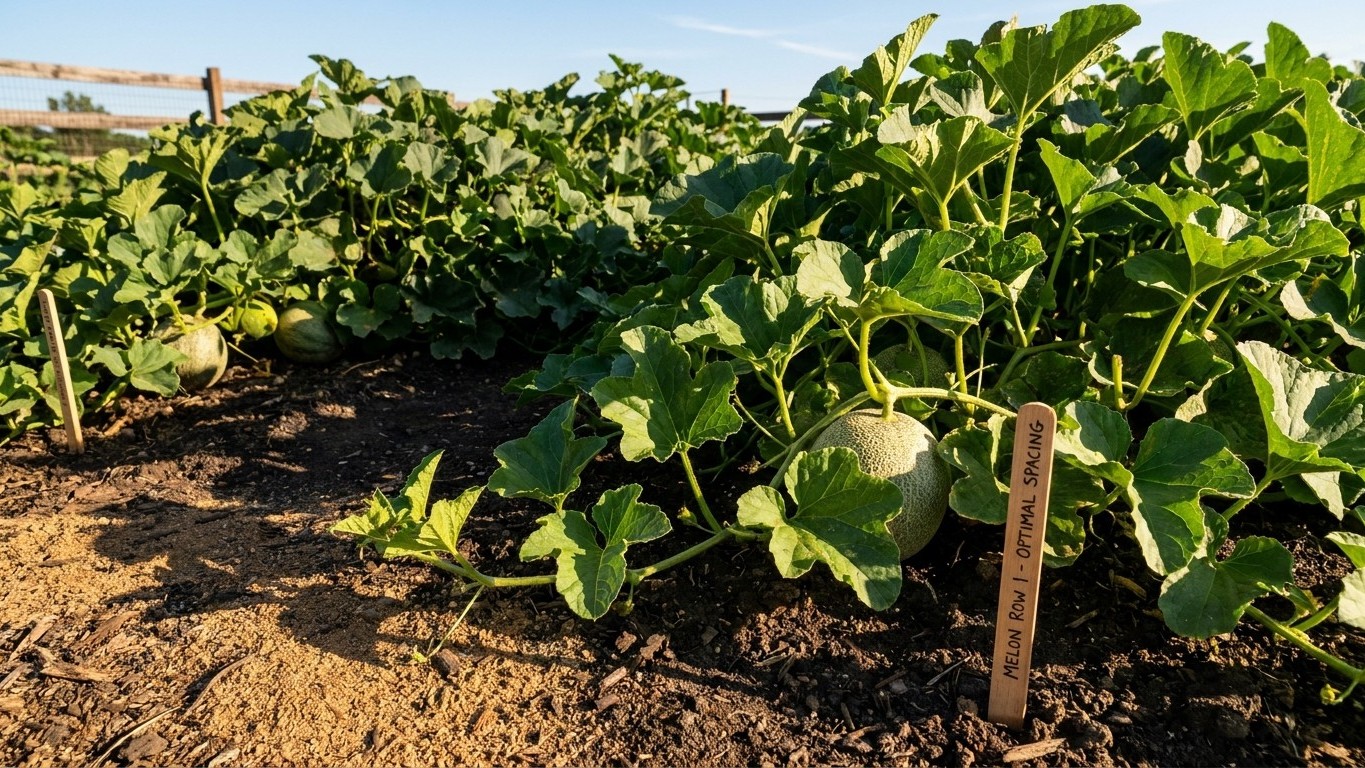

A single melon vine needs roughly 12 to 25 square feet to do its job well, depending on type. That means spacing plants 3 to 4 feet apart in rows set 6 to 8 feet apart for sprawling types, or as tight as 18 inches on a trellis for compact bush varieties. The number that matters isn’t the seedling in your hand, it’s the vine that seedling becomes by midsummer.
What is actually going on

The thing to understand here is leaf area. Every gram of sugar that ends up in a melon was made in a leaf, using sunlight, water, and carbon dioxide, then shipped down the vine to the fruit. A plant with plenty of unshaded leaf surface can push sugar into its fruit all season. A plant whose leaves are stacked three deep under a neighbor’s canopy is working with a fraction of that capacity, no matter how good the soil is underneath it.
Crowding doesn’t just cost size, though undersized fruit is often the first symptom growers notice. It costs sweetness. A melon that matures on a shaded, competing vine tends to be larger than expected but duller in flavor, because the plant had leaf tissue to build volume but not enough sunlit leaf area to fill that volume with sugar. This is why two gardeners can grow the same seed packet, in the same soil, and get completely different fruit. Spacing, not fertilizer, is often the hidden variable.
There’s a timing trap tied to this that catches new gardeners every year. A melon does not sweeten after it’s picked. It softens, and the smell gets stronger, and the flesh gives a little more under your thumb, but the sugar content is locked in at the moment the stem separates from the vine. Nothing on a countertop or windowsill adds sweetness back. So a melon grown on a crowded, shaded vine isn’t a melon that “just needs a few more days inside.” It’s a melon that already reached its ceiling in the garden, and that ceiling was set weeks earlier by how much sunlight its leaves were getting.
Root competition plays a supporting role here too. Melon roots spread wide and shallow, often extending several feet from the base of the plant, well past where the vine itself appears to reach. Plants set too close pull from the same soil moisture and the same band of nutrients at the same time, particularly during fruit sizing, which is the exact stretch when the plant needs uninterrupted water and food the most. Spacing gives roots their own territory the same way it gives leaves their own light.
Air movement is the third piece, and it’s easy to overlook. Tight spacing keeps humidity trapped in the canopy, and melon foliage is prone to fungal issues that thrive in still, damp air. Wider spacing isn’t just about sugar production, it’s about giving the plant a fighting chance against the diseases that shorten a productive season.
In the garden
The right footprint depends heavily on which kind of melon you’re growing and how you’re training it. Below is the practical range, along with what tends to go wrong at each end.
| Type | Typical spacing | What goes wrong too tight | What goes wrong too loose |
|---|---|---|---|
| Sprawling vine, grown on the ground | 3-4 ft between plants, 6-8 ft between rows | Shaded leaves, tangled vines, fungal disease from poor airflow, smaller and blander fruit | Wasted bed space, weeds fill the gaps, no real yield benefit past a certain point |
| Sprawling vine, trellised vertically | 18-24 in between plants along the trellis | Vines overlap and shade each other even off the ground, fruit needs slings and can still bruise from crowding | Trellis space goes unused, support structure oversized for the planting |
| Compact or bush type | 2-3 ft between plants | Bush habit still spreads more than the tag implies, leaves overlap and interior fruit sits in shade | Rare, but wide gaps mean lower total plants per bed than the space allows |
| Hill planting (2-3 seedlings per hill, thinned) | 4-6 ft between hill centers | Hills placed too close merge into one shaded mass by midseason | Hills placed too far apart waste bed space that could hold another hill |
Hill planting deserves a note of its own, because it’s where most home gardeners go wrong first. Seed packets often recommend clustering several seeds per hill and thinning to the strongest one or two seedlings. The mistake is skipping the thinning step out of reluctance to pull a healthy-looking plant. Those extra seedlings feel like insurance, but by the time the vines start running, that insurance has turned into competition, and the whole hill produces less than a properly thinned one would have.
Trellising changes the math in a useful way for anyone short on ground space. Training vines upward lets you cut horizontal spacing significantly, since the plant’s real limitation stops being square footage and becomes light exposure along the trellis line. The tradeoff is that fruit needs support, usually a sling made from soft fabric or mesh, since vertical vines can’t hold the weight of a maturing melon on the stem alone. Skip that step and you risk fruit tearing loose from the vine before it’s anywhere close to done ripening on the vine, which again means it stops sugaring immediately and never catches up in the kitchen.
Whatever the layout, resist the urge to judge spacing by the seedling in front of you in June. A four-inch transplant with two true leaves gives no visual hint that it will cover a card-table-sized patch of ground by August. Plan for the mature vine, not the current one.
What it depends on where you are
Everything above is the mechanical part, the part that holds true in a raised bed in one state and a field row in another. What changes by location is how much room you can afford to give each plant without running out of growing season before the fruit finishes.
In regions with a long, hot summer, wider spacing rarely causes trouble, because there’s enough season left for vines to fill their allotted ground and still finish fruit well before the first cool snap. In regions with a shorter or cooler summer, gardeners sometimes tighten spacing on purpose, accepting a bit more shading in exchange for a planting layout that warms up faster in spring and holds heat better as a mass of foliage. That’s a real tradeoff, not a shortcut, and it works better with types bred for shorter seasons than with types that expect a long, steady stretch of heat.
Rainfall and humidity matter just as much as heat. In wetter climates, the airflow argument for wider spacing gets stronger, since damp, still air around crowded foliage is exactly what fungal disease needs to take hold. In dry climates, that risk drops, and growers sometimes have a bit more flexibility to tighten spacing without paying a disease penalty, though the sugar and light argument still applies regardless of rainfall.
Soil type plays a quieter role too. Sandy soils drain fast and often support slightly tighter spacing because roots can spread down rather than purely outward competing for the same shallow moisture band. Heavy clay soils, which hold water near the surface, tend to reward wider spacing so root systems aren’t packed into the same saturated zone.
Spacing for a specific yard depends on that yard’s exact summer length, average rainfall, and soil drainage. The reliable next step is the local one: state land-grant university extension services publish trial data for the types and spacing that perform best in their specific climate, often down to the county level. That local trial data will always beat a general rule, because it was measured in conditions close to the reader’s own, not averaged across the whole country.
The mistake that costs the most
The single costliest mistake isn’t planting too few melon vines. It’s planting too many, in too little space, because the seed packet’s spacing note felt overly cautious next to a tiny seedling in a nursery pot. That one decision, made in the first week after transplanting, quietly sets the ceiling on flavor for every fruit that plant produces months later.
The fix isn’t complicated, but it takes nerve. Thin ruthlessly, and do it early, before root systems tangle underground and before removing a plant means disturbing its neighbors. If hills were seeded with several plants for insurance against poor germination, cut that down to the strongest one or two as soon as true leaves appear, not after the vines start running. If a garden simply doesn’t have the ground for proper spacing, the honest answer is fewer plants trained vertically on a trellis, not the same number of plants squeezed closer together. A trellis solves the space problem. Crowding just relocates it.
What makes this mistake expensive is that it doesn’t show up right away. Through June and early July, crowded vines often look lush and productive, sometimes more impressive than a properly spaced planting with visible gaps of bare soil between plants. The problem surfaces later, when fruit sizes up under shaded leaves and the sugar never quite arrives. By then it’s too late to fix that season’s harvest, since a melon that’s already on the vine can’t be moved to better light, and picking it early only means it sits on the counter softening without ever gaining the sweetness that never made it into the fruit in the first place.
The better habit is to treat spacing as the first decision, made before seed goes in the ground, based on the mature footprint of the type being grown rather than the size of the transplant in hand. Everything else, watering, feeding, pest management, works within whatever ceiling that spacing decision sets. Get it right early, and the rest of the season has room to work in the plant’s favor instead of against it.