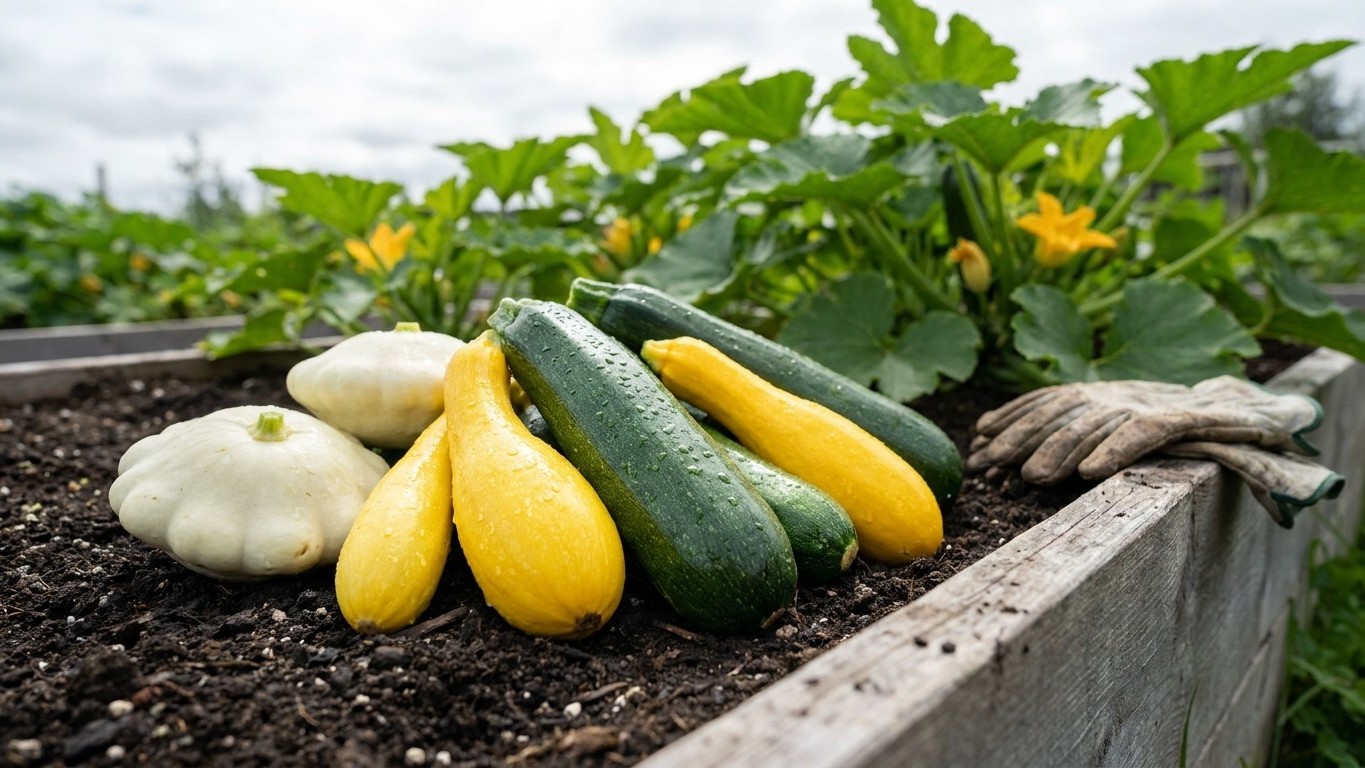

Illinois gardeners get a long enough season that maturity days rarely decide the winner. The real split is between standard Cucurbita pepo zucchini and crookneck, which mature fastest but sit exposed to squash vine borer and powdery mildew for months, and Cucurbita moschata types like Tromboncino, which take longer but shrug off both. For most home gardens, a mix of one fast bush pepo and one resistant moschata hedges the bet.
The short answer for Illinois
Start with what the season actually gives you. Using the reference station’s frost dates, last spring frost falls between April 11 and April 22, and first fall frost lands between October 24 and November 3. Even in the worst-case pairing, that’s about 185 frost-free days; in the best case, closer to 206. Every summer squash on the market, whether it needs 42 days or 65, finishes with room to spare. That means variety choice in Illinois isn’t a race against the calendar the way it is in a short-season state. It’s a decision about what survives the pressures that build up over a long, warm, moderately humid stretch.
Those pressures are heat and moisture, not cold. The reference station averages 14.0 days a year at or above 90°F, which is a real but not extreme heat load, enough to stress shallow-rooted seedlings but not enough to shut down flowering the way a Deep South summer can. Summer rainfall runs about 12.1 inches across June, July and August, with July, the driest month, delivering only 3.71 inches. That’s a decent baseline, but it rarely falls in the gentle, steady pattern squash actually want. It tends to arrive as thunderstorms, with dry stretches in between, right when 90-degree days are pulling moisture out of the soil fastest.
Given that combination, three types make sense for most of the state. Bush zucchini and yellow crookneck (both C. pepo) are the fastest to a harvest and the easiest to find as transplants, but they’re also the variety group most attacked by squash vine borer, a pest that overwinters in Illinois soil and finds pepo stems first. Scallop and pattypan squash, also pepo, share that vulnerability but tend to have a shorter productive window, which can work in your favor if you’re planting in succession. Tromboncino and other C. moschata summer squash take a bit longer to bear and need more trellis or ground space, but their solid stems resist the borer’s larvae far better than hollow pepo stems do.
The practical answer: if you’ve had vine borer trouble before, or you garden anywhere in the state’s more humid pockets, lean toward Tromboncino or another moschata type as your main crop, and treat fast pepo varieties as a bonus planting you’re prepared to lose to pests partway through summer.
What will not work here
The mistake that shows up most in Illinois gardens is planting a single early batch of bush zucchini and assuming it will carry the whole season. Squash vine borer moths typically emerge and lay eggs in a window that lines up with the state’s early summer warmth, and a stand planted all at once gives them one synchronized target. When the larvae bore in, usually a few weeks after those long frost-free stretches get the plants growing fast, an entire pepo planting can collapse within days, wilting from the base up with no obvious cause until you split a stem and find the damage done.
Relying on that 12.1-inch summer rainfall total to cover irrigation is the second common failure. The number sounds adequate until you notice it’s uneven: July’s 3.71 inches is the low point of the year, arriving right alongside those 14 days of 90-degree-plus heat that push evaporation rates up. A single missed week of watering during a dry July stretch, especially in fruiting squash with shallow root systems, is enough to trigger blossom drop and misshapen fruit even if the monthly rainfall total looks fine on paper.
Tight spacing is the third trap, and it’s specific to how Illinois summers actually behave. Thunderstorm-driven rain leaves foliage wet, and wet foliage that doesn’t dry quickly because plants are crowded is exactly what powdery mildew needs to spread. Growers who plant pepo varieties at the tight spacing recommended for drier climates often find mildew moving through their patch by late July, well before the plants have finished producing.
None of these failures come from choosing the “wrong” variety in some abstract sense. A fast zucchini variety isn’t a bad choice everywhere, it’s a bad match for a single, unstaggered planting in a state with this specific pest and rainfall pattern. The fix is less about which seed packet you buy and more about timing, spacing and backup plants, covered in the next sections.
Quick comparison by type
| Type | Days to maturity | Vine borer resistance | Mildew tolerance in humid stretches |
|---|---|---|---|
| Bush zucchini / crookneck (C. pepo) | Fast (typically 42-55 days) | Low, hollow stems attract larvae | Moderate, needs airflow and spacing |
| Scallop / pattypan (C. pepo) | Fast (around 50-55 days) | Low, same stem structure | Moderate |
| Tromboncino / moschata types | Longer (often 60-90 days) | High, solid stems resist boring | Higher, more vigorous foliage |
What changes across Illinois
Illinois isn’t one growing zone, and the USDA Plant Hardiness Zone Map, built entirely on average annual extreme minimum winter temperature, puts the state’s range at 5a to 7b. That’s a genuinely wide spread for a single state’s borders. A 5a reading, more typical in the far north, describes a place where winter extremes regularly drop to between -20°F and -15°F. A 7b reading, closer to the state’s southern tip, describes winters rarely colder than 5°F to 10°F. That difference doesn’t just matter for perennials; it correlates with a longer frost-free window, warmer soil earlier in spring, and more cumulative heat units for squash to ripen against in the southern part of the state.
What that means for summer squash specifically: a gardener working in the milder end of that range can often start moschata types like Tromboncino a bit earlier and expect a longer stretch of harvest before fall frost arrives, simply because both the spring warm-up and the fall cool-down happen on a different schedule than in the colder end of the range. Someone in the colder end should expect a shorter effective window for a second, borer-avoidance planting, because there’s less calendar left after the first crop fails or finishes.
This page can’t tell you which end of that 5a-7b range your own garden falls into, and it shouldn’t try to guess from a county name. The hardiness zone map itself, plus your local extension office, is built to answer that at a finer resolution than a state-level page ever can. What’s worth taking from this section is simpler: if a planting date or variety recommendation you read elsewhere seems to assume one fixed Illinois climate, treat that as a red flag, not a shortcut.
Where to check this for your own county
The University of Illinois Extension, at extension.illinois.edu, is where the state-level figures on this page get corrected down to something specific to your county. That’s the whole point of a land-grant extension system: state normals like the frost dates and hardiness range cited above come from a single reference station and a national map, while your county’s extension office works from local trial data and grower reports gathered closer to your own soil and microclimate.
Two things are worth looking for once you’re there. First, a local planting calendar for your county or region, which will translate the frost-date range on this page into an actual recommended sowing window for your area, accounting for the fact that suburban and rural gardens away from the airport reference station often see a later last frost and an earlier first frost than the station itself, sometimes by a week or two, more at elevation. Second, look for any variety trial results specific to summer squash. County extension offices and master gardener programs frequently run comparison plots and publish which zucchini, crookneck or moschata varieties actually performed well against local vine borer and mildew pressure that year, information no state-wide page can replicate.
A county-level recommendation will always beat a state one for the simple reason that it’s built from a smaller, more specific set of conditions. This page describes what’s true across Illinois as a whole, the frost-date range, the summer heat load, the hardiness zone spread. Your extension office’s county material narrows all of that down to your actual growing conditions, and that’s the resource to lean on once you’ve got the general picture from here.
Checking this against your own garden
Every date and average on this page describes a region, not your particular bed, and your own observations will always outrank them once the season starts. Three signs are worth tracking by hand, no gauge or thermometer required.
Soil warmth by feel is the first. Squash seed germinates poorly in cold, wet soil no matter what the calendar says, so before sowing, push a finger a few inches into the bed. Soil that still feels cold and damp, even after the reference station’s frost-free window has technically opened, is telling you your particular spot, shaded, low-lying or heavy clay, is running behind the regional average and needs another week.
The first flush of male flowers is the second signal. Summer squash typically produces male blossoms before female ones, and a burst of males with no females yet forming isn’t a problem, it’s just early-season timing. What matters is watching how long that gap lasts. A long stretch with only males, especially paired with hot, dry weather, often means pollinator activity or moisture stress is holding back fruit set, a cue to check watering before assuming the variety itself is underperforming.
The first true leaves are the third. The rounded seed leaves that emerge first aren’t the plant’s real foliage; the true leaves that follow, with their characteristic squash shape, tell you the seedling has moved past its most vulnerable stage. Slow, pale true leaves suggest the soil is still cooler or less fertile than the plant wants, regardless of what the regional averages predicted for that calendar date.