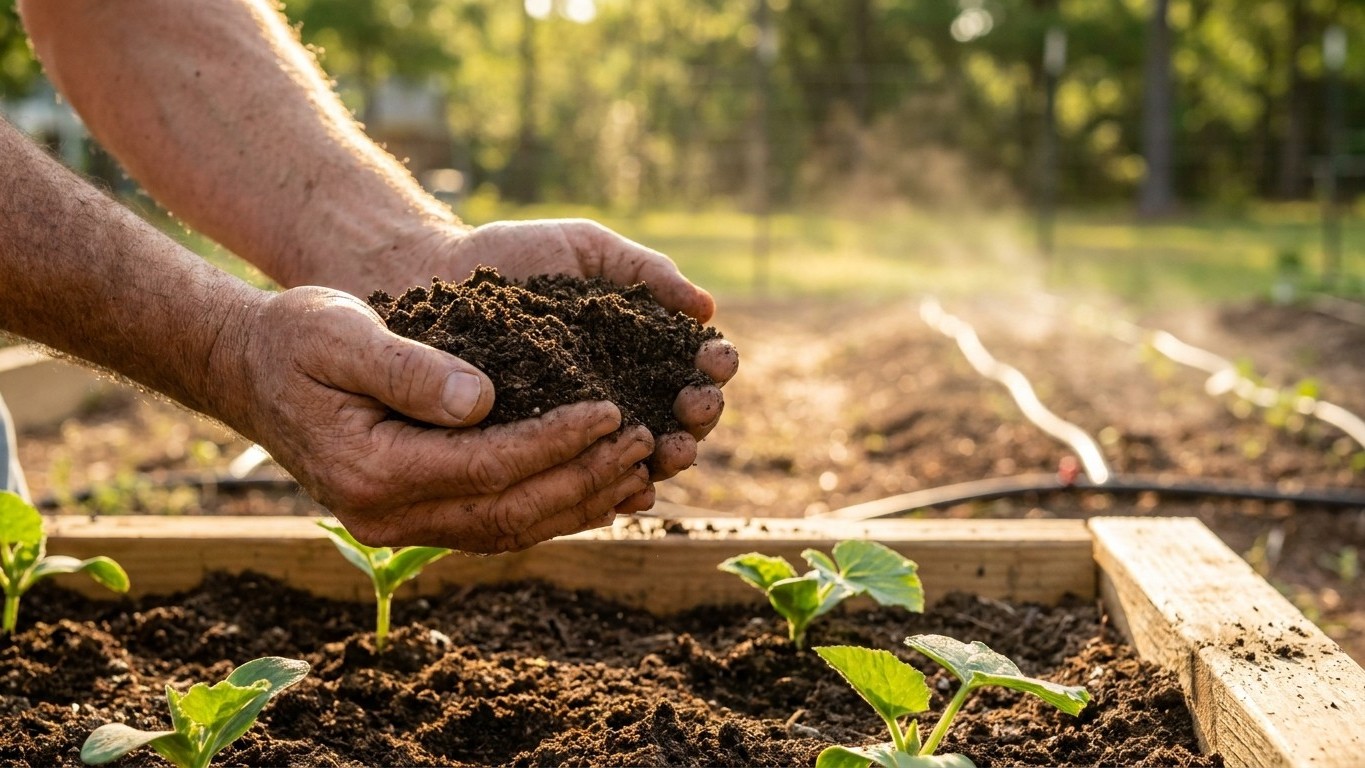

Summer squash goes in the ground once nighttime temperatures reliably clear the mid-50s and the soil itself has warmed, not simply once the calendar clears the frost date. In most of Illinois that means waiting until sometime between late April and mid-May, with the exact week depending on where in the state you garden and how quickly your particular patch of soil sheds its winter chill.
When the soil is warm enough in Illinois
The frost date matters, but treat it as a starting gun, not a green light. At the reference weather station used for Illinois climate normals, the last spring frost falls somewhere between April 11 and April 22, based on NOAA’s 1991-2020 records of when the 30 to 70 percent freeze-probability band closes. That’s a real measured range, not a rounded guess, and it comes from one airport-based station. Your own yard, especially if it sits in a low spot, on clay, or away from the city’s heat-holding pavement, can easily see frost a week or two later than that station does.
Frost risk ending is not the same thing as soil being ready. Summer squash seed rots in cold, wet ground before it ever gets a chance to fail from frost. The soil needs to sit consistently in the 60s at a couple inches down, which in Illinois usually happens one to three weeks after that last-frost window closes, depending on how much sun a bed gets and whether it’s covered in dark mulch or bare and reflective. Gardeners who push seed into the ground the same week the frost risk lifts are often the ones who end up reseeding in June.
Illinois spans USDA Hardiness Zone 5a to 7b, a range built entirely around the average extreme minimum winter temperature, a figure that matters for whether a fruit tree or perennial survives January, not for when an annual vegetable like squash can go in the ground come spring. Zone number is the wrong tool for this decision. The frost date and soil temperature are the right ones, and both vary more within Illinois, from the Ohio River counties in the south to the areas near the Wisconsin line, than the zone map alone would suggest.
Because that variation is real, check the freeze data for your own county rather than relying on the reference station figure as a statewide rule. Local Cooperative Extension offices keep county-level frost records, and a raised bed against a south-facing wall behaves nothing like an open field two counties north.
How long the season lasts here
Run the two reference-station dates together and Illinois’s frost-free window stretches from roughly 185 days, if you count from the latest edge of the spring frost band (April 22) to the earliest edge of the fall frost band (October 24), up to about 206 days if you use the earlier spring date (April 11) and the later fall date (November 3). Either way, that’s six months or more of open ground, which puts Illinois solidly in the category of states with room to spare rather than a state racing a short window.
That length changes the calculus on two fronts. First, it means a single planting almost never has to carry the whole season. Summer squash plants tend to slow down and get worn out by disease and pest pressure well before six months are up, so a second sowing partway through summer, timed to start bearing as the first planting fades, is a realistic and often better strategy here than nursing one planting from May through October. Second, a season this long makes the case for starting at least part of your crop from transplants less urgent than it would be in a shorter-season state. Direct-seeding after the soil warms is perfectly workable in Illinois because there’s enough calendar left afterward to reach a full harvest window, and it avoids the transplant shock and root disturbance that squash, with its sensitive root system, tends to sulk over.
Where transplants still earn their keep is in squeezing a slightly earlier start out of a cool spring, or in getting that second, mid-summer sowing established quickly during the hottest stretch, when direct-seeded plants can struggle to germinate evenly in hot, fast-drying soil. For the specifics of staggering plantings, spacing out the calendar so you’re not flooded with squash in one three-week stretch and empty-handed the rest of the summer, see the site’s succession sowing guide.
Heat and water in Illinois
Illinois is not a punishing-heat state for squash growers, and that’s worth saying plainly before going further. At the Chicago reference station, the average is 14.0 days a year reaching 90°F or above, a modest heat load compared with the six-week stretches of 90-plus days that growers deal with across the Southern Plains or the Southwest. Squash pollen loses viability fast once temperatures push into the high 90s and beyond, which is when fruit set drops off even with plenty of flowers open. Fourteen days a year of even hitting the 90-degree mark means Illinois growers mostly avoid that failure mode, though a hot stretch during peak bloom can still stall fruit set for a few days at a time.
Rainfall tells a similarly moderate story. The reference station logs about 12.1 inches of rain across June, July, and August combined, broken down as roughly 4.1 inches in June, 3.71 in July (the driest of the three), and 4.25 in August. That’s a reasonably generous summer rainfall total, and it means Illinois gardens are less dependent on constant supplemental irrigation than gardens in drier squash-growing states. But those numbers are normals, not weekly guarantees, and July’s dip toward under 4 inches lines up with when summer heat is doing the most evaporating. A stretch of that driest month without rain, paired with even a handful of 90-degree days, is enough to stress squash’s shallow, wide-spreading root system faster than its huge leaves would suggest from looking at them.
The more common problem in a state with this rainfall and humidity profile isn’t drought, it’s the opposite: powdery mildew, downy mildew, and other fungal diseases that thrive when squash leaves stay damp and air doesn’t move well between plants. A wet, humid Illinois summer, particularly one with rain arriving as scattered thunderstorms that leave foliage wet overnight, tends to slow ripening and invite disease pressure more than it threatens plants with water stress. Watering at the soil line rather than overhead, and giving plants enough spacing for air to move through the leaves, does more good here than mulching against drought ever will.
Which summer squash suit Illinois
Given a season long enough for two sowings, heat that rarely turns punishing, and rainfall generous enough that humidity and disease are the bigger threat, the type of summer squash that fits Illinois best is one bred or selected for disease tolerance and airflow-friendly growth, more than one selected purely for speed or heat endurance.
Bush-type squash, the compact, non-vining growth habit common across zucchini-type, crookneck and straightneck yellow squash, and scallop or patty pan types, tends to suit Illinois gardens well because the tighter form allows for the plant spacing that keeps foliage drier and better ventilated, directly addressing the mildew risk that matters more here than heat stress does. Vining types exist within summer squash too, but they’re less common and generally offer no real advantage in a climate where space, not heat tolerance, is the limiting factor.
| Type | Growth habit | Fit for Illinois conditions |
|---|---|---|
| Zucchini-type | Bush | Widely grown; benefits from spacing for airflow against mildew |
| Crookneck / straightneck | Bush | Handles the state’s modest heat load without special shading needs |
| Scallop / patty pan | Bush, often more compact | Good for smaller beds; still needs airflow in humid stretches |
| Vining types | Sprawling | Less common; offers little advantage where heat isn’t the limiting factor |
None of that points to a specific variety, and it shouldn’t. This page can describe what the Illinois climate rewards, but it has no business inventing a cultivar name or promising a maturity date it can’t back up. The seed catalogs change every year, and the varieties that actually perform well against Illinois’s disease pressure are the ones your local university trial gardens have already tested season after season. That information lives with University of Illinois Extension, whose county offices and horticulture staff track which squash varieties held up against mildew and produced reliably in your specific part of the state, information that’s worth more than any generic recommendation this page could offer.