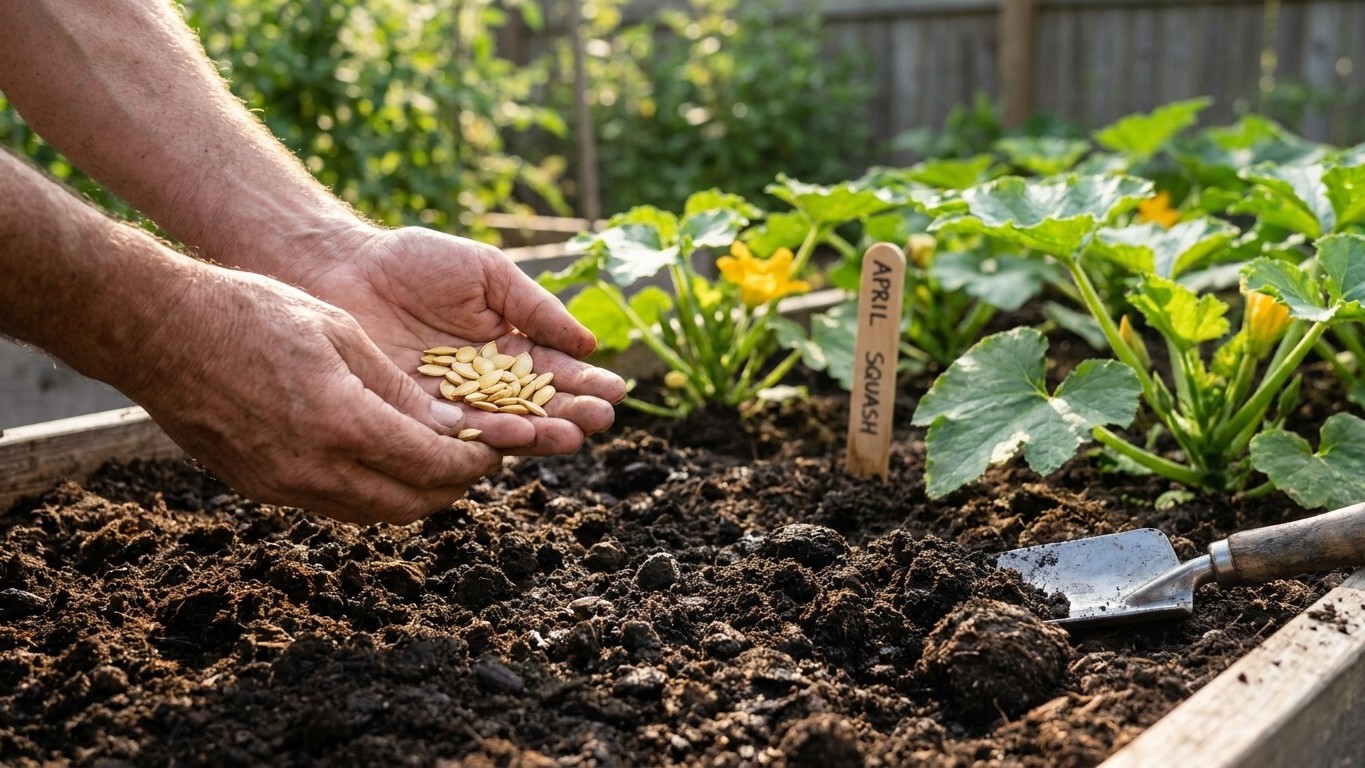

Summer squash goes in the ground in Illinois only after soil has warmed and frost risk has passed, which at the reference Chicago-area station means a window opening around April 11 to April 22 and stretching into May for most gardens. That date range is a probability, not a guarantee, and it changes with where you sit inside the state.
The short answer for Illinois
The last spring frost at the reference station (Chicago O’Hare, NOAA NCEI 1991-2020 Climate Normals) falls between April 11 and April 22. That’s a 30-70% probability band for a 32F freeze, meaning even after April 22 there’s still a real chance of frost in a given year, just a smaller one. Summer squash is frost-tender at every stage, seed included, so the safe move is to treat that date range as the earliest edge of the window, not the target date itself.
In practice, that pushes direct seeding closer to late April through May for most Illinois gardens, since squash seed does best in soil that’s already warmed rather than soil that’s merely frost-free. Cold, wet ground in mid-April rots seed before it germinates even if no frost touches it. Gardeners who want an earlier start typically raise transplants indoors and set them out once the frost risk has genuinely cleared, rather than pushing direct-seeded squash into cold soil.
On the back end, the first fall frost at the same station arrives between October 24 and November 3. That gives a working season, frost-free edge to frost-free edge, of roughly six months in a typical year, though again that’s a probability window rather than a fixed date. Summer squash is fast enough that this length of season is rarely the limiting factor in Illinois. What matters more is getting the spring end right.
The state’s heat load also shapes timing. The reference station averages 14.0 days a year at 90F or hotter, concentrated in July and August. That’s enough heat stress that plants set out too early into cool soil, then hit by a July heat spike before their root systems are established, tend to struggle more than plants started a week or two later into properly warmed ground. The short answer, then, isn’t just “after April 22.” It’s after April 22, once the soil itself has caught up, which for most of Illinois lands somewhere in the first half of May.
What will not work here
Seeding straight into the ground in mid-April because the calendar says frost risk is dropping is the most common misstep. The 30-70% band around April 11 to April 22 still leaves plenty of years with a frost after that date, and squash seed sitting in cold soil for two extra weeks before germinating is far more likely to rot than to simply wait patiently. Waiting for soil to warm, not just for frost to pass, is the difference that actually matters here.
Watering on a fixed weekly schedule is the second failure point, and it’s specific to Illinois’s summer rainfall pattern. The three summer months average about 12.1 inches combined, but that arrives unevenly: June averages 4.1 inches, July drops to the driest month at 3.71 inches, and August climbs back to 4.25. A once-a-week watering habit built around June’s rainfall will leave plants short in July, right as the 14 annual days above 90F concentrate and evaporation demand peaks. Squash roots are shallow enough that a dry stretch in late July, combined with heat, shows up fast as wilted leaves at midday and stunted fruit.
Rain in this region also tends to arrive as thunderstorms rather than steady soaking rain, which means a good part of a single storm’s inch runs off rather than sinking in, especially on compacted or clay soil. Gardeners who see “4 inches in August” on paper and assume that covers their watering needs often find their beds are drier at the root zone than the monthly total suggests.
Crowding plants close together is the third trap, and it’s a humidity problem more than a space problem. Illinois summers combine real heat with real moisture, and summer squash leaves are large enough to trap humidity at the canopy when spaced tightly. That’s the setup for powdery mildew, which shows up as pale, dusty patches on leaves by mid-to-late summer and can cut a planting’s productive life short well before the October frost would have ended it anyway. Wider spacing than the seed packet’s minimum, with airflow in mind, matters more here than in a drier climate.
What changes across Illinois
Illinois spans USDA Plant Hardiness Zones 5a to 7b, a range built entirely on the coldest temperature a location typically sees in winter, not on spring frost timing directly, but it’s a useful signal for how differently the state behaves end to end. A spread from 5a to 7b is not a small variation. It runs from the kind of winter minimums found in the northern Midwest down to conditions closer to the upper South, and a state that wide has no single honest answer to “when do I plant.”
The frost dates used throughout this page (April 11 to April 22 last spring frost, October 24 to November 3 first fall frost) come from one reference station, and that station sits toward the warmer, more developed end of the state’s climate range. Locations further north and at the colder end of the 5a-7b spread should expect their own last frost later than April 22, sometimes by a week or two, and their first fall frost earlier than October 24. Locations toward the southern end of the state, at the 7b end of the range, typically see the opposite: an earlier window to plant and a later date before fall frost closes things out.
That gap changes more than just the calendar. A shorter, cooler-edged season in the north compresses the margin for a bad spring, while a longer season in the south gives more room to try a second planting later in summer for a fall crop. None of this page’s dates should be read as a personal instruction. They describe what one station in Illinois experiences. Where a specific reader’s garden sits inside the 5a-7b spread is a question for a hardiness zone map, not a guess from a state average.
Where to check this for your own county
The University of Illinois Extension, at extension.illinois.edu, is the source built to close the gap this page can’t. A state-level page like this one can only report on frost normals from one reference station and a hardiness zone range that covers the whole state. County-level guidance from Extension narrows both of those down to what actually happens where a reader lives.
Two things are worth searching for once there. First, a local or regional planting calendar, which will reflect frost timing closer to the reader’s own county rather than the airport-station normals used here. Second, any variety trial results or recommendations specific to Illinois growing conditions, since Extension offices often track which squash varieties have performed well in university or county trial gardens under the state’s particular combination of summer heat and humidity. That’s information a state-wide climate page simply doesn’t have.
A county recommendation beats a state one every time, and it’s worth being direct about that: this page is the state one. It’s useful for understanding the mechanics, the frost probability bands, the heat load, the rainfall pattern, but it isn’t a substitute for what a local Extension office knows about a specific county’s microclimate, soil types, and the varieties that have actually done well there season after season. Treat this page as the framework and the county Extension office as the fine print.
Checking this against your own garden
No date on this page, or on any calendar, outranks what the soil and the plants themselves are showing in a given year. Three signs are worth watching before committing seed or transplants to the ground.
Soil warmth by feel is the first and most direct check. Press a hand into the top few inches of a planting bed on a sunny afternoon; if it still feels cold and damp rather than merely cool, squash seed sitting there is more likely to rot than sprout, regardless of what the frost date calendar says. Waiting a few more days for that soil to feel closer to room temperature at that depth is a better guide than the calendar date alone.
The first flush of male flowers on an already-growing squash plant is the second signal, and it tells a different story: it means the plant has moved past establishment and into reproductive growth, which is a sign the local conditions, heat and moisture together, are supporting steady growth rather than stress. Male flowers typically open before female flowers, so seeing them isn’t yet a harvest signal, but it confirms the plant is thriving in that spot.
The appearance of the first true leaves, the ones that look like small versions of mature squash foliage rather than the rounded seed leaves that emerge first, marks the point where a seedling has real photosynthetic capacity and is less vulnerable to a sudden cold snap or dry spell. A garden where true leaves appear quickly and look deep green rather than pale is one where that particular spot, that soil, that exposure, is running warmer and more favorable than the state average this page describes.