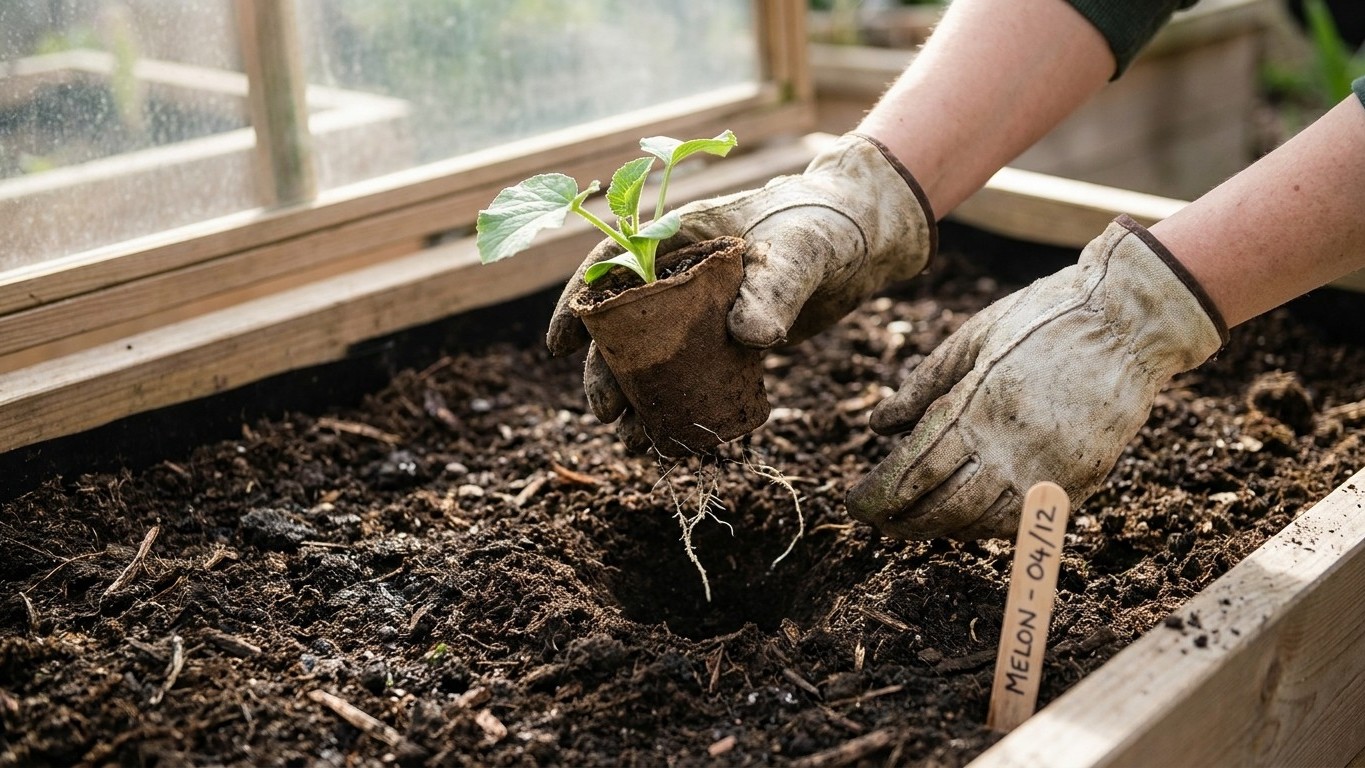

Melons split gardeners into two camps, but the honest answer is: transplant, started indoors three to four weeks before your last frost, unless your frost-free season already runs long and hot. Direct-seeding works fine where summer arrives early and stays. Everywhere else, a short head start under cover is what turns a marginal melon season into a real one.
What is actually going on
Melons belong to the cucurbit family, and like squash, cucumbers, and pumpkins, their roots don’t forgive rough handling. A melon root system is built around a single taproot with fine, brittle side roots that snap easily and don’t regenerate the way a tomato’s fibrous roots do. Disturb that root ball and the plant stalls, sometimes for a full week, while it rebuilds what broke. That’s the cost side of the ledger.
The benefit side is bigger than most people expect. A melon started indoors in a container gets three to four weeks of protected growth before it ever meets outdoor soil temperatures or a late cold snap. In a growing season that might only run five months from frost to frost, three weeks is not a small edge. It’s the difference between fruit that finishes sweet in warm weather and fruit still hanging on the vine when nights turn cool and sugar production slows to nothing.
That’s the trade at the center of this whole question: a week of transplant shock against three weeks of protected head start. In most of the country, the math favors transplanting. The exception is real, though. Where summers start early and stay warm long enough that the plant never needs the head start, direct-seeding avoids the shock entirely and the melon catches up on its own within days.
Why ripeness makes this decision matter more
Here’s the part that makes the seed-or-transplant question higher stakes than it looks: a melon does not sweeten after it’s picked. Once the fruit separates from the vine, whatever sugar is inside is all the sugar it will ever have. It can soften on a counter. It will not get sweeter. That means every week you gain or lose in the field, through transplant shock, cold soil, or a late start, shows up directly in flavor at harvest. There’s no windowsill fix for a melon pulled too early. Getting the timing right at planting is the only lever that actually controls how the fruit tastes in August.
In the garden
The goal with transplanting melons is to give the roots as little reason to notice they’ve moved as possible. That means container choice, timing, and size all matter more than they do for a plant like tomato that tolerates rough handling.
| Step | What to do | What happens if you get it wrong |
|---|---|---|
| Container | Use biodegradable or fiber pots, or soil blocks, that go into the ground with the root ball, root disturbance stays at zero | Standard plastic pots force you to slide the root ball out, tearing the fine roots and triggering the full week of stall this method is meant to avoid |
| Start date | Sow indoors three to four weeks before your local last frost date, no earlier | Start too early and the plant outgrows its pot before it’s safe to go outside, forcing a stunted, rootbound transplant that never fully recovers |
| Seedling size at transplant | Move outside when the plant has two true leaves, before the first true vine or tendril forms | Wait past that stage and the roots have already filled the container and started to circle; transplant shock gets worse the older the seedling |
| Hardening off | Set seedlings outside in shade for short periods over four to seven days, increasing sun and time each day | Skip this step and even a healthy transplant can scorch or wilt hard within a day of hitting full sun and outdoor wind |
| Soil temperature at planting | Wait until soil at a few inches deep stays consistently warm, not just the air | Cold soil around warm-air-hardened transplants stalls root growth for days even when nothing above ground looks wrong |
| Planting depth | Set the transplant at the same depth it grew in the container, not deeper | Burying the stem invites rot at the base before the plant has had a chance to establish |
Every row on that table points at the same idea: the container and the calendar exist to protect roots the plant can’t repair once damaged. A gardener who understands why the two-true-leaf stage matters, or why the fiber pot matters, can adjust the details for a greenhouse, a cold frame, or a windowsill setup this page never anticipated. The rule stays the same even when the setup changes.
What it depends on where you are
The trade described above, a week of shock against three weeks of head start, holds everywhere. What changes by region is how much that head start is worth, and that comes down to three local variables: how long the frost-free season runs, how early and how consistently summer heat arrives, and how much rain typically falls during fruit set and ripening.
A short, cool season makes the case for transplanting almost automatic, since there simply isn’t enough warm calendar left for a direct-seeded melon to catch up. A long, hot season weakens that case, sometimes to the point where direct-seeding is just as reliable and skips the transplant risk altogether. Rainfall patterns matter too, though in a different way: regions with humid, wet summers often see more disease pressure on melon foliage regardless of how the plant was started, which shifts the priority toward variety selection and spacing rather than the seed-versus-transplant question.
None of that is something this page can answer for a specific reader, because it depends on a specific place. This site’s state-level guides cover local frost windows and heat patterns in more detail, and they’re the better next stop for a reader who wants numbers tied to an actual location. Beyond that, a state’s Cooperative Extension Service publishes the most reliable local data available, including frost dates, regional disease pressure, and the melon types that have actually performed well in university variety trials nearby. That last point matters: a type that thrives in one region’s trial can underperform two states over, and extension trial results are updated more often than almost any other public source.
The practical takeaway is to treat the mechanism in this article as fixed and the timing as local. Get the trade-off right in principle here, then get the calendar right using a source that actually knows the reader’s frost dates and summer pattern.
The mistake that costs the most
The single costliest mistake is transplanting a melon seedling that has already outgrown its container, usually one that’s developed a vine or tendril, a tangle of circling roots, or leaves that have started to yellow from crowding. It looks like a shortcut, since the plant is bigger and seems further along. It’s the opposite. A rootbound melon seedling has already spent its early growth fighting its own container instead of building the root system it needs, and transplanting compounds that stress rather than relieving it. The plant that looked ahead of schedule in the tray often ends up behind schedule in the ground, sometimes permanently.
The fix is to plan backward from the two-true-leaf stage instead of forward from convenience. That means sowing later than instinct suggests, not earlier, and resisting the urge to start seeds indoors the moment cabin fever sets in. If a seedling does outgrow its pot before conditions outside are safe, the better move is usually to start a fresh batch of seed rather than push a stressed, overgrown transplant into the ground and hope it recovers.
The same instinct for patience applies at the other end of the season. A grower who transplants carefully and times everything right can still lose the payoff by picking a melon too soon, out of eagerness or uncertainty about ripeness. Since sugar production stops the instant the fruit leaves the vine, an underripe melon picked early is underripe forever. There’s no softening it into sweetness on a counter afterward. The same discipline that says wait for two true leaves before transplanting also says wait for the vine’s own ripeness signals, whatever they are for the type being grown, before cutting the stem. Patience at the start of the season and patience at the end turn out to be the same skill.