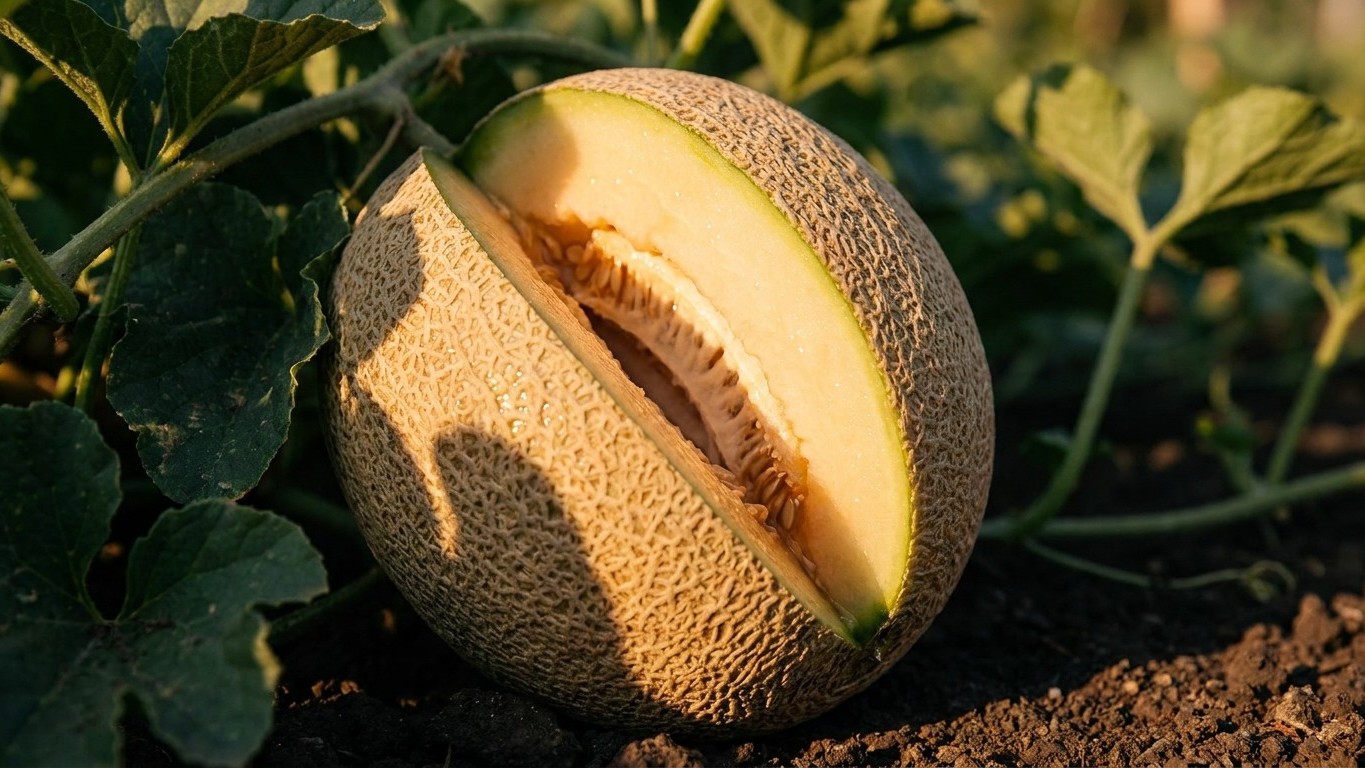

Splitting happens when a melon takes in water faster than its rind can stretch to hold it, and it almost always happens in the final stretch before harvest, when the fruit is sweetest and most fragile. The fix isn’t complicated, but it depends on catching the pattern before it starts, not after the crack appears.
What is actually going on

Every melon fruit is a balloon with two competing jobs. The flesh inside keeps swelling with water and sugar as long as the vine is alive and healthy. The rind, meanwhile, is supposed to stretch along with it, cell by cell, until the fruit reaches its mature size. The problem is that rind growth and flesh growth don’t slow down at the same rate. As a melon closes in on ripeness, the rind’s cell division essentially stops. It’s done expanding. But the flesh inside is still absorbing water through the vine, and if that water arrives in a sudden rush, internal pressure, what gardeners and horticulturists call turgor, spikes faster than the rind can accommodate. Something has to give. That something is usually a clean split along the weakest line of the rind, often right where a natural seam or scar already exists.
This is worth sitting with for a second: a split melon isn’t a diseased melon or a poorly bred one. It’s a fruit that was doing exactly what it’s supposed to do, right up until it hit a wall it couldn’t stretch past. That’s part of why splitting feels so unfair to gardeners who’ve done everything right for months.
Rind type matters here, though not in the way people expect. Thicker, more fibrous rinds, the kind found on heavily netted, cantaloupe-type melons, tend to resist splitting a bit longer because the netting itself adds structural give. Smooth-skinned types, like honeydew-type melons, have less of that built-in flexibility and can split more abruptly once pressure builds. This is a difference in melon type, not a reason to chase a specific named variety. Your state’s cooperative extension service publishes trial results for melon types that actually perform well in local soil and climate, and that’s a far more useful reference than any single variety name floating around online.
One point deserves to be stated without hedging: a melon does not ripen after it’s picked. It softens, and it can look and even smell more appealing a day or two off the vine, but sugar production stops the moment the stem separates from the plant. There is no windowsill ripening happening, no continued sweetening in a fruit bowl. Whatever sugar content the melon had at the moment of harvest is the sugar content it will have when you cut into it. That fact changes how you should think about a splitting fruit still attached to the vine.
In the garden
The single most common trigger for splitting is a watering pattern, not a single watering event. A melon plant that has been slightly stressed by dry soil, then suddenly given a large volume of water, whether from a garden hose or an actual storm, is the textbook setup. The dry period slows fruit expansion and lets the rind firm up and stop stretching. The sudden soak then floods the root zone, the plant pulls in water fast, and the fruit’s internal pressure jumps before the rind can respond.
| Watering pattern | What happens | Why it leads to splitting |
|---|---|---|
| Weeks of dry soil followed by a heavy rain event | Roots that had slowed water uptake suddenly flood with available moisture | The rind has already hardened for near-maturity; it can’t stretch fast enough to match the flesh’s swelling |
| Inconsistent hand-watering, feast or famine | Soil moisture swings from bone-dry to saturated over a few days | Fruit expansion becomes stop-and-start, weakening the rind at the points where growth paused |
| Heavy irrigation applied right as fruit nears full size | A large, single watering coincides with the plant’s peak water demand for that fruit | Timing overlaps with the exact window when the rind has the least flexibility left |
| Sandy or compacted soil with little organic matter | Soil holds almost no water reserve, so moisture swings are more extreme between waterings | There’s no buffer to smooth out the gap between dry stretches and wet ones |
The pattern that avoids all of this is steady, moderate soil moisture maintained on a consistent schedule, ideally through drip irrigation or soaker hoses rather than overhead sprinklers, paired with two to three inches of mulch to slow evaporation and reduce the swing between watering days. None of this requires guessing at gallons or measuring precise amounts. It requires consistency: the same rough moisture level, week over week, especially as fruit sizes up.
It’s also worth noting that splitting doesn’t necessarily mean the fruit is lost. A split that occurs while the melon is still attached to the vine doesn’t cut off its water and sugar supply the way picking does. The vine connection is still intact. The bigger risk at that point isn’t lost sweetness, it’s exposure: an open rind is an invitation for insects, rot organisms, and moisture to get into the flesh. That’s a pest and sanitation issue more than a ripening one, and it’s usually managed by removing affected fruit promptly rather than by any spray program.
What it depends on where you are
How often splitting shows up in a given garden has a lot more to do with regional weather patterns than with anything a gardener did wrong. Areas with long stretches of dry weather interrupted by sudden, heavy summer storms, a pattern common across much of the central and southern United States, see this problem far more often than regions with steadier, more evenly distributed rainfall. Humidity plays a role too: gardens in consistently humid climates tend to have more even soil moisture overall, simply because the soil doesn’t dry out as aggressively between rain events, while gardens in drier climates depend almost entirely on irrigation, which is easier to keep consistent because it’s under the gardener’s control rather than the sky’s.
Season length matters as well, though in a less obvious way. Where the growing season is short, gardeners sometimes push melon plants harder late in the season, watering more aggressively to help fruit reach maturity before the first frost. That late-season push is exactly the kind of watering behavior that raises split risk, even though the intention behind it is entirely reasonable.
None of this can be reduced to a single number or rule that applies everywhere. Local soil type, typical summer rainfall, and the specific melon types that have been trialed and performed well in a given state all shape the real answer for any one garden. This site’s state-specific melon growing guides cover those regional differences in more depth, and a state’s cooperative extension service remains the most reliable source for what’s actually been tested under local conditions, including which melon types have shown better rind resilience in regional trials. That’s a more useful starting point than any generic national advice, this article included.
The mistake that costs the most
The single costliest error is treating watering as an emergency response instead of a routine. It usually looks like this: a hot, dry stretch sets in, the plant looks a little wilted in the afternoon sun, fruit growth appears to stall, and the gardener responds by giving it a big, generous soak to make up for lost time, right around the point when the melons are closing in on maturity. That instinct is understandable. It’s also almost exactly the sequence that produces splitting.
The fix isn’t more water. It’s more evenly distributed water, delivered on a schedule the plant can count on rather than one that reacts to how stressed it looks on a given afternoon. That means checking soil moisture a few inches down every few days during the final two to three weeks before fruit is expected to mature, and watering in smaller, more frequent amounts rather than large infrequent ones. Mulch does a lot of the work here by holding moisture steady between waterings, which is often more valuable than any adjustment to the watering schedule itself.
The other half of this mistake is what happens after a split shows up. Panicking and cutting the fruit immediately, assuming it’s ruined, throws away whatever sugar the plant would have continued supplying through the intact vine connection. Waiting too long carries its own cost, since an open rind exposed to rot and pests for days can lose the fruit entirely. The practical middle ground is checking split fruit daily, removing it once the split has widened significantly or shows early signs of rot or insect damage, and otherwise leaving it connected to the vine for as long as it stays clean. That’s the balance that actually protects the harvest, not a blanket rule in either direction.