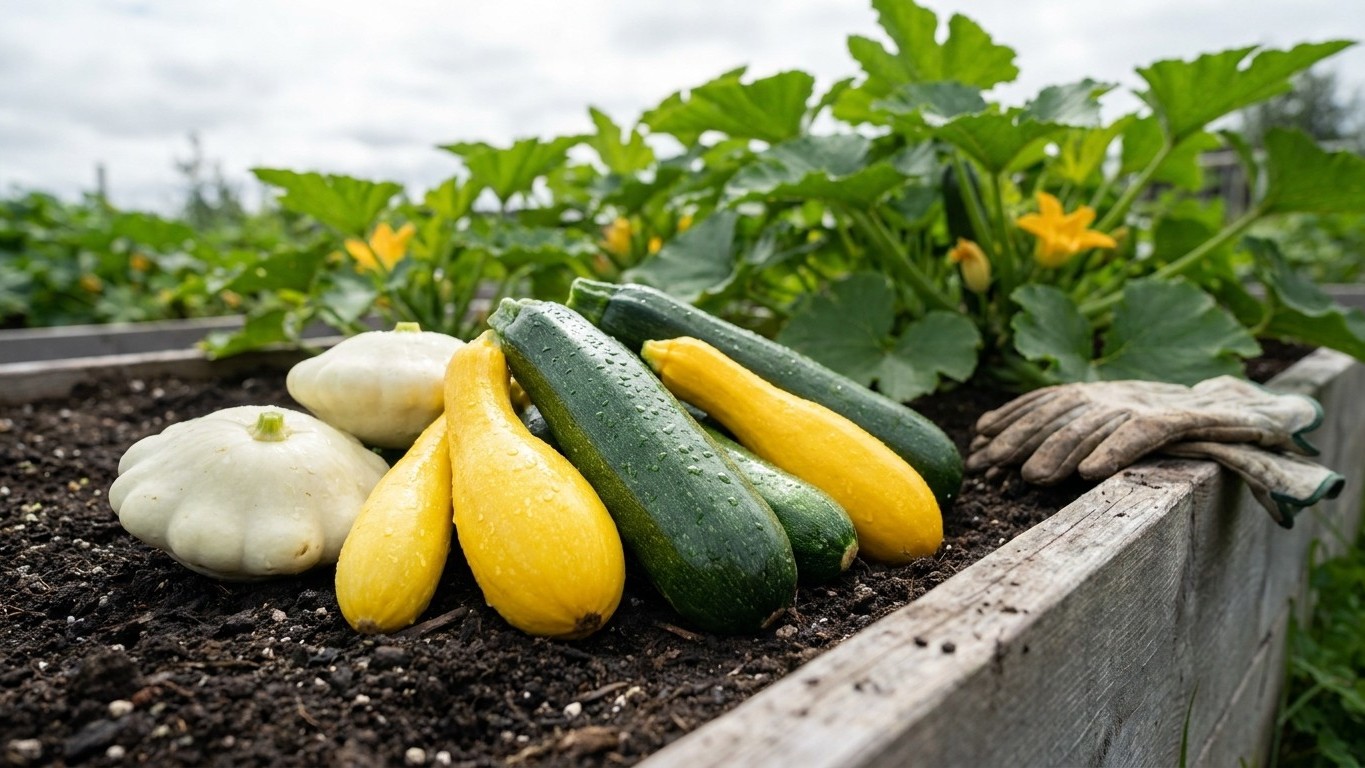

Iowa’s growing season runs long enough and hot enough to favor bush-type summer squash over trailing varieties. Zucchini, yellow crookneck, straightneck and pattypan all mature fast enough to fit multiple plantings, but the state’s humid early summer and its stretch of 90-degree days push the advantage toward disease-resistant bush types over vining ones that need more space and more water to cool themselves.
The short answer for Iowa
Bush-type summer squash is the safer bet across Iowa, and here’s the reasoning from the numbers on this page rather than a generic rule. The frost-free window runs from roughly mid-to-late April through mid-to-late October at the reference station used for these normals, a season long enough to Plant Summer Squash twice, sometimes three times, since bush varieties reach harvest in 45 to 55 days. That length of season is not the limiting factor here. Heat is. Des Moines averages 18.4 days a year at or above 90 degrees, concentrated in July and August, and that heat load stresses trailing vine types more than compact bush plants, because vines cover more soil surface and lose more water to transpiration on the hottest afternoons.
Rainfall pattern matters just as much as heat. June averages 5.26 inches, the wettest month of the growing season, which means seedlings and young plants face humid, wet-leaf conditions right when powdery mildew and bacterial wilt take hold. July drops to 3.82 inches, the driest summer month, right as the 90-degree days pile up. That combination, a wet start and a dry, hot middle, rewards varieties bred for mildew tolerance and penalizes dense plantings that trap moisture around the leaves.
| Type | Days to maturity | Heat tolerance | Humidity/disease risk |
|---|---|---|---|
| Bush zucchini | 45-55 | Good | Moderate, benefits from spacing |
| Yellow crookneck | 50-60 | Good | Lower risk, tougher skin sheds moisture |
| Pattypan/scallop | 50-55 | Good | Moderate |
| Straightneck | 50-58 | Good | Moderate |
| Vining/trailing types | 55-65 | Lower in extended 90F heat | Higher, more leaf cover holds moisture |
For most Iowa gardens, that table points toward bush zucchini or yellow crookneck as the first choice, with pattypan and straightneck as reliable seconds. Vining types are not ruled out, but they demand more room and more attentive watering through the July dry stretch, and this page’s job is to say that plainly rather than pretend every type performs the same here.
What will not work here
Weekly watering fails in an Iowa July. With only 3.82 inches falling that month and 18.4 days a year hitting 90 degrees or higher, a shallow weekly soak lets the top few inches of soil dry out between waterings right when the plant needs the most consistent moisture to fill fruit and keep flowers from aborting. Summer squash roots sit in the top foot of soil, and a single deep watering a week cannot buffer against several consecutive 90-degree afternoons. Gardeners who treat Iowa summer like a mild coastal one, watering on a fixed schedule instead of watching the soil, tend to see blossom drop and stunted fruit by late July.
Tight spacing fails too, and June’s 5.26 inches of rain is the reason. Summer squash planted 18 inches apart, the spacing that works in a drier state, keeps leaves wet longer after a June rain here, and that lingering moisture is exactly what powdery mildew and bacterial wilt need to spread. Iowa State University Extension and most seed suppliers recommend closer to 24 to 36 inches between bush plants specifically because airflow matters more in a state where June is the wettest month of the growing season. Skimping on spacing to fit more plants in a small bed is one of the most common and most avoidable failures here.
Planting too late is the third trap. First fall frost arrives between October 14 and October 25 at the reference station, and Iowa State Extension’s county-level figures run about ten days earlier than that in the fall, which means a grower relying on the optimistic end of that range can lose a planting to frost before it finishes. A second or third succession sowing needs to go in the ground by early-to-mid July at the latest to leave 55 to 65 days before the earlier, more realistic frost date. Waiting until late July to try one more round of squash is a common mistake that this state’s numbers do not support.
Long-season vining types bred for a longer, milder summer than Iowa’s are the fourth mismatch. They are not defeated by season length, since Iowa’s frost-free window is generous, but by the specific stress of mid-summer heat combined with the space and water they demand. A vining variety planted where a bush type would have fit spreads into pathways, shades neighboring plants, and needs more frequent deep watering exactly during the driest, hottest weeks of the year.
What changes across Iowa
Iowa spans USDA hardiness zones 4b to 6a, and that spread is built on one variable only, the average annual extreme minimum winter temperature, so it says nothing directly about summer squash performance but everything about how differently the state’s edges behave. A zone 4b garden in the state’s far north and a zone 6a garden near the Missouri or Mississippi River border are not the same growing environment, and this page cannot tell an individual reader which zone applies to their own yard.
What a northern, cooler-zone gardener should shift is timing and variety choice. Expect the last spring frost to land later than the April 12 optimistic end of this page’s range, and the first fall frost to arrive earlier than October 25. That combination shortens the safe window for a second or third succession planting, so a northern Iowa gardener does better sticking to faster-maturing bush varieties and starting the first planting a week or two later than someone near the southern border would.
A gardener near the state’s southern edge, closer to zone 6a, typically has a longer buffer on both ends of the season and more room to experiment with a slower-maturing type or squeeze in a third succession sowing in late July. The heat load, 18.4 days above 90 degrees as a state-level average, likely runs higher in the south and lower in the north too, though this page’s fact set does not break that number down by region. Anyone planting near either edge of the state should treat the ranges here as a starting point, not a fixed date, and lean on the more cautious, later-spring, earlier-fall end of the range rather than the airport-station optimistic end.
Where to check this for your own county
Iowa State University Extension and Outreach publishes county-level planting guidance that goes further than any statewide page can. This page works from a single reference station’s climate normals, and Iowa State’s own county figures, drawn from 1950 to 2021 records, run about four days later in spring and ten days earlier in fall than the airport-station numbers cited here. That gap matters more the closer a reader gets to either edge of the state.
Search the extension site for the planting calendar specific to the reader’s county, not just a statewide vegetable guide, since frost dates and season length shift noticeably between the state’s northern and southern thirds. Also worth searching for is any county-level or regional trial data on summer squash varieties, since local extension offices and university trial gardens often test which bush zucchini, crookneck or pattypan cultivars held up best against that county’s particular mix of humidity, soil type and pest pressure in recent growing seasons.
A county recommendation beats a state one every time, because it accounts for local soil, local microclimate and local pest history in a way a single statewide page cannot. This page gives the state-level picture built from the best available climate normals. The county extension office gives the picture built from what actually grew in gardens near the reader’s own address, and that is worth the extra search.
Checking this against your own garden
No date on this page beats what the reader’s own garden is doing right now. Soil warmth is the first check, and it can be felt with a bare hand pushed a couple of inches into the bed in the morning before the sun has warmed the surface. Summer squash seed wants soil that feels warm to the touch, not just frost-free air, since cold soil slows germination and invites rot even after the last frost date has passed.
The first flush of male flowers is the second signal worth watching. Summer squash plants typically produce male flowers a week or two before the female flowers that actually set fruit, and a strong early flush of males, especially if bees or other pollinators are active around them, suggests the plant has settled into its spot and is on schedule for that particular garden’s microclimate, whatever the calendar says.
First true leaves, the second set that appears after the rounded seed leaves, tell the third part of the story. Slow, pale true leaves point to soil that is still too cool or too wet from that wet June pattern discussed above, while quick, dark green true leaves within a week or two of germination suggest the bed has warmed and drained well enough to push ahead with a second succession planting sooner rather than later.