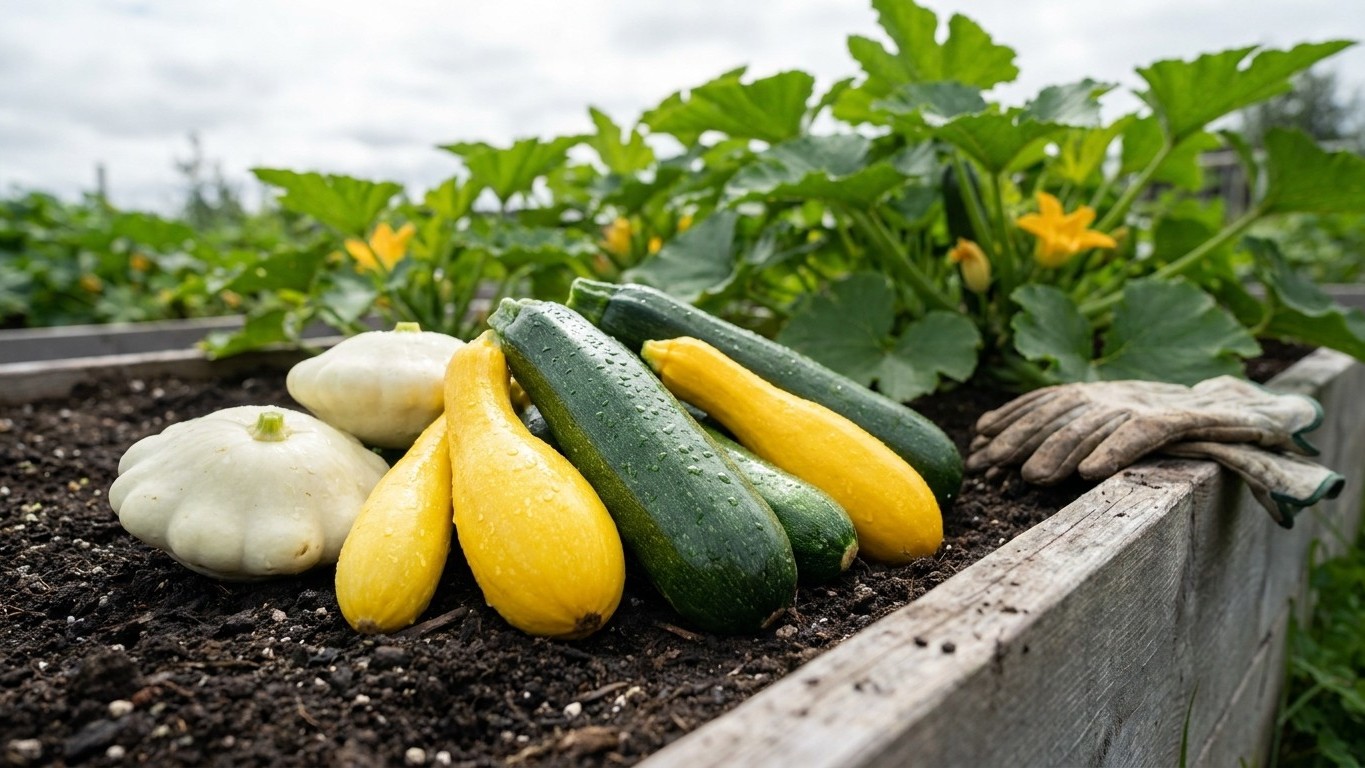

Choose fast-maturing, heat-tolerant bush types, straightneck and zucchini varieties bred for disease resistance, and plan on more than one planting a season. In a state where summer heat, not frost, calls the shots, the variety that survives July matters more than the one that looks best in a seed catalog photo.
The short answer for Louisiana
Louisiana’s growing decision starts with a number most planting guides ignore: 70.7 days a year at or above 90°F, measured at the New Orleans reference station. That’s not a hot spell. That’s ten weeks of sustained heat load that shuts down pollen viability, triggers blossom drop, and turns a productive squash plant into a stalled one almost overnight. Any variety pick for this state has to answer to that number before it answers to anything else.
Bush-type straightneck and zucchini varieties bred for early, concentrated harvest windows are the safer bet, because they can push out a crop before the worst of the heat run sets in, then get replanted for a second flush once temperatures ease. Compact bush habits also matter for a more practical reason: they take up less space, which means less to protect when a Gulf storm system rolls through in July or August. Vining types and the slower-maturing scallop or pattypan varieties can still work, but they ask for more day-to-day attention and more room to breathe, which this climate doesn’t always offer.
Disease resistance deserves equal billing with heat tolerance here. Louisiana’s summer rainfall runs about 21.3 inches across June, July and August, arriving mostly as thunderstorms rather than steady soaking rain. That combination, heat plus humidity plus intense but brief downpours, is close to ideal for powdery mildew and downy mildew. Varieties bred with mildew resistance built in aren’t a luxury item in this state. They’re closer to a requirement, especially for anyone who’s watched a healthy-looking squash patch turn gray and collapse in the space of ten days.
The frost dates on the calendar barely register in this calculation. Southern Louisiana sees a 32°F freeze in only 86.8 percent of years, meaning roughly one winter in seven never dips to freezing at all. That’s an unusual fact for a planting guide to lean on, but it means the frost window most guides use to bookend the growing season isn’t the limiting factor here. Heat is. Plan variety selection and succession timing around the 90-degree stretch, not around the last frost date.
What will not work here
Long-season, large-fruited types that need 60 to 70 days of uninterrupted good weather to reach full size are a poor match for a state where the productive window between spring warm-up and peak summer heat can close fast. Squash vine borer pressure builds through the season, and a slower-maturing plant simply spends more calendar time exposed to it. By the time a long-season variety is finally sizing up fruit, the borer population has often had weeks longer to find it.
Watering on a once-a-week schedule is another common failure point, and the rainfall numbers explain why. Summer rain here totals about 21.3 inches, which sounds generous on paper, but it lands as 7.62 inches in June, 6.79 in July, and 6.91 in August, concentrated in storm bursts rather than gentle, evenly spread showers. A lot of that water runs off rather than soaking into the root zone, and with 70.7 days a year above 90°F driving evaporation, a plant that only gets checked on weekly can go from adequately hydrated to heat-stressed between visits. July, the driest of the three summer months by this measure, is exactly when that gap tends to show up.
Tight spacing and humidity don’t mix
Packing plants close together to save space is a habit that works fine in drier climates and fails here. Poor airflow between crowded plants holds humidity right at leaf level, which is precisely the condition powdery and downy mildew need to spread. Wider spacing than the seed packet suggests, oriented to catch prevailing airflow, does more to protect a Louisiana squash patch than almost any spray program.
Finally, treating this as a one-planting season doesn’t hold up. A single spring sowing that’s expected to carry a household through summer will typically decline hard once the 90-degree days stack up in July and August. Succession planting, with a second sowing timed to mature after the worst heat has passed, is less optional here than in a milder climate.
What changes across Louisiana
Louisiana spans USDA Hardiness Zone 8a to 10a, a range built on one measurement: the average annual extreme minimum temperature, according to the USDA Plant Hardiness Zone Map. That’s a wide spread for a single state, and it means there’s no one answer to “when do I plant” or “how long is my season” that applies from Shreveport to the coast. A reader in the northern part of the state is gardening under meaningfully different winter conditions than one near the Gulf, even though both are technically in Louisiana.
The freeze data underscores just how different those two ends of the state really are. Southern Louisiana’s freeze window is unreliable almost by design, with a 32°F freeze occurring in only 86.8 percent of years and the fall frost window straddling the New Year. Northern Louisiana, sitting in the cooler end of that 8a-10a range, freezes far more consistently and on a more predictable calendar. That single difference reshapes the whole growing strategy: a southern grower can often push a fall squash crop later into the year with reasonable confidence, while a northern grower is working against a harder, more dependable cutoff.
Heat load likely varies across the state too, though the 70.7 days above 90°F figure cited here comes specifically from the New Orleans reference station and shouldn’t be assumed identical everywhere. A gardener further north or further inland is working with different heat and humidity patterns than the coastal reference point, even within the same broad climate story of hot, long summers.
None of this points a reader to a single zone number for their own yard, and it shouldn’t. The right move is checking the current USDA map for the specific county in question, then treating the state-level range as context rather than a personal answer.
Where to check this for your own county
Everything above describes Louisiana as a whole, and Louisiana as a whole isn’t where anyone’s squash patch actually sits. The LSU AgCenter is the state’s land-grant extension service, and it’s the resource built specifically to close that gap between statewide averages and what actually happens in a given parish.
Two things are worth looking for there specifically. First, a local planting calendar tuned to the reader’s own region of the state rather than a statewide range, since the frost and heat data above already show how much that range can swing between the northern and southern parts of Louisiana. Second, variety trial results or extension recommendations for summer squash that have actually been grown and evaluated under local conditions, whether that’s a parish-level fact sheet, a master gardener program, or a county agent’s seasonal guidance. Varieties that perform well in one region’s soil and pest pressure don’t always repeat that performance elsewhere in the state.
It’s worth being direct about the hierarchy here: a county-level or parish-level recommendation from the extension service outranks anything on this page. This article works from statewide climate normals, which are genuinely useful for understanding the broad forces at play (the heat load, the freeze unreliability, the rainfall pattern) but they average out the very local differences that determine whether a specific variety thrives in a specific backyard. The extension service exists precisely to fill in that local layer, with agents who track what’s actually been planted and harvested nearby, season after season.
Calling or visiting the local extension office ahead of planting season, rather than relying only on statewide figures, is the single most useful step a Louisiana gardener can take beyond reading an article like this one.
Checking this against your own garden
Every date and average in this article describes a region. A reader’s own garden is a single plot, and it will always tell them something more specific than a climate normal can. Three signs are worth tracking directly, none of which require anything beyond attention.
Soil warmth by feel is the first. Squash seed germinates poorly in cold soil, and a hand pressed a few inches into the bed on a sunny afternoon gives a rough but reliable read on whether the ground has actually caught up to the season, regardless of what the calendar says. A bed in full sun against a south-facing wall will often warm weeks ahead of a shaded, low-lying spot even in the same yard.
The first flush of male flowers is the second signal worth watching. Squash plants reliably produce male blossoms before female ones, sometimes by a couple of weeks, and that first wave is a sign the plant has moved past its vegetative stretch and is gearing up to fruit. Seeing plenty of male flowers with no females yet isn’t a problem to fix. It’s a normal stage, and a useful marker of exactly where a given plant sits in its own timeline.
The appearance of the first true leaves, the ones that follow the rounder seed leaves and actually look like squash foliage, is the third. Their timing and vigor say more about that specific bed’s fertility, drainage, and warmth than any regional average can. A slow, pale set of true leaves in one part of the garden versus a fast, dark green set in another is a direct clue about microclimate differences most gardeners don’t realize exist on their own property until they start comparing beds side by side.