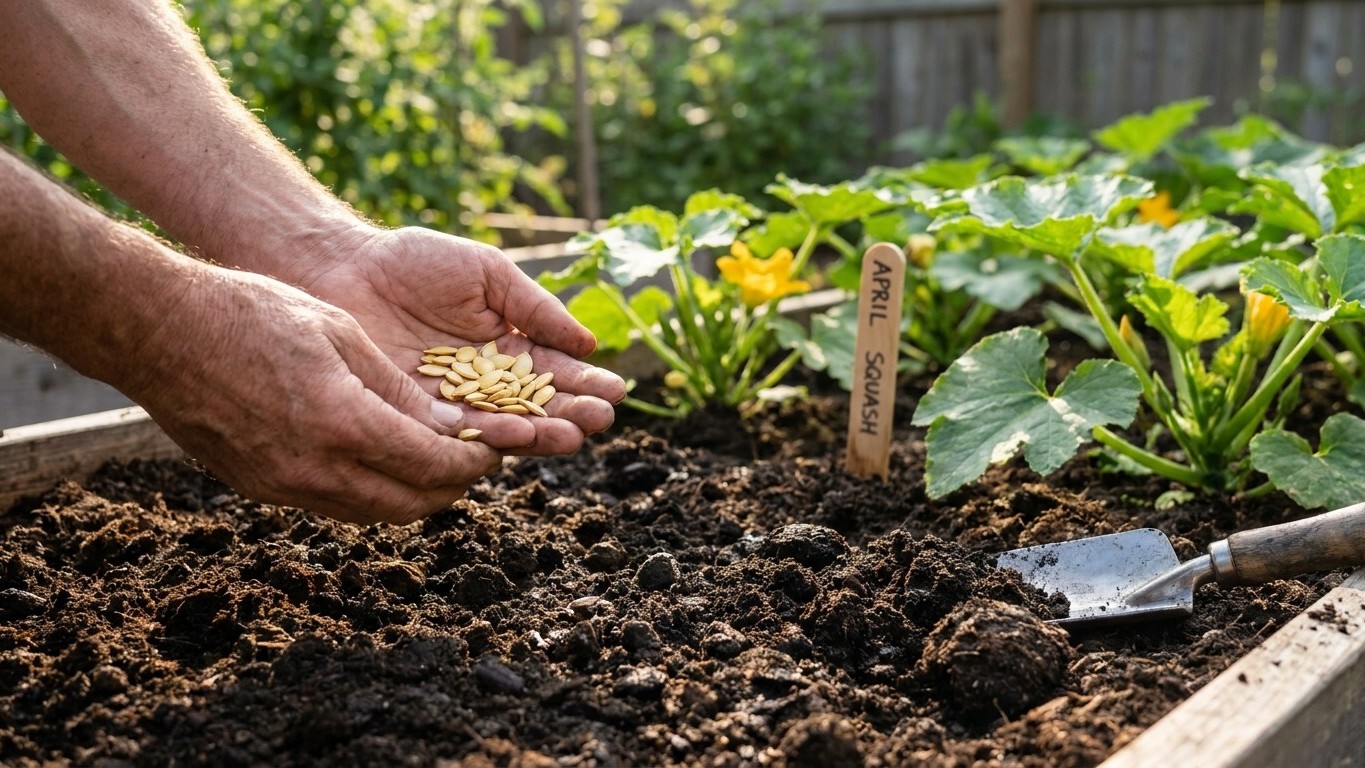

Direct-sow summer squash outdoors in Massachusetts once the soil has warmed past the last spring frost window, which falls between April 1 and April 8 at the state’s mildest reference station. Because that date only marks the coastal minimum, most Massachusetts gardens should wait until mid-to-late May, and succession plant into early July since the first fall frost doesn’t typically arrive until November 3 to November 14.
The short answer for Massachusetts
Summer squash is frost-tender at every stage: the seed rots in cold, wet soil and the seedling dies at 32°F. The frost dates cited here (April 1 to April 8 for spring, November 3 to November 14 for fall) come from NOAA’s 1991-2020 climate normals, and they describe a specific thing: the window when the probability of a 32°F freeze sits between 30% and 70% at Boston’s Logan Airport station. That’s not a guarantee the frost ends on April 8. It means that by that date, the odds of freezing have dropped into a middle range, still a coin-flip in places, and Logan is a waterfront, urban station, the warmest spot the state has to offer.
That caution matters more for squash than for hardier crops, because squash gains nothing from being planted early. Unlike peas or spinach, it won’t tolerate a light frost, and cold soil below 60°F just sits on the seed without germinating it. So the practical answer for most of Massachusetts is to skip the April frost date entirely as a planting cue and instead target mid-May through early June for the first direct sowing, once the soil itself has caught up with the season.
On the back end, the math is forgiving. Most summer squash varieties mature in 45 to 60 days from seed. Counting back from the earliest fall frost date of November 3, that leaves room for a final direct sowing in early-to-mid July, well past the traditional Fourth of July marker many New England gardeners use. Succession planting every three to four weeks from late May through early July keeps a steady harvest running and sidesteps the squash borer and mildew pressure that tends to build on a single planting left in the ground all season.
This page draws its numbers from the statewide reference station, not from any single county. A gardener in Worcester County or the Berkshires works from a later spring date and an earlier fall one than what’s cited above, a point covered in the sections that follow.
What will not work here
Planting in early April, right at the start of the frost-probability window, is the most common failure this calendar predicts. That date reflects conditions at Logan, the mildest station the state has. Inland and upland gardens frost later in spring and earlier in fall, so seed or transplants set out in early April face real odds of a freeze that coastal gardens don’t. Squash offers zero frost tolerance to buy back that risk.
Watering on a fixed weekly schedule is the second failure mode, and it shows up specifically in August. The state averages 3.23 inches of rain in August, the driest of the three summer months, against 3.89 inches in June and 3.27 in July. Combine that dry stretch with 10.2 days a year that reach 90°F or hotter, mostly clustered in mid-to-late summer, and a squash plant on a once-a-week hose schedule runs short right when fruit is sizing fastest. Squash roots sit shallow, and a plant that dries out between waterings drops blossoms and produces bitter, misshapen fruit rather than dying outright, which makes the problem easy to miss until the harvest disappoints.
Tight spacing is the third failure, and it’s a humidity problem rather than a heat problem. June’s 3.89 inches of rain, often falling as scattered thunderstorms rather than steady soaking rain, leaves foliage wet for hours at a time in a state that also carries the humidity typical of the Northeast. Summer squash planted on 18-inch centers, a spacing that works in drier western states, keeps leaves damp and packed close together here, and powdery mildew moves through that canopy fast. Massachusetts gardens do better giving squash the wider end of its recommended spacing, generally 3 to 4 feet between plants, so air moves through the leaves after a storm instead of sitting on them.
Relying on a single planting date also fails here, just less dramatically. Massachusetts has enough of a gap between its last spring frost and first fall frost, over six months at the reference station, to support two or three staggered sowings. A gardener who plants once in late May and stops has usable squash by July but nothing fresh by September, when the first planting’s vines are worn down by borers and mildew anyway.
What changes across Massachusetts
Massachusetts spans USDA hardiness zones 5a through 7b, and that’s a wide spread for a state this size. The USDA system is built on one number, the average annual extreme minimum winter temperature, so it doesn’t measure spring warm-up speed directly. But in practice, the same geography that produces that zone spread also produces a real difference in how early soil warms enough for squash seed.
| Region | General pattern | What it means for squash timing |
|---|---|---|
| Coastal and Cape Cod | Milder end of the state’s zone range | Soil warms earlier; sowing can often start toward the earlier side of the mid-May window |
| Metro Boston and central lowlands | Middle of the range | Follows the statewide window fairly closely, mid-May onward |
| Western Massachusetts and Berkshire elevations | Colder end of the state’s zone range | Soil warms later; sowing usually pushed toward late May or into June, and fall harvest ends sooner |
None of this tells an individual reader which zone their own yard sits in. Elevation, distance from the coast, and even a slope’s compass direction shift the local zone by a full band or more within a few miles, something a statewide range can’t capture. The USDA Plant Hardiness Zone Map lets any reader enter a ZIP code and get the zone assigned to their specific location, and that’s the tool to use before adjusting the dates in this article.
What the spread does confirm is that there’s no single “Massachusetts date” for summer squash that fits everyone equally well. A gardener near the water is often planting and harvesting on a schedule that would still be too early for someone gardening at elevation forty miles inland, even though both are technically following the same state calendar.
Where to check this for your own county
UMass Amherst runs the state’s Cooperative Extension Service, and its site at ag.umass.edu is the next stop after this page, not a substitute for it but a step down in scale. A state-level calendar, like the one above, has to average across zone 5a and zone 7b conditions. A county extension office doesn’t; it works from local trial data and local growers’ actual results.
Two things are worth hunting for once there. First, look for the county or regional planting calendar, if one is published for vegetable crops; some UMass county offices maintain their own dates that reflect local frost records rather than the statewide station used here. Second, look for variety trial results specific to Massachusetts growing conditions. Summer squash varieties differ in their resistance to powdery mildew and squash vine borer, both of which are live issues in the state’s humid summers, and a variety that performs well in a Cape Cod trial garden may not be the one recommended for a Berkshire county with a shorter, cooler season.
A county-specific recommendation will always outrank what’s written here. This page works from a single reference station’s climate normals to describe Massachusetts as a whole; a county office works from years of local observation in the actual soil and microclimate a reader is planting in. Treat this page as the starting estimate and the extension office as the correction.
Checking this against your own garden
No planting calendar, state or county, replaces what’s happening in the actual bed. Three signs are worth checking by hand before trusting any date on paper.
Soil warmth comes first, and it’s simple to check without a thermometer: dig down two to three inches and feel the soil. Squash seed wants soil that feels warm and dry enough to crumble, not the cold, damp grip that spring soil still has in April. A garden that still feels cold to the hand in mid-May, even after the calendar says to plant, is running behind the regional average and should wait another week or so.
The first flush of male flowers on an already-growing plant is the second signal. Squash produces male blossoms before female ones, sometimes by a week or two, and a plant putting out male flowers heavily with no fruit set yet is simply working through its normal early cycle, not failing. Watching for the first female flowers, the ones with a tiny swollen squash shape at the base, marks the real start of harvest countdown.
The pace of true leaves rounds it out. A squash seedling that pushes its first true leaves (the second set, shaped like the mature plant’s foliage rather than the rounded seed leaves) within a week of sprouting is growing in soil warm enough to support it well. A seedling that sits at the seed-leaf stage for two weeks or more is signaling that the local soil, sun exposure, or overnight temperatures are running colder than the state average this page is built on, and it’s worth adjusting next year’s date accordingly rather than fighting the current planting.