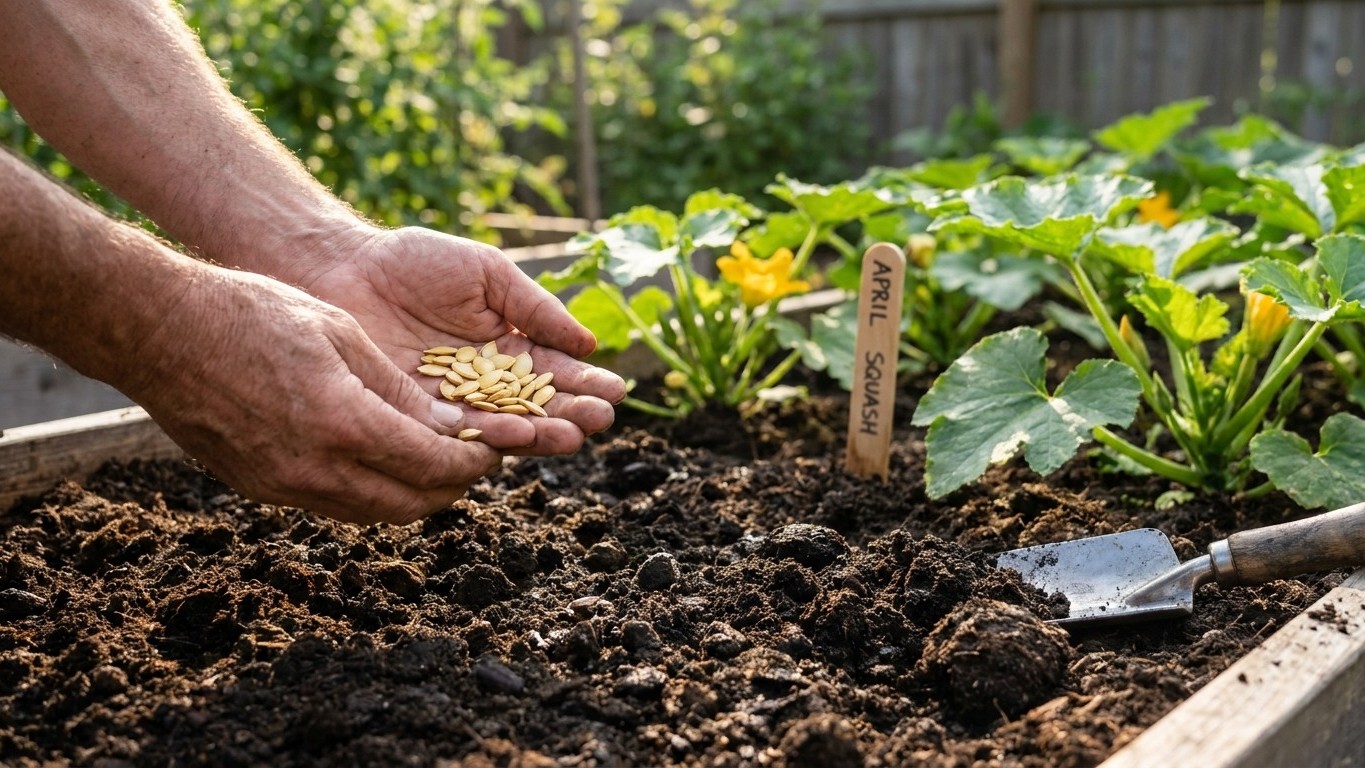

Missouri gardeners can direct-seed summer squash once the soil has shed its spring chill and the last frost date has passed, generally from late April through May depending on where in the state you’re planting. The window narrows toward the state’s north, widens toward its south, and a second sowing in early summer keeps zucchini and yellow squash producing until the first fall frost arrives in mid-to-late October.
The short answer for Missouri
At the reference station used for these normals (near Kansas City), the last spring frost falls somewhere between April 6 and April 20. That’s not a single date but a probability band, the 30-70% range in which a 32°F freeze has historically occurred. Sow before that window closes and you’re gambling on an unusually early spring; sow after it and the odds favor you. Summer squash is frost-tender seed to fruit, so the safest direct-sow start sits at the tail end of that band, roughly the last week of April into early May for gardens near the reference station.
Here’s where it gets specific to this state rather than generic advice that would fit any zone-6 garden: the station behind these numbers sits well north of downtown Kansas City. Downtown itself tends to warm about five days earlier in spring, and southern Missouri, sitting in warmer hardiness zones, runs milder still. A gardener in the Bootheel or the Ozark foothills can often push a sowing date earlier than a gardener near St. Joseph, even though both are technically “Missouri.”
On the other end of the season, first fall frost arrives between October 18 and October 29 at that same reference station. Subtract the two windows and you get a frost-free stretch of roughly 181 to 206 days, depending on which edge of each band your particular spring and fall land on. Summer squash moves fast, often producing within two months of sowing, so that frost-free stretch comfortably supports one planting and, in most years, a second succession sowing in June or early July to replace plants that have slowed down or succumbed to vine borers by late summer.
This page can tell you the state-level window. It cannot tell you the sowing date for your specific county, because that depends on local microclimate, soil type and elevation that no statewide normal captures. That’s a separate stop, covered further down.
What will not work here
Planting before mid-April anywhere north of the Missouri River is the most common way gardeners lose a squash planting to frost in this state. The April 6-20 window is a 30-70% probability band, meaning even at its late edge there’s real risk remaining. A seedling that emerges into a surprise freeze in the first half of April doesn’t just get set back. It dies, and replanting costs two to three weeks that matter later when the fall frost clock starts running.
On the other end of summer, watering on a fixed weekly schedule fails here more often than gardeners expect. Rainfall through the growing season averages about 14.1 inches across June, July and August combined, but it doesn’t fall evenly. June brings roughly 5.25 inches, July drops to 4.58, and August, the hottest stretch, delivers the least at 4.24 inches. That’s the exact month when the reference station also logs the bulk of its 32.7 average annual days at or above 90°F. Heat drives evaporation up while rainfall is falling off, and a single weekly soaking that worked fine in June can leave roots gasping in August. A squash plant under that kind of heat and moisture stress drops blossoms, produces bitter or misshapen fruit, and becomes far more vulnerable to squash bugs and vine borers.
Sowing too late is its own failure mode. Push a planting into late August hoping for a fast fall crop, and you’re racing a first frost that could land as early as October 18. Summer squash needs consistent warmth from flower to harvest, and a plant still setting fruit when temperatures crash doesn’t finish the job.
Tight spacing is the fourth trap. Missouri’s early-summer rainfall, especially that June average above 5 inches, keeps foliage and soil surfaces damp longer than a drier climate would. Crowd plants close together and you cut off airflow between leaves right when humidity is already working against you, which is exactly the setup powdery mildew needs to spread through a squash patch.
What changes across Missouri
Missouri isn’t one climate wearing a single hat. The USDA Plant Hardiness Zone Map places the state across zones 5b through 7b, a spread wide enough that a sowing calendar built for one edge of the state can be flatly wrong for the other. That range describes average annual extreme minimum winter temperatures, not summer growing conditions directly, but it’s a useful proxy for how much earlier or later a season starts and ends as you move across the state.
| Region tendency | What shifts | Practical adjustment |
|---|---|---|
| Northern Missouri | Cooler end of the 5b-7b range, later spring warm-up | Hold off sowing until the later edge of the frost window; expect fewer succession plantings |
| Kansas City area (reference station) | The April 6-20 / October 18-29 window cited above | Baseline for this page; downtown itself runs about five days earlier in spring |
| Southern Missouri | Warmer end of the range, milder falls | Earlier sowing possible; longer stretch for a second or third succession planting |
The takeaway isn’t that one part of the state is “better” for squash. It’s that a statewide answer has to be treated as a range, not a single date. A gardener at higher elevation in the Ozarks, even within a broadly milder zone, can see a noticeably later spring warm-up than the map’s zone number alone would suggest, since elevation cools things down independent of latitude.
This page won’t tell you which of those zones your own garden sits in, because that’s not something a statewide article can know. What it can do is point you to the tool that does: the USDA Plant Hardiness Zone Map lets you check your zone by ZIP code, and that number, cross-referenced with your own observed frost dates, does more to refine a sowing date than any statewide average.
Where to check this for your own county
Everything above is built from a single reference station and a statewide hardiness range, useful for a first pass but not a substitute for local data. The University of Missouri Extension runs the county-level system that actually accounts for your soil, your local frost history and the varieties that have performed in trials near you. Start at extension.missouri.edu.
Two things are worth hunting for once you’re there. First, the local or regional planting calendar, which will typically give a sowing window built from decades of county-level, or at least district-level, frost records rather than a single reference station five counties away. Second, look for variety trial results or recommended cultivar lists specific to your part of the state. Extension offices often track which summer squash varieties held up against squash bugs, vine borers or powdery mildew in field trials near you, information that a national seed catalog simply doesn’t have.
A county recommendation beats a state one every time, for the same reason a weather forecast for your town beats one for the whole region. This page is deliberately the state-level layer: the frost windows, the heat load, the rainfall pattern, the hardiness range that spans Missouri’s north to south stretch. It’s meant to give you the shape of the season before you narrow it down. Extension staff and their published calendars are the ones who can tell you that Livingston County typically clears frost several days after the statewide average, or that a particular squash variety has a track record of resisting borers in Ozark county gardens. That kind of granularity only exists at the local level, and it’s worth the extra step of tracking it down before finalizing a sowing date.
Checking this against your own garden
Every date on this page is a normal built from thirty years of station data, useful for planning but blind to what’s happening in your specific yard this particular spring. Your own garden will tell you more, if you know what to watch.
Soil warmth by feel is the first signal. Reach a hand a few inches into the bed in mid-spring. Cold, damp soil that feels closer to refrigerator temperature than room temperature means seeds will sit and rot rather than germinate quickly, regardless of what the calendar says. Once the soil feels consistently warm to the touch, even on a cool morning, that’s a stronger signal than any calendar date.
The first flush of male flowers is the second marker. Summer squash reliably produces male blossoms before female ones, sometimes by a week or two, and their appearance tells you the plant has moved past the seedling stage into active growth. It’s also a rough proxy for when pollinators are becoming active in your specific area, which matters because a female flower with no pollinator activity nearby simply won’t set fruit.
Third, watch how fast true leaves follow the seed leaves. A quick transition, within a week or so of germination, suggests soil and air temperatures are solidly in the plant’s favor. A sluggish transition, where true leaves take much longer to emerge, is a sign your particular spot, whether it’s a shaded corner or a low-lying pocket that holds cold air, is running behind the general pattern for your area. That’s information no regional normal can give you, and it’s the detail that ultimately decides whether your squash gets ahead of the season or falls behind it.