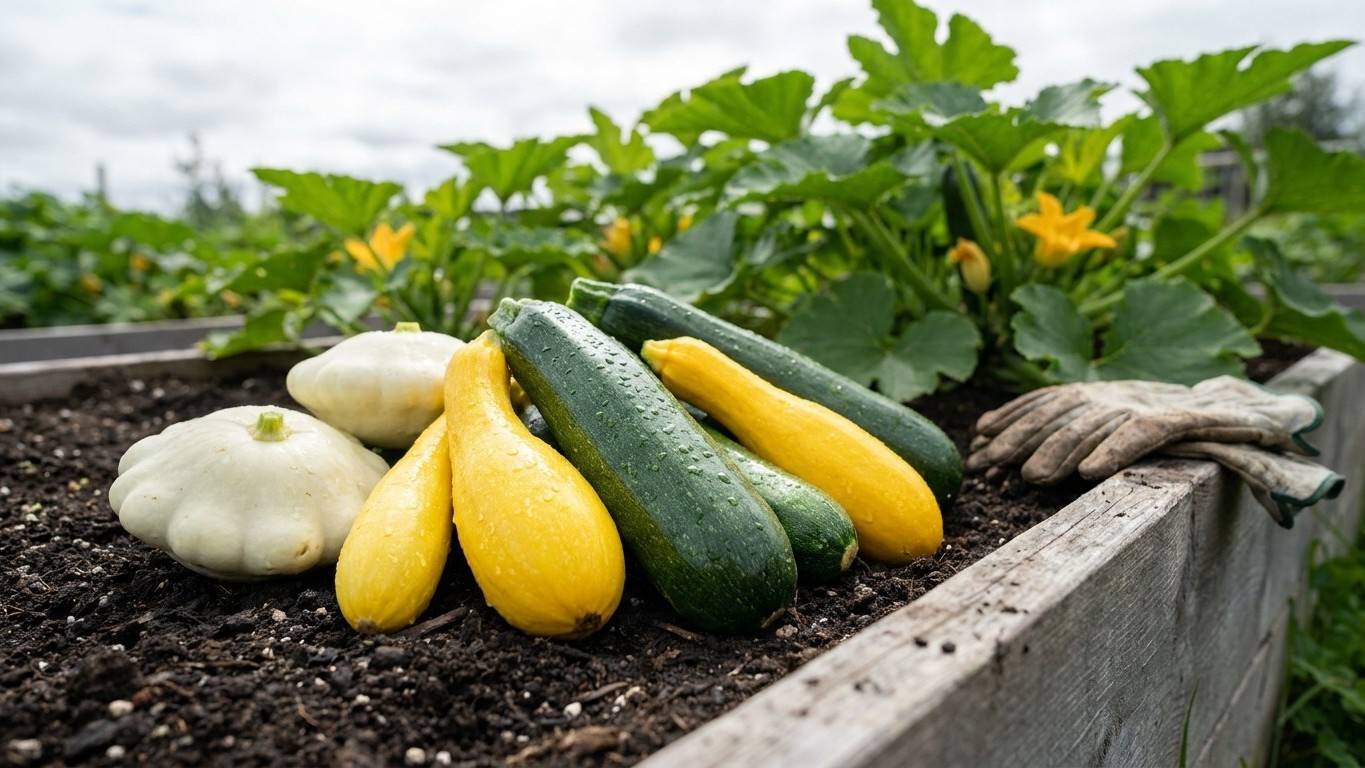

Bush zucchini, yellow crookneck, straightneck, and pattypan squash are the best bets across Montana, because they mature in 45 to 55 days, comfortably inside even the shortest version of the state’s frost-free window. Vining summer squash types that need 75 days or more, like tromboncino, are a gamble outside the mildest valleys.
The short answer for Montana
That answer comes straight from two numbers on the calendar. The last spring frost across the reference station runs from April 29 to May 10, and the first fall frost arrives between October 1 and October 14, according to NOAA’s 1991-2020 Climate Normals. Take the worst-case pairing, a late last frost on May 10 and an early first frost on October 1, and the frost-free window still runs about 144 days. Take the best-case pairing and it stretches past 165 days. Either way, a squash that needs 45 to 55 days to first harvest fits with weeks to spare, which is exactly why bush-type summer squash is the safe default here.
Why the numbers point that way
Summer squash isn’t picky about heat the way melons or okra are. The reference station logs 28.3 days a year at or above 90F, a moderate heat load, not a scorching one. That’s plenty to push flowering and fruit set along, but it’s not the kind of sustained heat that punishes cool-season crops or that summer squash actually needs to thrive. In practice, this means the deciding factor in Montana isn’t summer heat, it’s how much of the frost-free window a variety needs before frost risk returns. Fast bush types spend that window producing. Slow vining types spend it just getting established.
Where the trade-off shows up
| Type | Typical days to maturity | Fits Montana’s frost-free window? |
|---|---|---|
| Bush zucchini | 45-55 | Yes, wide margin |
| Yellow crookneck / straightneck | 50-55 | Yes, wide margin |
| Pattypan (scallop) | 50-60 | Yes, adequate margin |
| Vining types (tromboncino, similar) | 75-100 | Tight to risky, especially at elevation |
The bush types leave four to six weeks of buffer even in a shortened season. The vining types eat most of that buffer just reaching maturity, which is fine in a mild valley and a poor bet anywhere the frost dates run long.
What will not work here
Long-season vining summer squash is the first thing to cross off the list for most of the state. A variety that needs 90 days to first harvest, planted after the last frost date of May 10, doesn’t reach maturity until early August at the earliest, and that assumes a warm, uninterrupted run of growing days. Any setback, a cool week, a hailstorm, a late transplant, pushes harvest into September, right up against a fall frost that can arrive as early as October 1. That’s not a comfortable margin, it’s a bet against the calendar.
Long-season vining types
The caution attached to Montana’s frost data matters here too: Billings sits among the milder valleys in the state, and mountain valleys elsewhere can see frost in any month of the year. A vining squash that’s merely tight in a mild valley becomes a poor gamble in a colder pocket. If a gardener wants to grow a vining type anyway, starting it indoors and transplanting out as a head start is the only way to make the math work, and even then it’s a hedge, not a guarantee.
Bush types left to fend for themselves
The second failure mode has nothing to do with maturity dates and everything to do with water. Summer rainfall across June, July and August totals about 4.3 inches, and August, the month when fruit is sizing up fastest, averages just 0.87 inches. Pair that with 28.3 days a year above 90F, and a bush squash left on a weekly watering schedule through August will stall, drop blossoms, or turn bitter. This isn’t a humid-region crop where a light rain refreshes the soil for days. On sandy soil especially, that August rain runs through within a day, leaving the root zone dry again almost immediately. A bush type that would thrive with attentive watering fails simply from being watered on autopilot.
What changes across Montana
Montana is not one garden, and the hardiness data makes that plain. The state spans USDA zones 3a to 6a, under the USDA Plant Hardiness Zone Map system, built on average annual extreme minimum winter temperature. That’s a four-zone spread inside one state’s borders, which means there’s no single frost-free window that applies everywhere, and the dates cited above, tied to the Billings reference station, describe one of the milder ends of that range, not the average.
The colder end of the range
In a zone 3a mountain valley, the frost-free season is shorter than Billings sees, and frost can occur in any month, per the caution attached to these normals. A gardener there should lean on the fastest bush varieties available, the ones rated 45 days rather than 55, start transplants indoors instead of direct-seeding, and keep row cover on hand through June. Vining types are largely off the table in this zone unless grown under protection.
The milder end of the range
In a zone 6a valley, closer to the Billings profile, the season is long enough that direct-seeding bush zucchini or yellow squash after the last frost date gives a confident six-week-plus harvest window before fall frost risk returns. This is the end of the range where a vining type becomes plausible, though still not risk-free.
The gap between those two pictures is the whole reason a zone-only answer isn’t useful here. A recommendation built for Billings doesn’t automatically hold at 6,000 feet forty miles away, which is exactly why the next step matters more than anything on this page.
Where to check this for your own county
This page describes the state as a whole, using one reference station’s frost and heat data. A county recommendation will always beat a state one, because it accounts for local elevation, local soil, and local microclimate in a way a statewide page can’t. The place to find that is the Montana State University Extension office, the land-grant university extension service for the state.
What to look for once there
Two things are worth searching for specifically. First, a county-level or regional planting calendar, which will translate the statewide frost pattern into dates that reflect the actual elevation and valley conditions where the reader gardens, rather than the Billings-area normals cited on this page. Second, a list of squash varieties trialled by the local extension office, which carries more weight than any generic list, since those varieties have already been tested against the specific combination of season length, heat, and rainfall found in that county.
Extension offices also field direct questions from local gardeners, and a phone call or email describing a specific garden site, its elevation, its soil, its exposure, will often get a more useful answer than any published calendar. That’s the kind of detail no statewide page can replace.
Checking this against your own garden
Every date in this article is a normal, an average built from thirty years of data at one station. A reader’s own garden will run ahead of or behind that average depending on slope, soil, and shelter, and three simple observations settle the question better than any calendar.
- Soil warmth by feel: squash seed germinates poorly in cold soil. If the ground still feels cool and damp to the hand at planting depth, germination will lag regardless of what the frost date calendar says.
- The first flush of male flowers: squash plants typically produce male flowers before female ones. Their early appearance signals the plant is entering active growth and that pollinator activity, not just calendar timing, will now decide fruit set.
- The first true leaves: the speed at which true leaves follow the seed leaves is a direct readout of how warm the plant’s actual microclimate is running, faster than any regional normal can tell a gardener.
Taken together, these three signs describe the garden as it actually is this season, not as the thirty-year average says it should be, which is the only measurement that ultimately matters for a specific patch of ground.