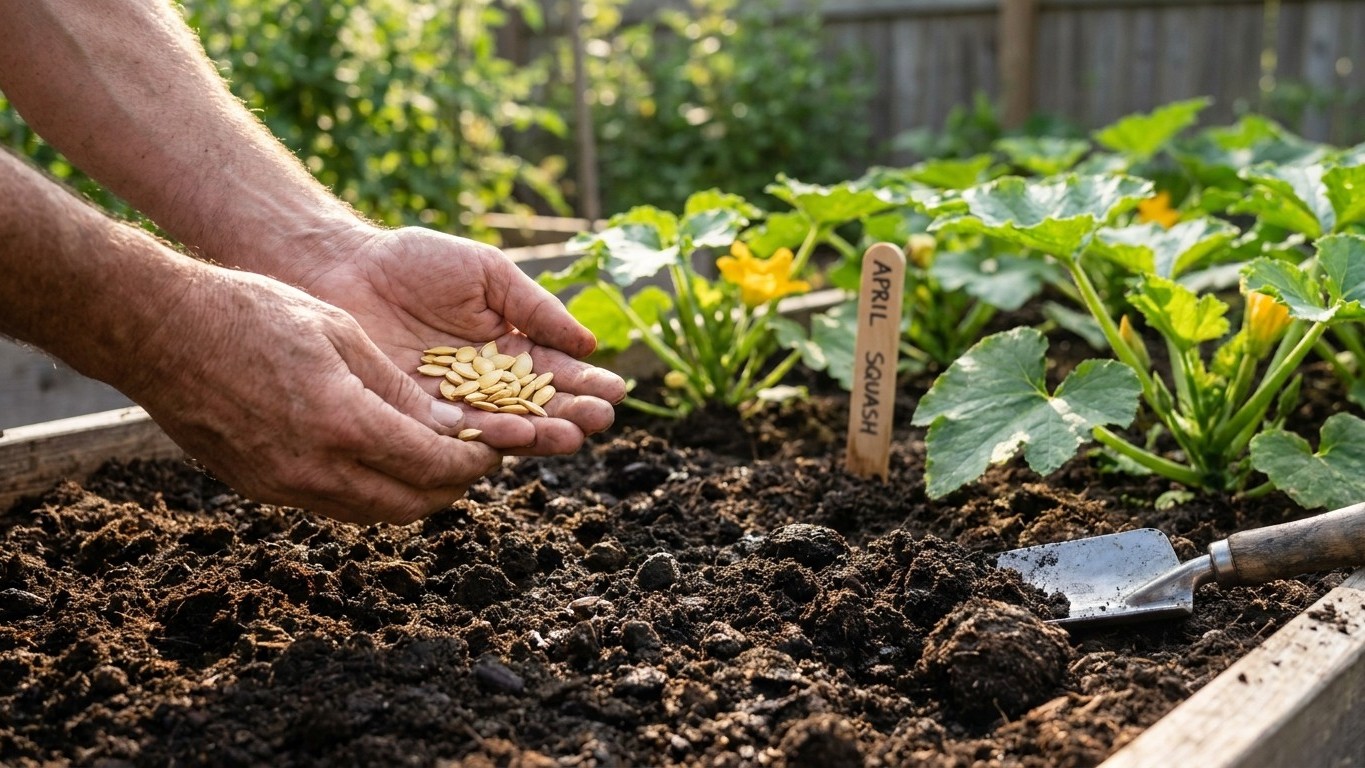

In New Brunswick, summer squash goes into the ground once frost risk has passed in spring and keeps cropping until frost returns in fall, giving a working window of a bit over four months. But the two dates that mark that window are averages pulled from decades of weather records, not fixed calendar days you can circle and trust.
The short answer for New Brunswick
Sow summer squash outdoors after May 23, and expect the season to close around October 2. Those are the two numbers that frame everything else on this page, and they come from Environment and Climate Change Canada’s Climate Normals for the Moncton station, covering 1981-2010.
Here’s what those dates actually mean, and it’s not what most gardeners assume. May 23 is the average last spring frost, not a safe cutoff. Average means half of the past thirty years saw frost fall after that date. So a gardener who sows squash seed outdoors on May 23 every year is planting into frost risk in roughly half of those seasons. The same logic runs in reverse for October 2: it’s the midpoint of when fall frost typically arrives, meaning some years it comes earlier, some later.
Between those two average dates sits a stretch of about 132 frost-free days. Summer squash needs somewhere between 45 and 60 days from transplant or direct sowing to first harvest, depending on variety, so on paper there’s room to spare. The margin exists precisely because the frost dates are unreliable at the edges. Gardeners who sow right on May 23 and lose their first planting to a late frost still have enough season left to resow and harvest before October.
| Milestone | Average date | What it tells you |
|---|---|---|
| Last spring frost | May 23 | Midpoint of risk, not a safe planting date |
| First fall frost | October 2 | Midpoint of when the season ends, not a firm deadline |
| Frost-free window | ~132 days | Buffer built in for a late spring or an early fall |
The practical move most Maritime gardeners settle on is sowing in the first days of June rather than the last week of May, trading a week of growing time for a real drop in frost risk. Given that squash sown even in mid-June still has three and a half months before the average first fall frost, that trade costs almost nothing.
What will not work here
Two things fail here that don’t fail everywhere else, and both trace back to the same fact: this station records zero days a year above 90F. New Brunswick summers simply don’t deliver sustained heat. That’s good news for a plant that stops setting fruit in extreme heat, but it also means varieties bred and marketed for hot southern climates, the ones that boast heat tolerance as their selling point, are solving a problem this region doesn’t have. What actually limits yield here is accumulated warmth over the season, not heat stress, so the traits worth chasing are early maturity and cold-soil vigor, not heat resistance.
The second failure point is moisture management, and it runs opposite to what a hot, dry-summer territory would face. Summer rainfall here averages about 10.5 inches across June, July and August, with August running driest at 3.18 inches. That’s not a drought pattern. Rain arrives fairly reliably through the growing season, which means the common squash-growing habit of watering on a fixed weekly schedule, borrowed from drier climates, tends to oversaturate beds here rather than rescue them. Combine regular rainfall with the humidity that comes off the Bay of Fundy and the Gulf of St. Lawrence, and dense planting becomes the real problem. Squash set close together, or grown under row cover left on too long, trap moisture around the leaves and invite powdery mildew, a fungal disease that thrives in exactly this kind of damp, cool-summer air.
The fix isn’t more water or less water in the abstract. It’s spacing that lets air move between plants, and morning watering rather than evening, so foliage dries before nightfall rather than sitting wet through the cooler night hours that a zero-90F summer delivers in abundance. Gardeners transplanting starts rather than direct-sowing should also resist the urge to crowd rows to make up for a shorter effective season; in a climate without heat stress, airflow does more for yield than density ever will.
What changes across New Brunswick
Everything above is built on one reference point: the Moncton station, sitting at Canadian hardiness zone 5a. That single number does not describe the whole province, and it can’t. New Brunswick stretches from milder coastal pockets along the Bay of Fundy to colder inland and upland areas toward the Restigouche region in the north, and hardiness zones shift with both latitude and elevation across that distance.
The Canadian zone system itself is worth understanding before leaning on it too hard. It’s built from seven climate variables, not one, which is part of why Natural Resources Canada is explicit that Canadian zones don’t convert cleanly to the USDA system used across the border. A Canadian zone 4a, for instance, can overlap nine different USDA zones. So treat the 5a figure here as describing conditions specific to the Moncton area, not the province as a single climate.
What that means practically: a gardener near the Fundy coast, where the ocean moderates temperature swings, likely sees a milder frost pattern than the Moncton normals suggest, while someone farther north or at higher elevation should expect both a later last spring frost and an earlier first fall frost than the dates given above. There’s no single adjustment that covers the whole province, and this page won’t invent one. The honest move is to check the zone for the specific area in question rather than assume Moncton’s number travels.
Natural Resources Canada maintains an interactive plant hardiness map built from the same 1991-2020 normals referenced elsewhere, searchable by municipality, and that’s the tool for narrowing this down rather than guessing from a provincial average.
Where to check this for your own county
This page describes the province through one reference station. That’s useful for a general sense of the season, but a county-level or municipal recommendation will always beat a provincial one, because it’s built from data closer to the actual garden in question.
The federal Agriculture and Agri-Food Canada site, at agriculture.canada.ca/en, is the starting point for that kind of local detail. It’s the resource cited here specifically because it’s confirmed working, unlike some provincial pages that block automated verification. From there, the two things worth searching out are a local or regional planting calendar, since sowing dates shift meaningfully between the Fundy coast, the Saint John River valley, and the northern counties, and any variety trial results for the immediate area, since summer squash cultivars that perform well in one microclimate can lag in another only a couple hours’ drive away.
Provincial and county-level extension resources also tend to track pest and disease pressure specific to a region, which matters more in the Maritimes than the frost dates alone suggest. Powdery mildew pressure, slug activity in wetter years, and squash vine borer range all vary enough within the province that a county-specific note can save a season that a provincial average would not have warned about.
Treat this page as the broad framework: the mean frost dates, the general moisture pattern, the heat load. Treat a county-level source as the correction layer on top of it, the one that accounts for a particular valley, coastline, or elevation this page was never built to capture.
Checking this against your own garden
None of the dates above outrank what a gardener can see and feel in their own soil, and that’s worth taking seriously rather than treating as folk wisdom. Three signs matter more than any calendar date.
- Soil warmth by feel: summer squash seed germinates poorly in cold soil regardless of the calendar date. Pushing a bare hand a few inches into the bed, if it feels merely cool rather than cold, that’s a better readiness signal than the average frost date alone.
- The first flush of male flowers: squash plants typically produce male flowers before female ones, and a strong early flush signals the plant has settled into active growth. A long delay in flowering, well past what the variety’s seed packet suggests, often points to a cooler-than-average microclimate on that specific plot.
- The first true leaves: the initial rounded seed leaves don’t tell much, but the jagged true leaves that follow show whether the plant is actually thriving in that soil and that spot, versus merely surviving.
Read together, these three signs describe the garden’s actual microclimate far than any provincial average can, since they account for local drainage, sun exposure, and soil type all at once. A plot that lags behind the dates on this page one year and matches them the next isn’t inconsistent. It’s just responding to conditions this page was never built to measure at that scale.