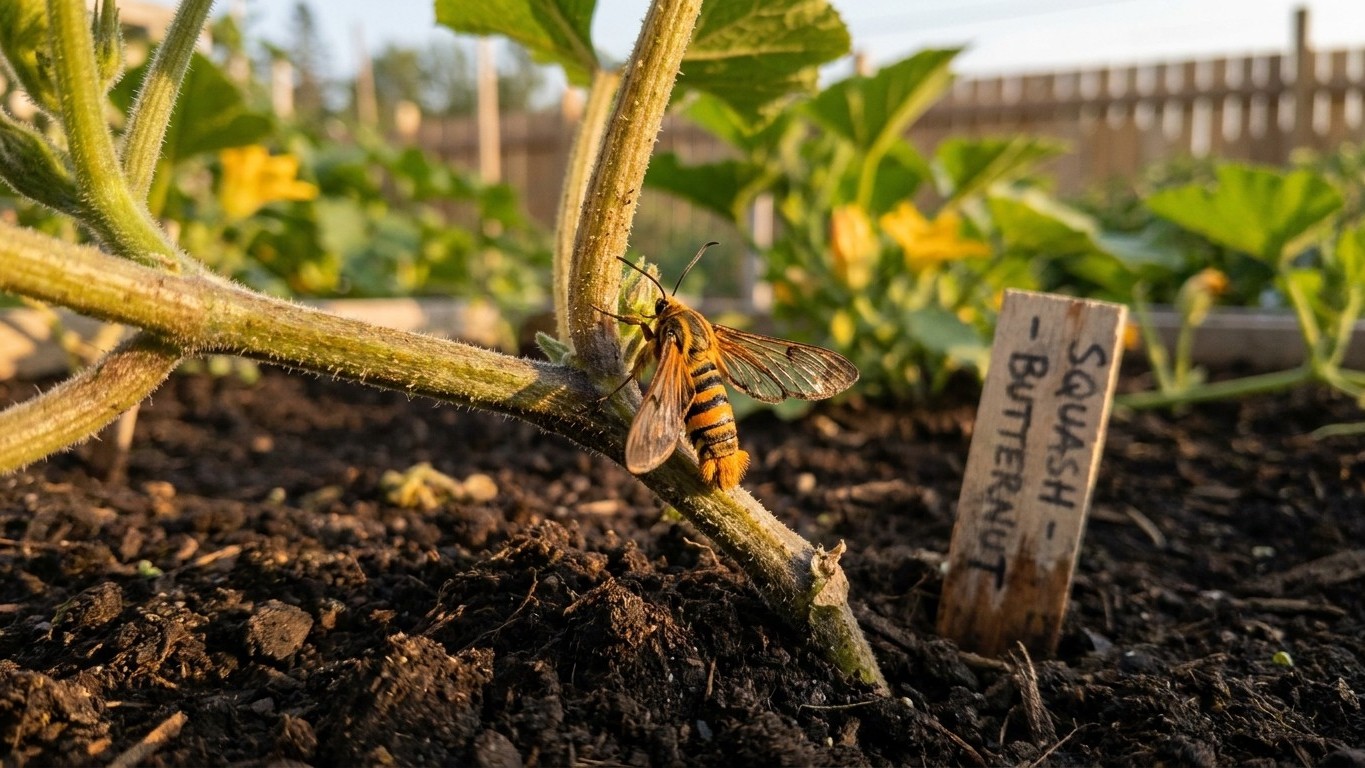

Squash vine borer moths typically start flying in the New Brunswick area between mid-June and early July, with egg-laying activity peaking through the middle of July. The single most effective way to stop them is denying the moth access to the stem base during that window, using row covers, aluminum foil wraps, or delayed planting, combined with quick removal of any vine that starts to wilt before the larvae tunnel deep enough to kill it.
New Brunswick sits in Canadian Plant Hardiness Zone 4b, according to Natural Resources Canada, which puts the average frost-free window from roughly mid-April through mid-October. That six-month growing season is exactly what the squash vine borer (Melittia cucurbitae) needs to complete one full generation, sometimes pushing toward a partial second cycle in an unusually warm year.
The adult moth doesn’t look like a typical moth at all. It flies during the day, has an orange and black body with hairy hind legs, and is often mistaken for a wasp or a large, clumsy bee buzzing around the base of squash plants. That daytime activity is actually useful for gardeners, since it means you can spot the adults on patrol without waiting for dusk.
Cooperative extension entomologists who track cucurbit pests in central New Jersey generally note first adult activity in the last two weeks of June, with the heaviest egg-laying running from early July into early August. Larvae hatch within a week or two of the eggs being laid, immediately burrow into the stem, and feed inside it for four to six weeks before dropping into the soil to pupate. That soil layer, usually one to two inches deep, is also where the insect overwinters as either a larva or a pupa, ready to emerge the following June.
Recognizing an Infestation Before the Plant Collapses

The first visible sign almost never looks like a borer problem at all. A vigorous zucchini or yellow squash plant that suddenly wilts in the middle of a hot afternoon, even though the soil is moist, is the classic red flag. Growers often blame heat stress or root rot, and by the time they realize it’s a borer, the plant has already lost most of its vascular connection to the leaves.
A closer look at the base of the stem tells the real story. Look for a small entry hole, often no bigger than a pencil eraser, surrounded by a sawdust-like frass that’s greenish-yellow and slightly moist, almost like wet sawdust mixed with plant sap. That frass is the larva’s droppings pushed out of the tunnel as it feeds, and it’s the single most reliable diagnostic sign, more useful than the wilting itself.
Splitting open a wilted stem lengthwise, starting an inch or two above the soil line, will usually reveal one or more cream-colored larvae with brown heads, each about an inch long at maturity. Finding them early, while the vine still has some green growth beyond the damaged section, gives you a real shot at saving the plant.
What Actually Stops Squash Vine Borer
Prevention works far better than treatment once the larvae are already inside the stem, because almost nothing sprayed on the leaves reaches them at that point. The most dependable strategies all target the two-week window when adult moths are laying eggs at the stem base.
Floating row covers, put in place at transplanting and kept sealed at the edges with soil or landscape staples, physically block the moth from reaching the plant. The catch is that squash needs pollinators to set fruit, so covers have to come off once flowers open, which is roughly when moth activity is also ramping up. Some gardeners split the difference by covering only through late June, then removing the cover and switching to stem protection for the rest of the season.
Wrapping the lower four to six inches of stem in aluminum foil or a strip of nylon stocking, right where eggs are typically laid, denies the newly hatched larva a soft entry point. It’s a low-cost, physical barrier that a lot of long-time vegetable growers rely on instead of any spray program, and it can be checked and adjusted as the vine thickens.
Staggering planting dates changes the odds significantly. A squash crop started indoors in early April and transplanted out by early May often reaches full size and sets a good chunk of fruit before peak moth activity hits in July. On the other end, a second planting seeded directly in mid-July misses the main egg-laying wave entirely and can produce a clean fall harvest, a technique sometimes called succession planting for borer avoidance.
Not all squash are equally vulnerable. Varieties in the species Cucurbita moschata, which includes butternut and most tromboncino types, have solid, less hollow stems that resist tunneling far better than the hollow-stemmed zucchini and yellow summer squash in Cucurbita pepo. Swapping even half a garden bed to a moschata variety cuts losses noticeably without giving up squash altogether.
Some growers plant a “trap crop” of Blue Hubbard squash along the garden border. Moths strongly prefer it over other varieties, concentrating their egg-laying there instead of on the main crop, which lets a gardener focus removal efforts on just that sacrificial planting.
Sanitation closes the loop for next season. Pulling and destroying every squash vine, healthy or infested, right after harvest removes the larvae and pupae that would otherwise overwinter in the soil beneath the plants. Tilling the bed in fall disturbs those overwintering cocoons further, and rotating squash to a different part of the yard the following year reduces the chance that emerging moths find a host right where they left one.
Chemical Treatments as a Backup, Not a First Move
Insecticide applications only make sense during the egg-laying period, before larvae tunnel in, and they need to target the stem base specifically rather than the whole plant. Products containing spinosad or pyrethrin, applied every five to seven days from late June through mid-July, kill newly hatched larvae before they burrow deep enough to be protected. Once a larva is a half-inch or more into the stem, spraying the surface does essentially nothing.
Some gardeners inject a small amount of Bacillus thuringiensis (Bt) directly into the stem near a suspected entry hole using a syringe, which can knock back a larva that’s already inside without killing the whole vine. It’s fiddly work, better suited to a prized pumpkin plant than a whole row of zucchini, but it has saved individual vines when caught early.
Even a plant that’s already wilting from an active infestation isn’t necessarily a lost cause. Slitting the stem lengthwise over the damaged section, removing the visible larvae by hand, then mounding moist soil over the wound often lets the vine root at that node and keep producing, since squash stems are capable of putting down secondary roots wherever they touch soil.
Related guides
- Squash vine borer in Quebec: When It Shows Up and What Stops It
- Squash vine borer in Nova Scotia: When It Shows Up and What Stops It
- Squash vine borer in Newfoundland and Labrador: When It Shows Up and What Stops It
- Squash vine borer in New Hampshire: When It Shows Up and What Stops It
- Browntail moth in New Brunswick
- Colorado potato beetle in New Brunswick
- Spotted wing drosophila in New Brunswick
- Squash vine borer in Prince Edward Island: When It Shows Up and What Stops It