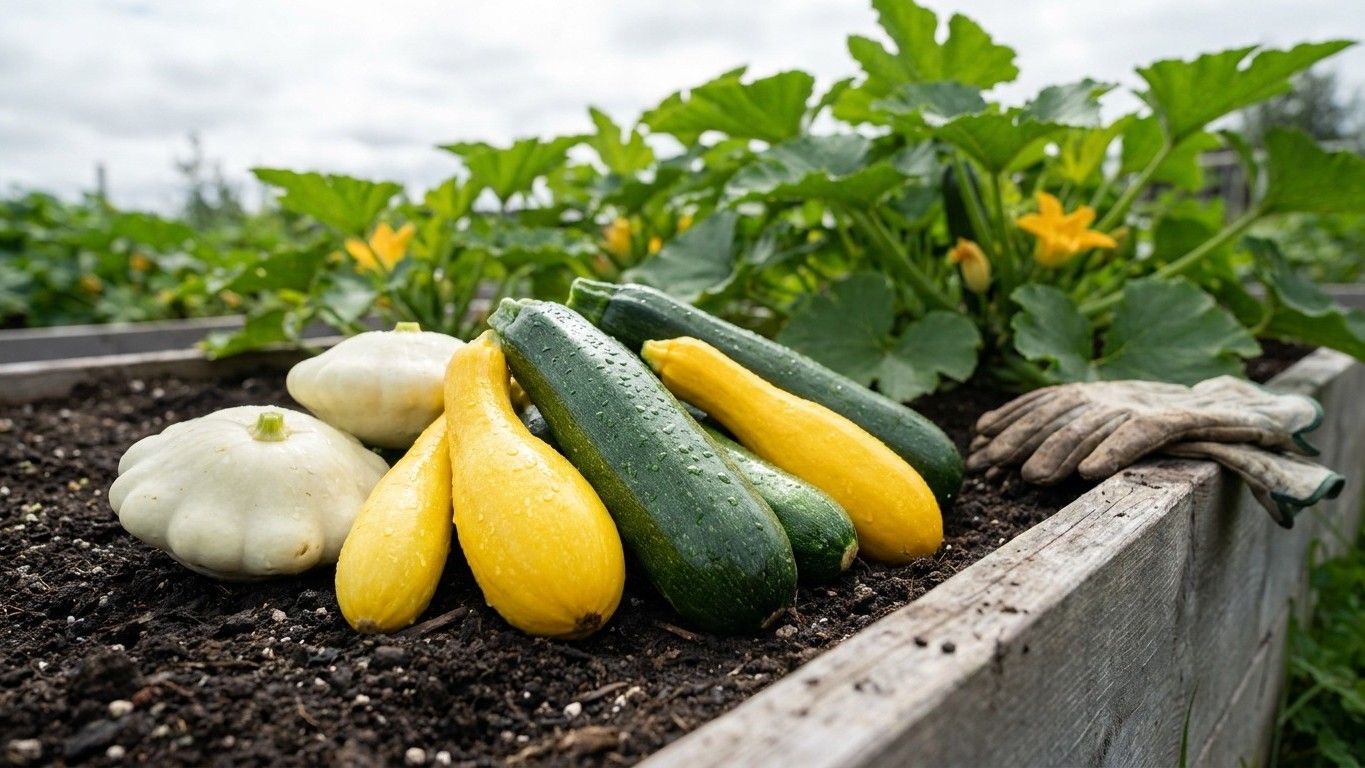

Bush-type zucchini and yellow crookneck squash, started indoors as transplants rather than direct-seeded, are the summer squash that actually finish a crop in the Northwest Territories. The territory’s frost dates leave a growing window that looks generous on paper but is riskier in practice, and almost no summer heat to speed things along. That combination rules out most of what a seed catalog calls “summer squash” before you even get to taste or yield.
The short answer for Northwest Territories
Start with the two numbers that matter most: an average last spring frost of May 25 and an average first fall frost of September 18 at the Yellowknife A station, a spread of about 116 days. That sounds like plenty of time for a squash that needs 50 to 65 days to bear fruit. But both of those dates are means, not guarantees. In roughly half of all years, the last spring frost lands later than May 25, and the same caution applies to the fall date. Treat the 116-day window as the middle of a range, not a promise, and plan for something noticeably shorter.
The other number that shapes the decision is days above 90F: 0.0. Yellowknife’s summer never reaches that threshold, which means there is no heat surplus to bank against a slow start. Every day of the season has to count, because there is no late-July heat wave to push a lagging plant through its final growth spurt the way there might be farther south.
Put those two facts together and the answer sorts itself by type rather than by variety name:
| Squash type | Typical days to maturity | Fit for this territory |
|---|---|---|
| Bush zucchini | 45-55 days | Best fit; short enough to finish inside a tight, uncertain window |
| Bush yellow crookneck/straightneck | 50-60 days | Good fit, especially started as a transplant |
| Vining/trailing summer squash | 65-75 days | Poor fit; needs more warm days than this territory reliably offers |
| Patty pan, standard varieties | 50-60 days | Workable if started indoors, borderline if direct-seeded |
Bush habits mature faster and set fruit closer to the crown of the plant, which matters when every week of the season is scarce. Starting seed indoors three to four weeks before the average last frost, then transplanting once the soil has genuinely warmed, effectively buys back the days that a mean frost date takes away.
What will not work here
Long-season vining summer squash is the first casualty. A variety bred to run 70 or 75 days to first harvest is gambling that the frost-free window holds at its full 116 days, and the frost data here says that is only a coin flip. Lose two or three weeks to a late spring frost, or an early fall one, and a vining type simply never gets there.
Direct-seeding into open ground is the second problem, and it has nothing to do with frost dates directly. Squash seed wants soil in the 70 to 95F range to germinate well, and germination slows sharply below 60F. With zero days a year reaching even 90F in the air, soil temperatures at Yellowknife’s latitude take a long time to climb into that comfortable range, and a seed sitting in cold, damp soil in late May is more likely to rot than sprout. That is why transplants, not direct seed, are the practical starting point across most of this territory.
A third failure mode is treating the average summer rainfall as reliable irrigation. Summer rain here totals about 4.3 inches across June, July and August, and June, the exact month a young transplant needs steady moisture to establish, is the driest of the three at just 1.14 inches. A gardener who assumes “it usually rains enough” and skips watering in that first month after transplanting is likely to watch a slow-growing plant get slower still, right when it can least afford it.
What is not a threat here is heat stress or heat-driven blossom drop, the kind of failure that plagues Summer Squash in hotter states. With no days above 90F on record for the reference station, that particular risk simply does not apply, which is one less thing to manage but not a reason to relax on timing or watering.
What changes across Northwest Territories
The hardiness zone figure available for this page, 1b in the Canadian system, applies to Yellowknife specifically, not to the whole territory. That distinction matters more here than almost anywhere else in this content series: the Northwest Territories stretches from settled communities near the Alberta border to Arctic coastal communities hundreds of miles farther north, and a single zone number for one reference city cannot speak for that entire range.
The Canadian hardiness system is also built differently from the USDA system used elsewhere on this site, drawing on seven climate variables rather than one. That means a Canadian zone 1b location and anything described by a USDA zone number are not on the same scale, and there is no simple conversion between the two. Anyone comparing notes with a gardener in the Lower 48 should treat the zone numbers as describing different things entirely, not as interchangeable shorthand.
What this practically means for a reader in the Northwest Territories is that a community sitting north of Yellowknife, or at a colder microclimate within the same region, should assume a shorter frost-free window than the 116-day figure calculated here, not a longer one. A community farther south, closer to the provincial boundary, may see conditions closer to or slightly better than Yellowknife’s normals. This page cannot tell an individual reader which zone applies to their own yard. That answer comes from checking the official zone map for the specific location, not from applying Yellowknife’s number territory-wide.
Where to check this for your own county
This page describes the territory using one reference station. A community-level answer will always beat it, because it accounts for local elevation, latitude and microclimate in ways a single weather station cannot. The Northwest Territories’ agriculture program, run through the territorial government, is the place to look.
Two things are worth hunting for once there. First, any planting calendar or growing guide specific to your community or region within the territory, rather than a territory-wide generality; growing season length varies enough across the Northwest Territories that a calendar built around one location can mislead a gardener working a very different one. Second, look for any list of varieties that have actually been trialled locally, whether through community garden programs, agricultural extension demonstrations, or local seed-saving networks. A variety that has proven itself in a Yellowknife-area garden, or in Hay River, or Inuvik, carries more useful information than a seed packet’s generic days-to-maturity number, because it has already survived this territory’s particular mix of short season and cool nights.
This page works from territory-wide normals recorded at one station. That is useful for a first-pass decision on plant type and timing, but it is not a substitute for what your own community’s growers and program staff have already learned by trial and error. Treat this article as the starting point, and the territorial program as the source that can narrow it down.
Checking this against your own garden
Once transplants are in the ground, your own observations will tell you more than any calendar date. Three signs are worth watching closely.
Soil warmth, checked by hand rather than instrument, is the first. Push a finger a few inches into the bed before transplanting; soil that still feels cold and heavy to the touch, even after the calendar says the average frost date has passed, is telling you that this particular spot is running behind the territory-wide normal, and that setting plants out now risks the same stall that cold soil causes at germination.
The first flush of male flowers is the second signal. Summer squash typically produces male blossoms before female ones, and a healthy plant growing under decent conditions will show that first flush within a few weeks of establishing. A plant that sits without flowering well past that point is signaling stress, whether from cool soil, insufficient water during that dry June stretch, or a setback at transplanting.
The appearance of the first true leaves, the leaves that emerge after the initial seed leaves and actually look like squash foliage, is the third. Their timing and vigor tell you how well the plant has adjusted to your specific bed, your specific exposure, and your specific soil, all of which vary within a single yard, let alone across a territory this large. A slow, pale set of true leaves is worth investigating before assuming the season will sort itself out on its own.