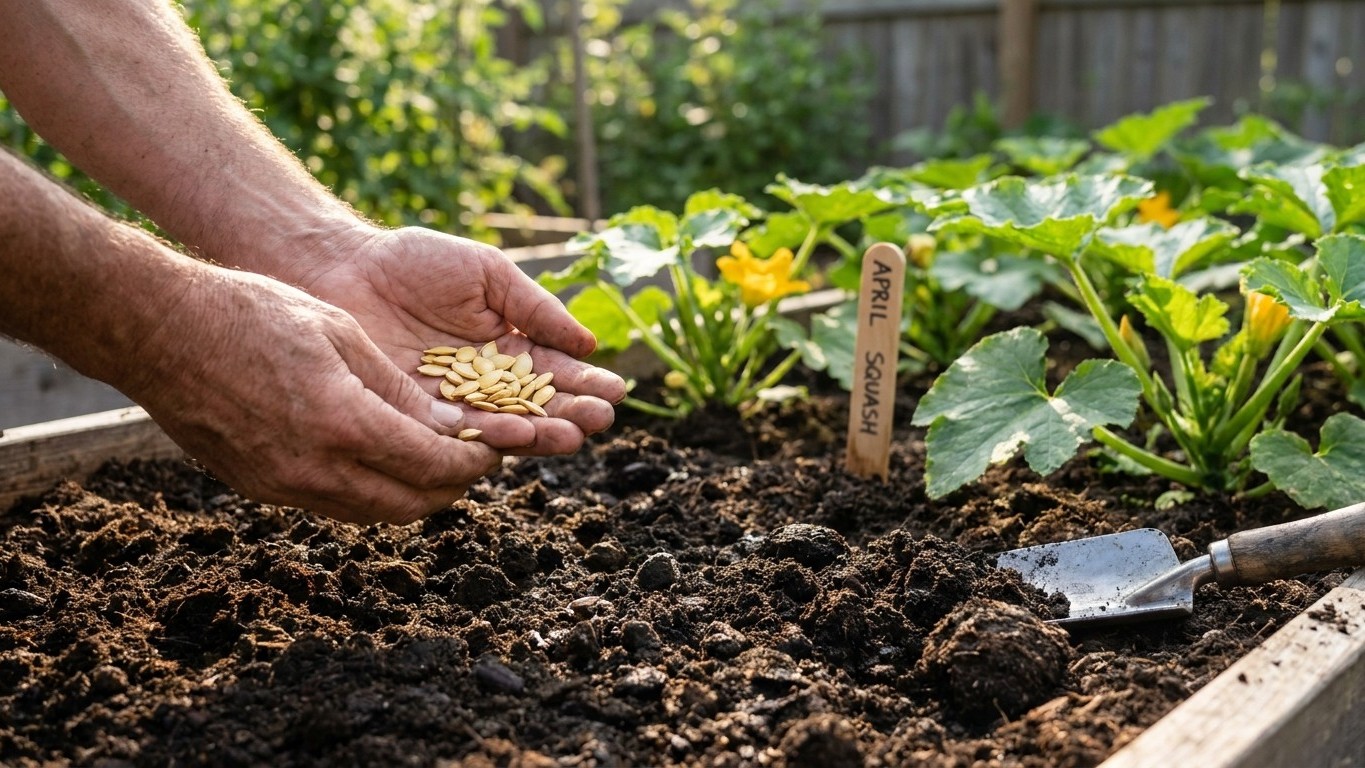

Sow summer squash transplants in Northwest Territories only after the risk of frost has genuinely passed, which averages May 25 at Yellowknife but is a 50/50 midpoint, not a guarantee. With zero days a year above 90°F, cool soil and short heat accumulation are the real constraints here, not scorching summer temperatures.
The short answer for Northwest Territories
The mean last spring frost at Yellowknife A is May 25, and the mean first fall frost is September 18 (Environment and Climate Change Canada, 1981-2010 normals). That gives a mean frost-free window of roughly 116 days. On paper, that sounds like plenty of room for a summer squash crop that typically needs 50 to 65 days to first harvest. In practice, this territory’s numbers pull that math apart.
Start with the frost dates themselves. These are averages, not safe dates: in one year out of two, the last spring frost arrives after May 25, and the first fall frost can arrive before September 18. Anyone treating May 25 as a green light to direct-seed outdoors is betting on a coin flip. The more defensible approach is to start seed indoors three to four weeks ahead, then transplant hardened-off seedlings only once local soil has warmed and the immediate frost risk has clearly passed, typically not before the first days of June for most gardens near Yellowknife, and later still further north.
Then there’s the heat side of the equation, which in Northwest Territories works in the opposite direction from most of the continental United States. Zero days a year reach 90°F here. Summer squash is a warm-season crop that wants steady warmth to germinate quickly, grow fast, and set fruit reliably. Without any hot stretches to push growth along, the “days to maturity” printed on a seed packet, usually calculated in warmer test plots, tends to run longer in practice. A variety rated at 50 days should be treated as closer to 60 in this climate, and a 60-day variety closer to 70 or more.
Put those two facts together and the short answer becomes clear: aim to have transplants in the ground by early-to-mid June, choose the fastest-maturing varieties available, and expect harvest to run later than the seed packet suggests. The margin for error, between a mean frost-free season of 116 days and a crop that may need 65 to 75 days of real growth in cool conditions, is thinner than the raw date math implies.
What will not work here
Direct seeding summer squash straight into outdoor soil in late May is the most common way this crop fails in Northwest Territories. Squash seed germinates poorly in cold soil, and with zero days a year hitting 90°F, this region’s soil simply doesn’t warm the way a Zone 6 or 7 garden’s does by the same calendar date. Seed sown into cool, damp ground in late May often rots before it sprouts, or sits dormant for two or three weeks while slugs and cutworms find it first.
Slow-maturing varieties are the second failure point. Anything rated past about 60 days to maturity is racing against a fall frost that, on average, lands September 18, but can arrive noticeably earlier in a cold year. Add the extra week or two that cool summer temperatures tack onto that maturity rating, and a “65-day” squash variety can easily need closer to 75 to 80 real days here. Planted even slightly late, it never finishes before the cold shuts the season down.
Watering habits imported from warmer, drier states also misfire. Summer rainfall across June, July and August averages about 4.3 inches, with June the driest month at 1.14 inches. That is a modest but not negligible amount, and because there’s no heat load pulling moisture out of the soil quickly, a weekly-watering habit built for a hot, dry state can actually leave squash sitting in soil that’s wetter than the plant wants, particularly on clay ground that holds water for days after a rain. Squash roots that sit in cool, saturated clay are prone to rot long before drought becomes the concern.
Finally, transplanting too early undoes all the careful variety selection in the world. Because the May 25 frost date is a mean, not a safe cutoff, seedlings set out right at that date carry roughly even odds of meeting a late frost. A single cold night can kill young squash outright, since the plant has essentially no frost tolerance at any growth stage.
What changes across Northwest Territories
The hardiness zone figure available for this territory, Canadian zone 1b, applies to Yellowknife itself, the reference station these normals come from, not to the territory as a whole (Natural Resources Canada, Plant Hardiness Site, 1991-2020 normals). That distinction matters more here than almost anywhere else covered by this site. Northwest Territories stretches from boreal forest in its southern reaches to Arctic tundra along its northern coast, spanning a landmass far larger than most U.S. states combined, and climate conditions shift dramatically over that range.
Natural Resources Canada’s zone system is built from seven climate variables, not the single winter-minimum figure the USDA uses, and the agency is explicit that the two systems don’t convert cleanly onto each other. A Canadian zone number a few steps warmer or colder can represent conditions well outside what a similarly-numbered USDA zone would suggest. That’s a separate caution from the geographic one, but both point the same direction: a single zone number attached to one city cannot describe a territory this size.
What a gardener further north or at higher elevation should expect, in general terms, is a shorter effective growing season than the Yellowknife figures suggest, later soil warm-up in spring, and an earlier realistic risk of fall frost than the September 18 mean implies for the reference station. None of that can be pinned to an exact zone number without checking the specific location, and this page won’t guess at what zone any individual reader’s own community falls into.
The right move is to check the interactive map directly at Natural Resources Canada’s Plant Hardiness Site and enter the actual community in question. That gives a real answer, tied to that specific place, instead of a borrowed one from Yellowknife.
Where to check this for your own county
Northwest Territories doesn’t organize agriculture information by county the way U.S. states do, but the same principle holds: a territorial calendar built from one reference station is a starting point, not a final answer, and the local agriculture service will always beat it. The territorial resource to check is the Government of Northwest Territories’ Industry, Tourism and Investment agriculture services page.
Two things are worth looking for once there. First, any planting guidance specific to the reader’s own community or region within the territory, since growing conditions around Hay River, Fort Smith or Inuvik differ meaningfully from those at Yellowknife, even though this page’s frost and heat figures all come from the Yellowknife station. Second, any list of varieties that have actually been trialled locally. Northern and territorial agriculture offices often keep track of which vegetable varieties have performed reliably in short, cool seasons, information that a national seed catalog simply can’t offer because it’s written for growers hundreds of miles south.
This page works from territory-wide normals gathered at a single reference station, which makes it useful for a general sense of the season’s shape, the rough length of the frost-free window, the near-total absence of extreme heat, the modest summer rainfall, but it cannot substitute for guidance rooted in a specific community’s own conditions. A recommendation built around one location will always be a rougher fit than one built around the reader’s actual community. Where those two sources disagree, the local one should win.
Checking this against your own garden
Every date on this page is an average pulled from decades of weather records at one station. A gardener’s own observations, made right there in the yard, will almost always be a better guide to when to act than any calendar figure, because they reflect the actual microclimate the plants are growing in.
Soil warmth is the first and most useful check, and it doesn’t require a thermometer. Squash seed and transplants both want soil that feels genuinely warm and dry-ish to the touch, not just thawed, when a hand is pushed a couple of inches in. Cold, damp soil that still feels raw or chilly, even in late May or early June, is a clear sign the ground hasn’t caught up to the calendar yet, whatever the mean frost date says.
The first flush of male flowers is the second signal, and it tells a grower the plant has moved from vegetative growth into reproductive mode. Squash typically produces several male flowers before the first females appear, and a rush of male blooms is often the earliest visible sign that warmth and light are finally sufficient for the plant to try setting fruit.
The appearance of the first true leaves, the serrated, squash-shaped leaves that follow the rounder seed leaves, is the third marker. Slow, stalled true-leaf development after germination usually points to soil that’s still too cool or light that’s still too weak for the season, a useful early warning before wasted weeks show up as a stunted plant later on.