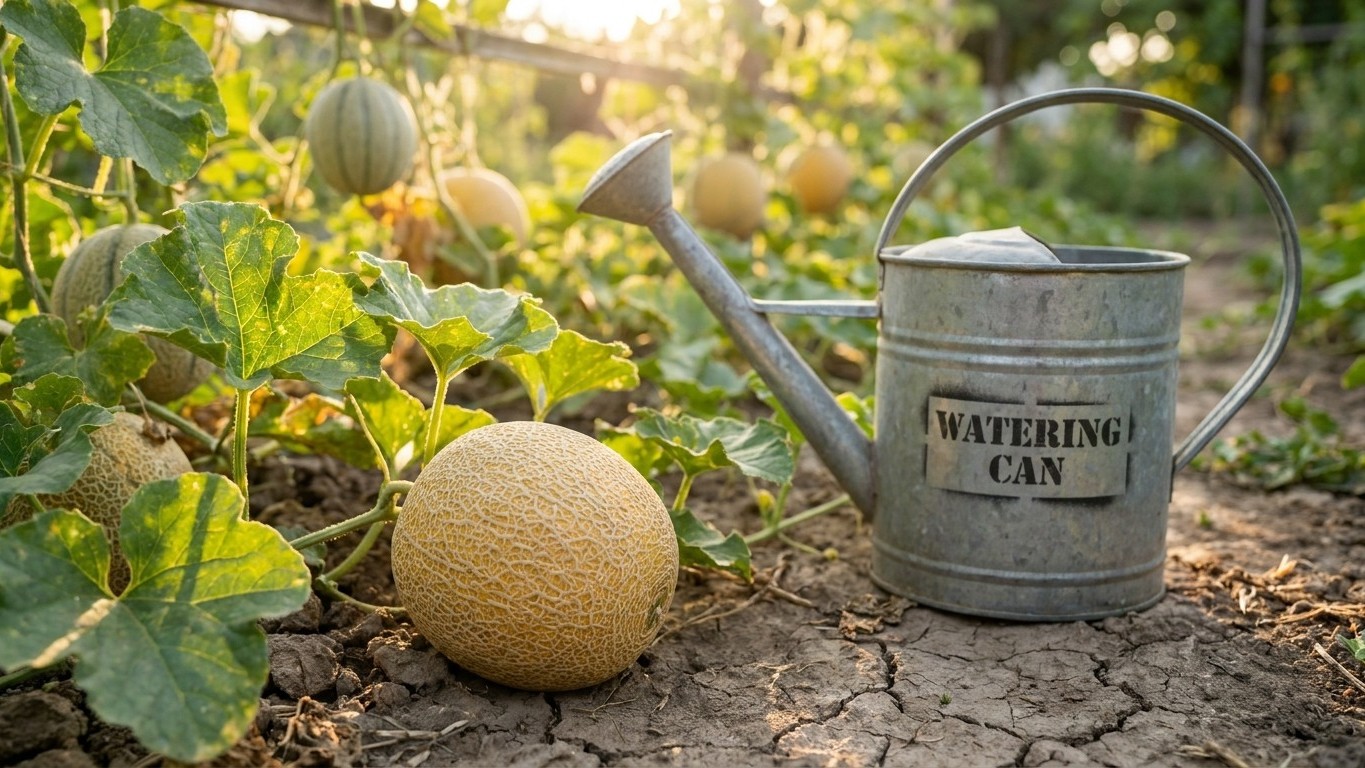

Melons need deep, steady moisture while the vines grow and the fruit fills out, then a hard taper as harvest nears, tailing off to almost nothing in the last week or so. That shift concentrates sugars in the fruit and keeps the rind from splitting. Skip the taper and the plant just keeps doing what it’s told: pulling in water and pushing it straight into the melon.
What is actually going on
A melon is mostly water held inside a rind, and the sugar inside it is a fixed batch, built through the leaves during the weeks of active growth. Once the fruit is close to full size, the plant isn’t manufacturing much new sugar to send in. What it’s still doing is moving water, and water goes wherever the roots find it. If you keep the soil consistently damp right up to harvest, that water has nowhere to go but into the fruit that’s already sized up, and it thins out the sugar concentration that gives a melon its flavor. The technical term gardeners use is dilution, and it’s the reason a melon picked after a heavy watering or a hard rain often tastes flatter than one picked after a dry stretch.
The rind adds a second problem. Melon rind has some elasticity, but it’s not infinite. When water uptake spikes late in the game, usually after a big rain event on the heels of a dry spell, the flesh inside expands faster than the rind can stretch, and the skin gives way in a long crack. That’s a split melon, and it’s not a disease or a pest. It’s hydraulics.
This is also where the biggest misunderstanding about melons causes real damage: a melon does not keep sweetening once it’s off the vine. Unlike a tomato or a banana, melons don’t have a meaningful post-harvest ripening process that adds sugar. What happens on a counter or windowsill after picking is softening of the flesh, not sweetening, and sometimes a bit of aroma development in the skin. The sugar level a melon has the moment the stem parts from the vine is the sugar level it will have on the plate. That single fact is why the watering taper matters so much. You don’t get a second chance at flavor after harvest. Whatever sugar concentration is locked in at picking is the final answer, which is exactly why controlling water in those last two weeks does more for taste than almost anything else a home gardener can do.
For named types suited to a particular season length, the state’s cooperative extension trial results are the reliable source, since performance varies enough by region that a national guide can’t respond to it.
In the garden
Watering a melon crop well means treating it as a curve, not a constant. Early on, the plant wants frequent, shallow moisture to get roots established. Through the middle of the season, it wants deep, consistent water that reaches well below the surface. Near the end, it wants less and less, and eventually almost none. Here’s how that breaks down stage by stage, along with what tends to go wrong at each point.
The watering curve, stage by stage
| Stage | Watering approach | What goes wrong if you get it wrong |
|---|---|---|
| Seedling and establishment | Light, frequent watering to keep the top few inches of soil consistently moist while roots are shallow | Letting this stage dry out stunts root development before the plant ever gets going; overwatering here tends to invite damping-off and weak stems |
| Vine growth (vegetative stretch) | Deep watering less often, encouraging roots to grow down rather than stay near the surface | Shallow, frequent watering in this window trains a shallow root system that struggles the moment summer heat arrives |
| Flowering and fruit set | Steady, even moisture with no big swings between wet and dry | Letting the soil dry hard and then flooding it back tends to cause blossom drop and poor fruit set, since the plant sheds flowers under stress |
| Fruit sizing (bulking up) | Continued deep, consistent watering, ideally on a regular schedule rather than reactive bursts | Inconsistent watering during sizing is the classic cause of misshapen or undersized fruit, and it sets up the splitting risk that follows later |
| Final one to two weeks before harvest | Taper sharply, cutting back to well below the sizing-stage amount, and stop entirely in the last several days if rain isn’t doing the job | Keeping full watering going here dilutes sugar and drives splitting; cutting water off too early, weeks before the fruit is near mature, can stall sizing and leave melons undersized |
Mulch does real work in that final stretch. A layer of straw or similar organic mulch keeps soil temperature and moisture more even, which matters most right when you’re trying to control water precisely. It also keeps the fruit off bare, hot soil, which helps with rot and pest issues that have nothing to do with watering but tend to show up at the same point in the season.
Timing the taper against the calendar doesn’t work well, since melons don’t ripen on a fixed schedule. It works far better to time it against the fruit’s own signs of maturity, which brings up the regional piece of this.
What it depends on where you are
Everything above describes a mechanism that holds true everywhere melons are grown: dilution and splitting happen because of water physics, not local climate. What varies by region is the timing and the margin for error around that mechanism.
A short growing season compresses the whole curve. Gardeners working with a tight window between last frost and first fall frost have less time for vines to establish, less time for fruit to size, and a narrower final stretch in which to manage the taper. Get the taper wrong there and there may not be time to recover before frost ends the season anyway.
Summer heat changes water demand directly. In regions with intense, sustained summer heat, soil dries faster and plants pull water harder, which means the deep watering during the sizing stage needs to happen more often just to maintain the same soil moisture level. It also means the final taper needs to be watched more closely, because a hot spell can dry soil out fast enough to stress the plant even while you’re deliberately cutting back.
Summer rainfall is probably the biggest wildcard. Gardeners in regions with reliable dry summers can control the taper almost completely, since they decide how much water the plant gets. Gardeners in regions with frequent summer thunderstorms are managing around the weather instead, and a heavy rain in that final week can undo careful tapering in a single afternoon. Raised beds, ridged rows, or plastic mulch that sheds water are common local responses to that problem, and it’s worth checking whether growers in a humid region handle drainage differently than growers in an arid one.
Because season length, heat, and rainfall patterns are specific to each state and often to each county, this page isn’t the right source for a planting date or a target harvest window. The state’s cooperative extension service and the state-specific growing guides on this site are built to answer that part.
The mistake that costs the most
The single most expensive mistake with melon watering is keeping the full, generous watering schedule going right up until harvest day, on the logic that more water means a bigger, juicier melon. It’s an understandable instinct. It’s also backwards for this crop in its final two weeks.
What that mistake actually produces is fruit that looks impressive on the vine and disappoints on the plate: watery, less sweet flesh, sometimes a cracked rind from a late watering or rain event that pushed the fruit past what its skin could hold. The fix isn’t complicated, but it does require paying attention rather than running the irrigation on autopilot. Once fruit on the vine looks close to full size for its type, start watching the signs of approaching maturity that are relevant to that melon, whether that’s a color shift on the skin, a change at the point where the fruit touches the ground, drying at the point where the stem meets the vine, or an easing loose at that same stem joint. Different melon types show maturity differently, and the state extension resources for the type being grown will describe the specific signal to watch for.
The moment those signs start showing up, that’s the cue to taper water hard, not the calendar and not the size of the fruit alone. And it’s worth repeating the point from earlier, because it’s the reason this mistake is so costly and so hard to undo: once a melon comes off the vine, its sugar level is set. There’s no windowsill fix, no extra day on the counter that brings back sweetness that dilution washed out in the final week of growth. The watering decision made in that last stretch is, in a very real sense, the last decision that affects flavor at all.