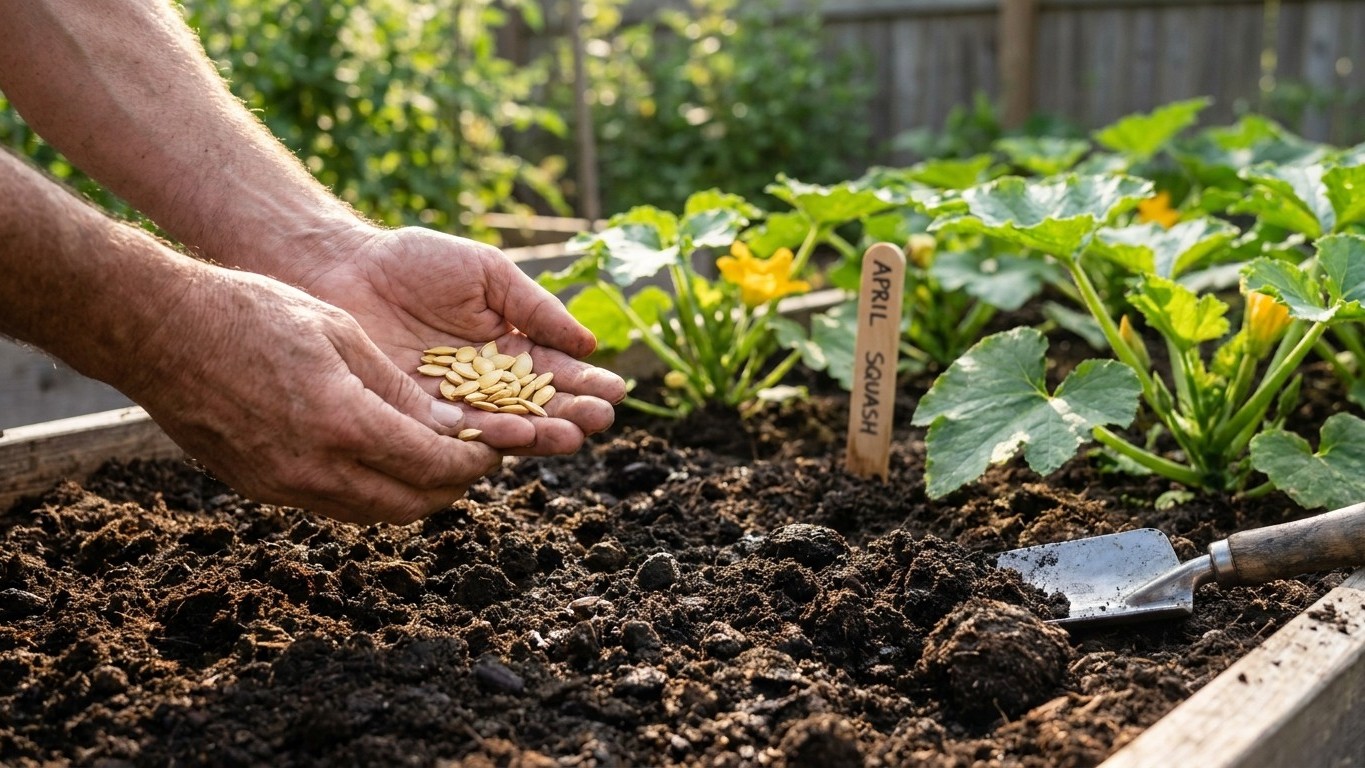

Summer squash goes into Prince Edward Island soil after the frost risk has genuinely passed, not on the calendar date that gets quoted most often. The average last spring frost at Charlottetown is May 16, but that number is a midpoint, not a guarantee. Understanding what that midpoint actually means changes when a PEI gardener should trust the ground and the seed packet.
The short answer for Prince Edward Island
Direct-seed or transplant summer squash outdoors from late May through the first week of June. That window sits deliberately after May 16, the average last spring frost recorded at the Charlottetown A station under Environment and Climate Change Canada’s 1981-2010 climate normals. The word “average” matters more than usual here: in one year out of two, the last frost lands after May 16, not before it. Treat May 16 as the center of a range, never as a green light on its own.
Summer squash is frost-tender at every stage, cotyledon through fruit. A frost any time after seeding can kill young plants outright, and a cold snap even without frost slows germination to a crawl in soil that hasn’t warmed enough. Waiting until the very end of May, or starting transplants indoors three to four weeks before that so they go into the ground with a head start, gives a buffer against the years when the “average” date runs late.
On the back end, the average first fall frost at the same station is October 17. That gives a mean frost-free stretch of roughly 154 days between May 16 and October 17, which is generous for a crop that typically produces its first fruit 45 to 60 days after seeding. Even accounting for a late spring and an early fall, most summer squash varieties have room to mature and keep producing for weeks before frost shuts the season down.
What this page can’t do is tell an individual gardener their own frost dates. Charlottetown A is one weather station representing one location. A garden in a low-lying inland spot, or one thirty miles up-island, can see frost days or weeks apart from what the station records. The planting window above is a province-level starting point, refined later in this page by hardiness zone spread and, more usefully, by the reader’s own soil and plants.
What will not work here
Two failure modes show up more than any others on this island, and both trace directly back to the climate normals above.
Seeding too early into cold soil
Because the average last frost is May 16, and because that date runs later in half the years on record, seed sown in early May sits in soil that’s often still too cold for squash to germinate reliably. Squash seed wants soil in the 60s Fahrenheit to sprout with any vigor; cold, wet soil in early May more often rots the seed than grows it. Pushing the date earlier to chase a longer season is a common instinct, and on PEI it’s usually the wrong one.
Tight spacing bred for drier, hotter climates
Charlottetown averages 0.0 days a year above 90°F. That’s not a typo, it’s a genuine maritime summer: mild, humid, rarely scorching. Summer rainfall averages about 10.8 inches across June, July and August, spread fairly evenly across the three months (June 3.89 inches, July 3.15, August 3.77). That’s enough regular moisture that a garden rarely goes bone-dry for long, but it also means the air stays damp for extended stretches, especially in low, poorly ventilated corners of a yard.
Planting layouts designed for hot, dry inland climates, where growers pack squash tightly to shade the soil and conserve water, work against a PEI gardener. Tight spacing here traps humidity around the leaves and fruit, and powdery mildew and other fungal issues move in faster in that kind of still, damp air. Wider spacing than a seed packet written for a hotter, drier region recommends, plus rows oriented to catch prevailing wind, does more good on this island than any amount of extra watering.
Finally, varieties bred specifically for high heat tolerance, the kind marketed for gardens that regularly clear 95°F, gain nothing here and sometimes underperform, since they’re often selected for heat-set fruiting rather than the mild, even warmth PEI actually supplies.
What changes across Prince Edward Island
The hardiness zone figure available for this province, 5b under the Canadian system, is drawn from the Charlottetown reference city in Natural Resources Canada’s Plant Hardiness data (1991-2020 normals). It is not a province-wide number, and it is not a USDA zone. The Canadian system is built from seven climate variables rather than the single minimum-temperature measure the USDA uses, so a Canadian 5b cannot be lined up against a USDA zone map at all, let alone treated as interchangeable with hardiness numbers used elsewhere on this site.
Prince Edward Island’s coastline, its central agricultural belt, and its more sheltered or exposed pockets do not all warm at the same pace in spring. A garden close to the moderating water along the coast often sees a gentler, later frost pattern than one further inland, where cold air can pool overnight even in May and June. That difference can shift a realistic seeding date by a week or two in either direction from the province-level window given above.
This page can’t assign a reader to a specific zone or tell them whether their own plot runs warmer or cooler than Charlottetown. Natural Resources Canada’s interactive hardiness map lets a gardener check the zone for their own municipality directly, and that’s the right next step before adjusting the planting window described here. Anyone gardening well inland, at higher elevation, or in a known frost pocket should treat the late May start as a floor, not a target, and lean toward the first week of June instead.
Where to check this for your own county
This page gives Prince Edward Island’s provincial picture, built from a single reference station in Charlottetown. A county-level or parish-level recommendation, based on trials and observations closer to a specific garden, will always beat a province-wide average, because it accounts for local soil, drainage and microclimate in a way a single weather station never can.
The Government of Prince Edward Island’s agriculture portal, at princeedwardisland.ca/en/topic/agriculture, is the place to look for that finer detail. Two things are worth searching for specifically once there: any local or regional planting calendar published for home gardeners or small growers in Kings, Queens or Prince County, and any list of vegetable varieties that have actually been trialled or recommended for the island’s growing conditions rather than for Canada broadly.
Provincial agriculture offices update this kind of guidance more often than climate normals get revised, and they’re built from feedback and trial plots closer to the ground than a single airport weather station. Where the two sources disagree, the local one should generally win, since it reflects conditions closer to an actual garden rather than an averaged reference point drawn from decades of data at one site.
Checking this against your own garden
Every date on this page is a starting estimate. A gardener’s own observations, made right on the plot where the squash will actually grow, outrank all of it once the season is underway.
Soil warmth by feel is the first and most reliable check. Pushing a bare hand a couple of inches into the planting bed in mid-morning gives an honest read: soil that still feels cold and damp, even well into late May, is telling a gardener to wait regardless of what the calendar says. Soil that feels comfortably warm to the touch, similar to a mild day’s air temperature, is a much better cue that germination will go well.
The first flush of male flowers is the second signal worth watching. Summer squash typically produces male blossoms before female ones, sometimes by a week or two, and an early, strong showing of male flowers usually means the plant found the season’s warmth to its liking and is on schedule to set fruit soon after.
The appearance of the first true leaves, the serrated squash-shaped leaves that follow the smooth, rounded seed leaves, marks the point where a plant has moved past its most fragile stage. Slow, stunted true-leaf growth after a normal germination often points to a cool spell or a spot in the yard that runs colder than the rest of the garden, information worth remembering for next year’s planting plan as much as for this one.