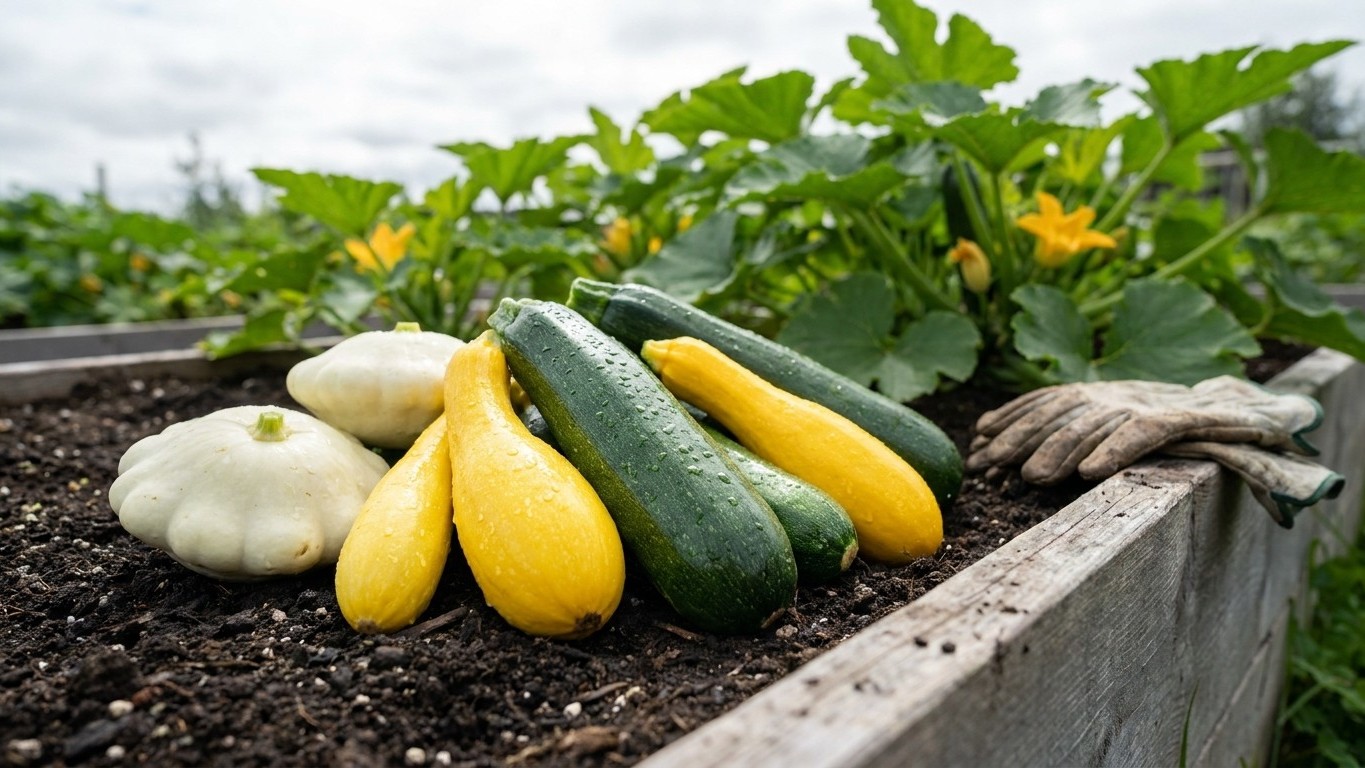

For Prince Edward Island’s short, cool-summer growing season, bush-type zucchini and yellow straightneck squash are the safer bets over sprawling or slow-to-mature varieties. With zero days a year averaging 90°F or hotter and a frost season that only fully clears in mid-May, summer squash here needs to be quick off the mark and tolerant of cool nights rather than built for scorching heat.
The short answer for Prince Edward Island
Start with the numbers that actually shape the decision. Charlottetown’s climate normals put the last spring frost at May 16 on average and the first fall frost at October 17, which works out to roughly five months of frost-free growing in a typical year. That sounds workable for summer squash, which usually needs 45 to 60 days from seed to first harvest. The catch is that May 16 is a mean date, not a guarantee: in half the years on record, frost showed up after that date. Planting squash transplants into the ground on May 17 is a coin flip, not a plan.
Add to that a summer with zero days reaching 90°F. Summer squash is a warm-season crop that pushes hardest when soil and air are genuinely hot, and PEI simply doesn’t deliver that kind of heat load. Growth will be steadier and slower than what a grower in a hot inland state would see, even with the same seed packet. That single fact, no 90-degree days at all, is the biggest reason to lean toward fast-maturing, compact types rather than anything bred for long, blazing summers.
Which types make sense here
Given a hardiness zone of 5b (Canadian system) at the reference station and a cool, moderate summer, three general types of summer squash suit the island best:
- Bush zucchini — compact plants that mature quickly and don’t need a long heat run to start producing.
- Yellow straightneck and crookneck squash — similarly fast, and generally tolerant of the cooler nights that come with PEI’s maritime climate.
- Scallop or pattypan types — compact growth habit, though they tend to run a touch slower to first harvest than straight zucchini, so they’re worth choosing only if the calendar allows a bit of margin.
Vining or trailing summer squash varieties bred for long, hot growing seasons are the ones to skip. They ask for more heat and more time than this island’s summer reliably supplies, and by the time they’d be hitting stride here, the October frost date is already close.
What will not work here
The clearest failure mode on PEI is choosing a summer squash variety on the slow end of the maturity range and expecting it to catch up once summer arrives. It won’t, because summer here never arrives with the heat those varieties are counting on. A plant that needs consistent 85°F-plus days to size up quickly is working against a climate that averages zero days above 90°F all year. The plant survives. It just produces late, and often produces less, because the growing degree-days it needs simply aren’t in the ledger.
Second failure: planting on the calendar instead of the ground. Because May 16 is a mean frost date pulled from 1981-2010 normals at the Charlottetown A station, treating it as a safe transplant date is a mistake baked into the statistics themselves. Half of all years see frost land later than that. Tender squash seedlings set out on May 16 in a year running late are gambling with a crop loss in the first two weeks.
Third, and less obvious: assuming the region is dry enough that spacing plants close together won’t matter. Summer rainfall here runs about 10.8 inches across June, July and August, with July the driest month at 3.15 inches. That’s a moderate, fairly steady rainfall pattern, not a drought pattern. Combined with cool nights and maritime humidity, tightly spaced summer squash plants are more prone to powdery mildew and other foliar problems than they would be in a hot, dry inland climate where the same spacing might be fine. Give plants the fuller end of their recommended spacing here, and prioritize airflow over cramming more plants into a bed.
Finally, don’t plan on a late-summer succession sowing the way a grower further south might. With an average first fall frost of October 17, a second round of summer squash sown in early August is racing a clock that, in a normal year, gives it barely two months before frost risk returns. It can work in a warm year. It’s a poor bet to build a harvest plan around.
What changes across Prince Edward Island
The 5b hardiness rating that applies here comes from the Charlottetown A reference station, not from the island as a whole. Prince Edward Island is not one uniform climate: coastal areas moderated by the surrounding water tend to see milder winter lows and slightly later spring warm-ups, while inland and northern districts away from that moderating effect can run measurably colder in winter and slower to warm in spring. Natural Resources Canada’s own hardiness data makes clear that a single zone number tied to one reference city doesn’t describe an entire province, and PEI’s geography, a narrow island fully exposed to Gulf of St. Lawrence and Northumberland Strait influences, is exactly the kind of place where that gap shows up.
What that means practically: a gardener near the coast may find soil warms and frost clears close to the Charlottetown averages, while someone further inland or in a low-lying frost pocket could be looking at conditions running a week or two behind. Since this page can only speak to the reference station’s numbers, it can’t tell an individual reader which side of that spread their own garden falls on.
The right move is to check Natural Resources Canada’s Plant Hardiness Site, which maps zones by municipality rather than by a single provincial average. That map won’t replace watching your own soil and plants, but it narrows the range considerably compared to relying on one island-wide number pulled from a single station.
Where to check this for your own county
This page gives a provincial-level answer built from one reference station’s climate normals. That’s useful for setting expectations, but it’s not a substitute for what the Prince Edward Island government’s agriculture resources publish for local growers. The relevant page is princeedwardisland.ca/en/topic/agriculture, and it’s worth checking directly rather than assuming this page has already covered everything it offers.
Two things are worth hunting for there specifically. First, any local planting calendar or seasonal guidance that reflects conditions closer to a specific county, Prince, Queens or Kings, rather than the single Charlottetown-based average used throughout this page. Local guidance tends to build in the kind of microclimate knowledge that a province-wide normal simply can’t capture. Second, look for any information on summer squash varieties that have actually been grown or trialed in island conditions. A variety that’s performed well in local trials carries more weight than a general recommendation based on maturity days and heat tolerance alone, because it’s already been tested against the real thing, PEI’s short, cool, maritime summer.
A county-level or provincially-tested recommendation will always outrank the general guidance on this page, because it accounts for local soil, local rainfall patterns and local frost behavior in a way a single reference station can’t. Treat this article as the starting framework, and the provincial agriculture resources as the fine-tuning.
Checking this against your own garden
None of the dates or averages above beat what’s actually happening in your own soil. Three simple observations tell you more about your specific microclimate than any provincial normal.
Feel the soil itself before setting out transplants or direct-seeding. Summer squash seed germinates poorly and slowly in cold soil, no matter what the calendar says. If a handful of soil from a few inches down feels cool and heavy rather than close to room temperature, the ground hasn’t caught up yet, regardless of whether the calendar has passed the average frost date.
Watch for the first flush of male flowers. Summer squash plants typically produce male blossoms before female ones, and a strong early showing of males is a sign the plant is settling in and building energy for the fruiting flowers to follow. A long delay before any flowers appear, well past what the seed packet suggests, often points to a colder or shadier spot than expected.
Track how fast the first true leaves develop after the seedling stage. Quick, sturdy true-leaf growth signals the plant has found enough warmth and light to move. Slow, pale, or stalled growth at that stage is usually the plant telling you the site runs cooler than the general island averages suggest, and that adjusting expectations, or the planting spot, makes more sense than fighting the calendar.