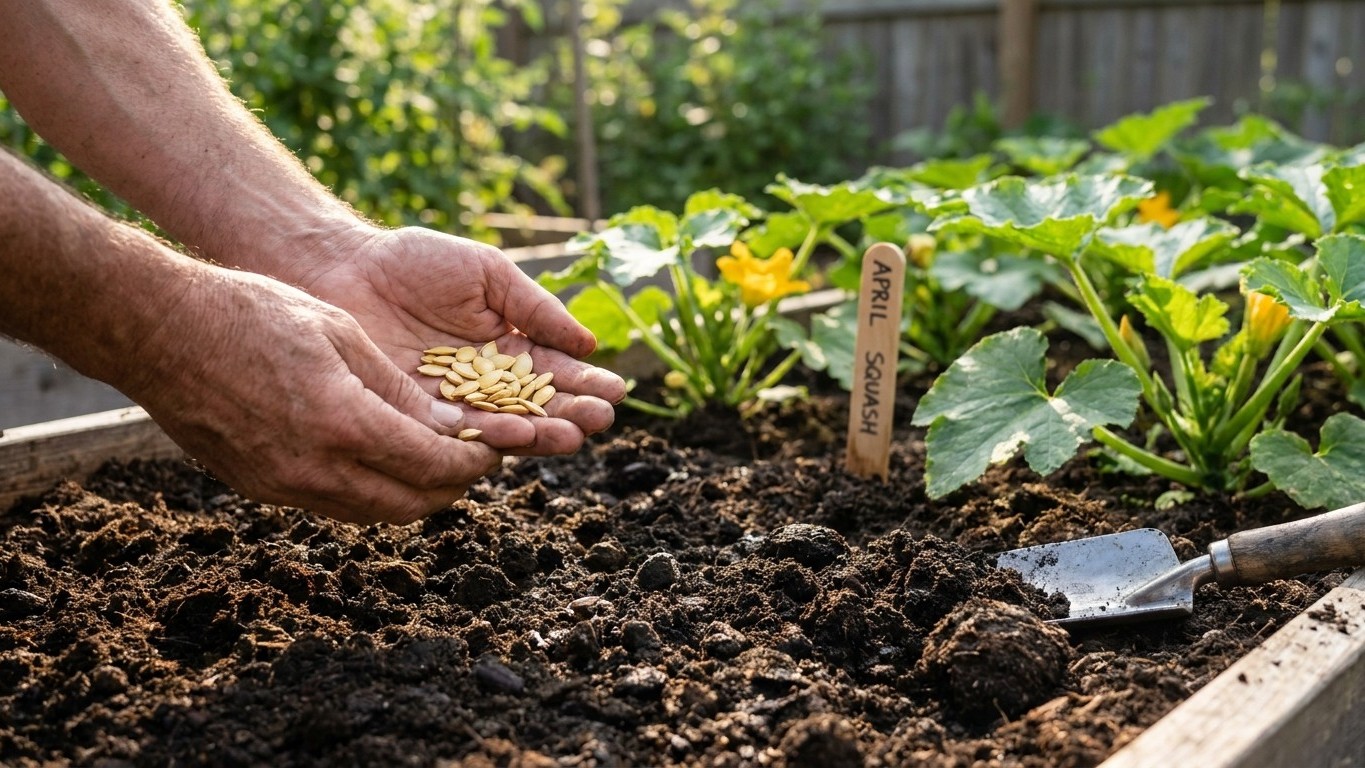

Sow summer squash outdoors in Quebec once the mean last spring frost date of May 6 has passed, and count on harvesting well before the mean first fall frost of October 5. But that May 6 date is an average, not a promise, and the safe window shifts depending on where in the province you garden.
The short answer for Quebec
Summer squash needs warm soil to germinate well, and the mean last spring frost recorded at the Montreal/St-Hubert reference station is May 6. Direct-seeding right on that date is risky: this is a mean date from Environment and Climate Change Canada, not a probability band, which means that in roughly one year out of two, frost actually arrives later than May 6. Treat it as the midpoint of a window, not a green light.
A more realistic direct-seeding window runs from mid-May into the first week of June, once soil has had time to warm past the point where squash seeds simply sit and rot. If you start seeds indoors, three to four weeks before that mean frost date puts your sowing date in mid-to-late April, with transplants going out once nights have settled, generally not before the very end of May.
The good news is that summer squash does not need much runway. Most varieties mature in 50 to 65 days from seed, and the gap between the mean last spring frost (May 6) and the mean first fall frost (October 5) works out to roughly five months. Even a cautious gardener who waits until the first week of June to sow still has a comfortable margin before that October frost date shows up, on average.
None of this changes because of heat. The Montreal reference station records 0.0 days a year above 90 degrees Fahrenheit, so this is not a climate where squash is racing against scorching afternoons. The constraint here is frost at both ends of the season, not heat stress in the middle of it.
What this means for your sowing date
If you garden close to the St. Lawrence valley and want a buffer against a late frost, plan to direct-sow in the last third of May rather than the first week of the month. If you are further north or at higher elevation, everything in this calendar needs to shift later still, a point covered in more detail below.
What will not work here
Sowing summer squash before mid-May, on the assumption that May 6 is a safe cutoff, is the single most common way to lose a planting in this region. Because that date is a statistical mean, half of all years see frost arrive after it. A cold snap in the second or third week of May is not a freak event here, it is a coin flip.
Chasing heat-tolerant varieties bred for scorching summers is also wasted effort. With zero days a year averaging above 90 degrees at the reference station, this climate never puts squash under the kind of heat stress that causes blossom drop or bitter fruit in hotter states. Varieties marketed for heat resistance offer no real advantage here; maturity speed and disease resistance matter far more than heat tolerance.
Assuming the region is wet enough to skip watering is another mistake. Summer rainfall across June, July and August averages about 10.6 inches, but it is not evenly spread, and June, the exact month when spring-sown squash is establishing its root system, is the driest of the three at 3.42 inches. A gardener who sows in late May or early June and then assumes summer rain will handle watering can end up with a stressed, slow-starting plant right when it needs consistent moisture most.
Relying on the first fall frost date as a hard backstop for late plantings is equally risky, for the same reason as the spring date. October 5 is a mean too, which means some years bring frost earlier. A gardener who delays sowing into late June, banking on a full run to early October, is gambling against the same kind of variability that makes the spring date unreliable.
Finally, dense spacing modeled on drier climates does not translate well here. Summer rainfall in the 10 to 11 inch range over the growing season, combined with the humidity that typically accompanies it in the St. Lawrence lowlands, favors the kind of powdery mildew and fungal pressure that thrives when squash leaves stay damp and airflow is poor. Spacing that might be fine in a drier, sunnier climate can leave Quebec plants more vulnerable to disease.
What changes across Quebec
The hardiness zone figure available for this region, 5b, comes from Natural Resources Canada and applies specifically to the Montreal/St-Hubert reference area, not to the province as a whole. Quebec stretches from the St. Lawrence lowlands near Montreal up through the Laurentians, the Eastern Townships uplands, and far north into regions Natural Resources Canada rates considerably colder. There is no single hardiness zone, and no single planting calendar, that honestly covers a province this large.
It is also worth flagging that the Canadian zone system behind that 5b figure is built on seven climate variables, not the single minimum-temperature measure used in the USDA system familiar to American gardeners. Natural Resources Canada itself states there is no simple conversion between the two, so this number should never be read against a USDA zone map or treated as directly comparable to hardiness figures published for US states.
Adjusting for the north or for altitude
A gardener in a northern district, or at meaningfully higher elevation than the St. Lawrence valley, should expect the last spring frost to arrive later than May 6 and the first fall frost to arrive earlier than October 5, compressing the safe growing window from both ends. In practice, that means pushing sowing dates later into late May or even June, and favoring faster-maturing summer squash varieties that can reliably finish within a shorter frost-free stretch.
Because this page works from a single reference station, it cannot responsibly tell an individual reader which zone their own property falls into. That is exactly what the Natural Resources Canada Plant Hardiness map is built for, and it is the right tool to check before adjusting these dates for your own location.
Where to check this for your own county
This page reflects provincial-level normals drawn from a single reference station near Montreal. Quebec’s actual growing regions vary enough that a county or regional recommendation will always beat a province-wide one, and that gap matters more here than in smaller states.
The place to check is Quebec’s Ministère de l’Agriculture, des Pêcheries et de l’Alimentation (MAPAQ). Look specifically for two things once there: a regional planting calendar that reflects your own district’s frost dates rather than the Montreal-area normals used on this page, and any list of summer squash varieties that have actually been trialled in your part of the province. Varieties that perform well in the milder St. Lawrence valley are not necessarily the ones recommended for the Saguenay, the Gaspé, or higher-elevation growing areas.
This is not a formality. A regional agricultural service works from local trial data and local frost records, not a single reference station’s 1981-2010 normals. If MAPAQ’s regional guidance and this page’s dates disagree, the regional source should win, because it is built specifically for conditions this page cannot capture at a provincial scale.
Checking this against your own garden
No calendar date, including the ones on this page, replaces what your own garden is telling you. Three observations matter more than any published frost date once the season is underway.
Soil warmth by feel comes first. Summer squash seed sitting in cold, wet soil simply stalls or rots rather than germinating, regardless of what the calendar says. If a handful of soil at planting depth feels cold and damp rather than merely cool, it is worth waiting, even past the dates suggested above.
The first flush of male flowers is the next signal worth watching. Summer squash typically produces male flowers before female ones, and their timing gives a rough read on how the plant is responding to your specific yard’s light and warmth, which can run ahead of or behind the regional normals depending on exposure, wind, and nearby structures.
The appearance of the first true leaves, the leaves that follow the initial rounded seed leaves and actually look like squash foliage, marks the point where a plant has moved past its most fragile stage. A slow gap between germination and true leaves often points to a microclimate running cooler than the regional average, a useful clue for adjusting your own sowing date next season rather than defaulting to this page’s provincial figures every year.