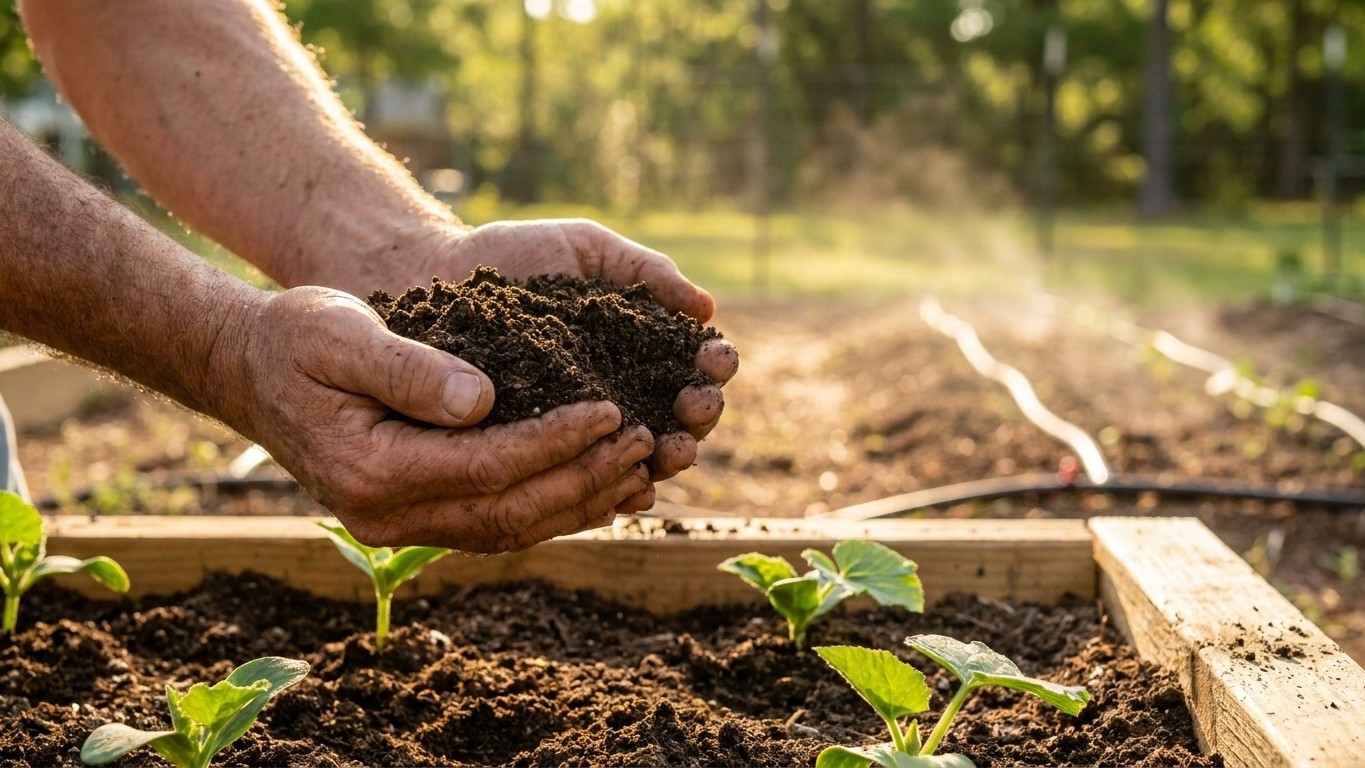

Quebec gardeners can transplant summer squash outdoors around the second week of May in the milder valley districts, but the real signal is soil warmth, not the calendar. Season length runs to roughly five months in the Montreal area, heat stress is rarely the problem here, and disease pressure from cool, damp summers matters more than sun scorch ever will.
When the soil is warm enough in Quebec
The average last spring frost for the Montreal/St-Hubert area is May 6, according to Environment and Climate Change Canada’s 1981-2010 Canadian Climate Normals for station MONTREAL/ST-HUBERT A. That single date, though, is a mean, not a promise. In one year out of two, frost shows up after May 6, sometimes well after. Treat it as the midpoint of a risk window rather than a green light for the trowel.
Summer squash doesn’t actually care about frost risk directly. It cares about soil temperature, and soil warms slower than air. Even once the frost danger has technically passed, cold, wet clay or a shaded bed can sit in the low 50s Fahrenheit for another week or two, and squash seed sown into that ground simply rots or sulks instead of germinating. The practical move is to wait until the soil itself feels warm to the back of a hand a few inches down, and to hold transplants indoors a little longer than the frost date alone would suggest, especially in the Laurentians, the Eastern Townships uplands, or anywhere north and east of the St. Lawrence valley where spring lags behind the Montreal reference station.
What zone 5b tells you and what it doesn’t
The Montreal area sits in Canadian hardiness zone 5b, per Natural Resources Canada’s Plant Hardiness Site using 1991-2020 normals. That’s the Canadian system, built from seven climate variables, and it does not translate to a USDA zone number; NRCan itself notes there’s no clean conversion, since a single Canadian zone can span multiple USDA zones. If a seed packet or an online source lists USDA zone hardiness, don’t try to line it up against this 5b figure. Use it only to gauge general winter severity for perennials, not as a squash-planting shortcut.
None of this changes with variety selection. Every seed catalog and extension bulletin lists days-to-maturity figures measured under specific trial conditions that this page can’t verify for Quebec soils, so it’s better to skip invented numbers entirely and instead watch the plant: squash seedlings that sit still for two weeks after Transplanting are usually telling you the ground was still too cold when they went in, not that the variety is slow.
How long the season lasts here
Between the average last spring frost of May 6 and the average first fall frost of October 5, the Montreal area gets a frost-free window of roughly five months, about 152 days on paper. Both dates come from the same Environment and Climate Change Canada 1981-2010 normals for station MONTREAL/ST-HUBERT A, so the subtraction holds together as a single, comparable figure rather than a guess stitched from two different sources.
Five months is a generous window for summer squash, which typically wants far less time than that to go from transplant to harvest. That slack changes two decisions right away. First, it opens the door to a second sowing: a gardener who plants in mid-May can often start a follow-up batch in early to mid-July and still bring it to harvest well before the October frost risk climbs, spreading out the crop instead of getting buried in zucchini all at once and then nothing. The site’s succession sowing guide walks through the timing logic for staggering plantings like this.
Why transplanting is worth the trouble here
Second, because the window is long rather than tight, there’s room to transplant instead of direct-seeding, and to actually check root health before committing a plant to the garden. In short-season territories, growers often direct-seed simply because there’s no time to lose to transplant shock. In a five-month window, that pressure eases. A gardener can start squash indoors a few weeks ahead, inspect the root ball for the tight, circling roots that signal a pot-bound start, and set back or discard a weak plant without meaningfully threatening the harvest date. That flexibility is a genuine advantage of the local season length, not just a theoretical one, since squash roots are notoriously touchy about disturbance and a poor transplant rarely recovers fully.
Where the frost-free stretch is this comfortable, the limiting factor for a second sowing usually isn’t the calendar at all. It’s whether the gardener has cleared space and refreshed the soil for another round of a heavy feeder, and whether they’re willing to manage two crops of squash bugs and vine borers instead of one.
Heat and water in Quebec
The Montreal reference station records an average of 0.0 days per year above 90°F, per the ECCC 1981-2010 Canadian Climate Normals. That’s not a rounding error or a low estimate, it’s essentially zero. Heat stress, the kind that causes squash pollen to lose viability and blossoms to drop without setting fruit, is not a meaningful risk in this territory the way it is farther south. Summer squash here rarely struggles because it’s too hot; it struggles for other reasons entirely.
Summer rainfall averages about 10.6 inches across June, July and August combined, with June the driest month at 3.42 inches, July at 3.52 inches, and August at 3.71 inches, based on ECCC normals from the Montreal/Pierre Elliott Trudeau Intl A station. That’s a fairly even, moderate distribution rather than a feast-or-drought pattern, and it’s enough moisture that irrigation is more of a backstop than a necessity in an average year. The bigger practical issue with rain this reliable, paired with almost no extreme heat to dry things out quickly, is that squash leaves and fruit stay damp longer after a storm or a humid night. Powdery mildew, which coats the big leaves in a white film and shuts down photosynthesis, and various fruit rots thrive in exactly these conditions: warm, humid, without the scorching afternoons that would otherwise bake foliage dry.
What actually decides watering and disease pressure
Because there’s no meaningful heat load pushing evaporation, the rainfall figures here read almost at face value; a rain gauge on the actual garden bed will still settle it better than any regional average, since a fence line, a slope, or heavy clay soil can shift how long moisture lingers around the base of the plant. The practical response in a cool, damp summer territory like this one is airflow and spacing rather than shade cloth or drip irrigation schedules: wider spacing between plants, morning watering at the soil line instead of overhead, and prompt removal of any leaf showing early mildew spotting, since heat-driven pollen failure simply isn’t the pressure this climate applies.
Which summer squash suit Quebec
The honest answer, given these facts, is a type description rather than a name. A short-to-moderate maturing type suits Quebec well simply because the five-month window, while comfortable, still benefits from squash that reach harvest efficiently rather than dawdling toward a first fall frost that, remember, is itself only an average and can arrive earlier in a given year. Beyond speed, the two qualities worth prioritizing are open, airy growth habit and some documented resistance to powdery mildew, since the region’s humid, non-scorching summers make foliar disease the dominant threat rather than heat stress or drought.
Squash types bred or selected for disease tolerance, and those with a more open bush habit that sheds moisture and lets air move between leaves, are the better fit for a climate defined by moderate, steady summer rain and essentially no days above 90°F. A tightly packed, sprawling habit that traps humidity against the leaves works against a gardener here in a way it might not in a hotter, drier province.
This page won’t name a specific cultivar, and that’s a deliberate choice rather than an oversight. Variety performance for disease resistance and habit shifts from one seed lot and one growing season to the next, and the only trials that mean anything for a Quebec backyard are the ones run on Quebec soil, under Quebec conditions. The Ministère de l’Agriculture, des Pêcheries et de l’Alimentation du Québec (MAPAQ) tracks regionally trialled varieties and disease-resistance data specific to the province, and that’s the resource to check before choosing seed, rather than relying on a days-to-maturity number or a resistance claim pulled from a catalog written for a different climate entirely.