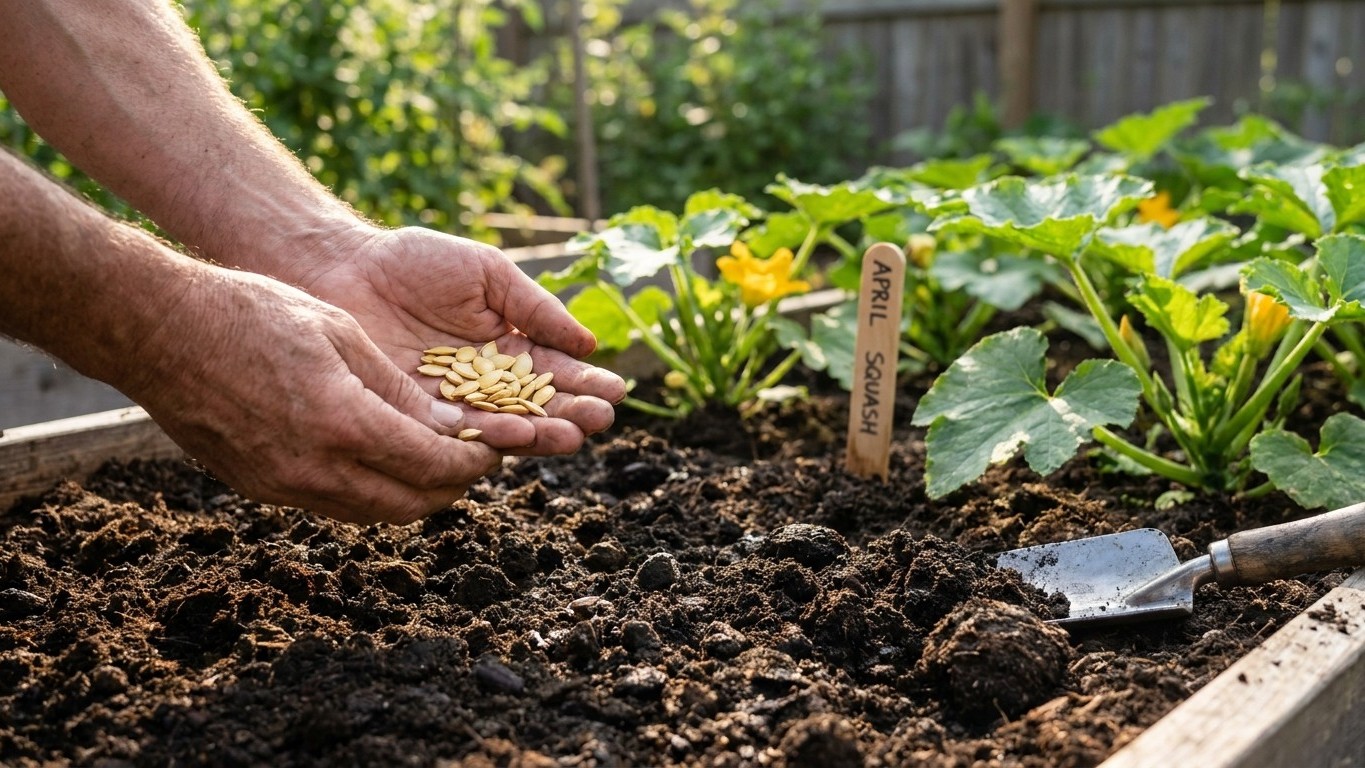

Summer squash goes into Rhode Island gardens outdoors between mid-May and early June, timed to the state’s frost calendar rather than the calendar on the wall. That window comes from actual freeze-probability data for the region, not a rule of thumb, and it shifts depending on where in the state a garden sits.
The short answer for Rhode Island
At the reference weather station used for Rhode Island’s climate normals, the last spring frost falls somewhere between April 7 and April 17, a range built from 32°F freeze probabilities between 30% and 70% over the 1991-2020 period. That is not a single date. It is a probability band: on April 7, there’s still roughly a 70% chance of another freeze, and by April 17, that risk has dropped to around 30%. Summer squash is a warm-season crop with zero frost tolerance, so gardeners don’t plant on the early edge of that band. They wait past it, and they wait for the soil to catch up too, since squash seed sitting in cold, wet ground simply rots rather than germinates.
That pushes the practical outdoor sowing window to roughly the third week of May through the first week of June, once soil has had a few weeks of warm days to build real heat at root depth. Gardeners who start seed indoors or buy transplants can move a little earlier, since a protected seedling handles a cool night better than a bare seed in cold soil, but they still hold off setting plants outside until that same frost risk has passed.
On the back end, the first fall frost at the same reference station arrives between October 24 and November 3. Summer squash varieties typically mature in 45 to 55 days, so a planting from late May leaves months of harvest before that fall window even opens. That gap is wide enough to support succession sowings, a second or third round of seed dropped in through late June, so the harvest doesn’t all land in one three-week rush in July.
One thing this page can’t do is hand a reader a single calendar date. The frost figures above come from one reference station, and the caution attached to them is real: suburban and rural gardens away from that station typically see the last spring frost later, and the first fall frost earlier, sometimes by one to two weeks, more at elevation. Treat the window above as a starting point, then narrow it using the sections below.
What will not work here
Jumping the frost window is the most common failure, and it’s an easy trap given how wide the April 7-17 band is. A gardener who plants on the first warm afternoon in early April is planting into soil that’s still cold at root depth, even if the air feels pleasant. Squash seed in that ground sits and rots rather than sprouting, and transplants set out that early often get knocked back hard by a late cold snap, since the probability of another freeze is still elevated through most of that band.
Watering on autopilot
Rhode Island summers bring about 10.3 inches of rain across June, July and August, with July running driest at just 2.91 inches. That sounds like enough moisture for a garden, and most years it is, but it doesn’t arrive evenly. Combine a dry July with the 9.4 days a year the region averages at or above 90°F, and a squash bed watered on a fixed once-a-week schedule can fall well short right when the plants are setting fruit fastest. This bites harder on sandy, fast-draining soils common near the coast, where a single inch of rain moves through in a day rather than holding for a week the way clay does. A rigid weekly schedule that ignores an active heat stretch is a recipe for blossom drop and stunted fruit.
Crowding plants in a humid summer
Rhode Island’s summer rain tends to arrive as thunderstorms rather than gentle steady soaking, which means foliage gets wet fast and takes a while to dry, especially in a shaded or tightly packed bed. Summer squash planted too close together, or watered overhead in the evening, holds that humidity right at leaf level, and powdery mildew shows up on the leaves well before the plant has finished producing. Wider spacing and watering at the soil line rather than over the leaves cost nothing and solve most of this on their own.
What doesn’t need to worry a Rhode Island gardener is season length. With roughly six months between the two frost windows, there’s no need to chase the fastest-maturing variety out of fear the season will run out. The real risks here are heat and moisture management, not the calendar running short.
What changes across Rhode Island
Rhode Island’s USDA hardiness zone range runs from 6a to 7b, and for a state this small, that’s a real spread rather than a rounding error. Zone 6a and 7b are defined by the average annual extreme minimum winter temperature, a full system built around that one number, and a jump of three half-zones inside one state’s borders means coastal Rhode Island and its interior are not experiencing the same winter, and by extension, not quite the same start to spring either.
Coastal areas and the islands, moderated by the ocean, tend to sit toward the warmer end of that range, with milder winter extremes and often a gentler transition into spring soil warmth. Inland and upland parts of the state, further from that ocean buffering, run cooler and land toward the 6a end, which typically means soil takes longer to warm in spring and cools faster once fall sets in.
For summer squash, the practical takeaway isn’t a different plant list, it’s a shift in timing. A gardener in a warmer coastal pocket may find their soil ready a few days to a week ahead of the state-level window described above, while a gardener further inland or at higher elevation should expect to wait longer in spring and watch more carefully for an early frost cutting the season short in fall. This page can’t tell an individual reader which zone their own yard falls into, since that number changes from town to town and even yard to yard depending on elevation and exposure. The USDA Plant Hardiness Zone Map is the tool for pinning that down precisely, and it’s worth five minutes before finalizing a planting date.
Where to check this for your own county
Everything above is a state-level picture, built from one reference weather station’s normals. A real garden sits in one county, on one soil type, with its own microclimate, and the gap between a state average and a county reality is exactly where planting mistakes happen. That gap is what a state’s land-grant extension service exists to close.
For Rhode Island, that’s the University of Rhode Island Cooperative Extension, reachable at web.uri.edu/coopext. Two things are worth hunting for there. First, any county- or region-specific planting calendar the office publishes, which will reflect actual local frost data rather than a single reference station’s normals, and will often be built from years of observed local conditions rather than statistical probability bands. Second, look for variety trial results or recommended cultivar lists specific to Rhode Island or southern New England growing conditions, since extension offices frequently track which summer squash varieties actually perform well against the local combination of humidity, pest pressure and heat load, information this state-level page doesn’t have.
A county-level recommendation from a local extension office will beat a state-wide page like this one every time, because it’s built on tighter, more local data. This page works from statewide climate normals; the extension office works from what’s actually growing in gardens near the reader. When the two disagree, defer to the county source.
Checking this against your own garden
No calendar date, state or county, beats what a gardener can observe directly in their own soil and plants. Three signs are worth tracking by hand, literally.
Soil warmth by feel comes first. Push a finger or a trowel a few inches into the planting bed on a morning before the day heats up. Cold, damp soil that feels little different from early spring means it isn’t ready yet, no matter what the calendar window says. Soil that feels warm and dry enough to crumble slightly is telling the gardener the ground has caught up with the season, which matters more for squash germination than the air temperature does.
The first flush of male flowers on an established plant is the second signal. Summer squash typically produces a run of male flowers before the female flowers, the ones with a small swelling at the base that will become fruit, start appearing. A plant already producing that first male flush is confirming it’s found conditions to its liking and is moving toward fruiting, a useful check for anyone unsure if their planting timing worked out.
Third, watch the true leaves that follow the first two seed leaves. Slow, pale, or stalled true-leaf growth after germination usually points to soil that’s still too cool or a plant that got set back by a late cold snap, even a mild one. Vigorous, dark-green true leaves within the first couple of weeks are the clearest sign that timing and soil conditions lined up, and that this particular garden, in this particular spot, got the planting window right this year.