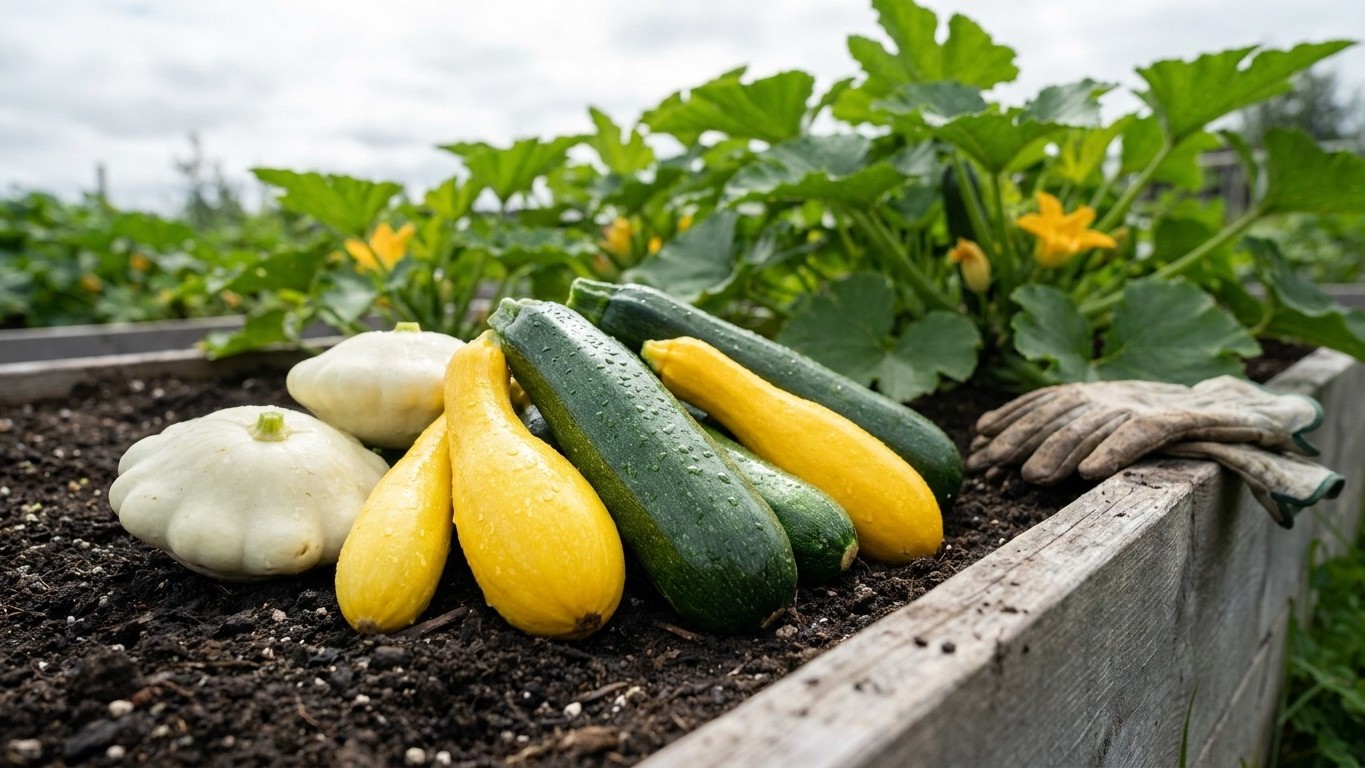

Summer squash grows well almost anywhere in West Virginia, and the state’s frost-free window is long enough that speed to maturity is rarely the deciding factor. The real question is which type shrugs off a wet June and a muggy July without rotting from the inside out.
The short answer for West Virginia
Pick bush-type zucchini, yellow crookneck, yellow straightneck, or pattypan squash bred for disease resistance, not for speed. West Virginia’s frost-free season, measured from the Charleston reference station, runs from a last spring frost of April 9 to April 23 out to a first fall frost of October 18 to November 1. Even in the tightest version of that window (April 23 to October 18), a gardener gets roughly 178 frost-free days. Summer squash needs 45 to 65 days from seed to first harvest. That gap is enormous by squash standards, so no standard summer squash variety runs out of season here, even a slow one.
That changes what actually separates a good choice from a bad one in this state. Days above 90F average 16.0 a year at the reference station, a modest heat load compared to states further south or west. That means West Virginia gardeners don’t need to chase heat-tolerant specialty types the way a Deep South grower might. What they do need is a variety built to handle humidity, because the summer rainfall pattern here (4.72 inches in June, 5.38 in July, dropping to 3.75 in August) means squash plants sit in damp soil and wet foliage for long stretches early in the season, right when powdery mildew and bacterial wilt get their start.
So the decision by type looks like this: standard bush zucchini and yellow squash varieties bred with powdery mildew resistance are the safest bet across the state, since they mature fast enough to get a harvest in before disease pressure peaks in late summer, and their open growth habit sheds moisture faster than sprawling vine types. Pattypan and scallop types work the same way and are worth growing if a gardener wants variety on the plate. Vining or trailing summer squash types, including tromboncino-style squash sometimes sold as a summer squash, need more room and more airflow to avoid the same rot risk, which makes them a poorer fit for a small raised bed pressed against a fence or a wall.
None of this is a season-length problem. It’s a moisture-management problem, and the variety that wins in West Virginia is the one that dries out fastest after a storm.
What will not work here
The type that struggles most in this state is anything selected for hot, dry-climate performance with minimal disease resistance built in. Several heirloom summer squash lines, developed in the arid Southwest for low humidity and infrequent rain, put resistance to sun scald and drought ahead of resistance to fungus. Drop one of those into a West Virginia June, with 4.72 inches of rain falling on foliage that rarely gets a full day to dry between showers, and powdery mildew or downy mildew can move through the planting before the first fruit sets.
Close spacing is the second failure point, and it’s a habit borrowed from drier climates where growers pack plants tight to conserve soil moisture. In a state averaging over 13.8 inches of rain across June, July, and August, tight spacing blocks airflow between leaves, and wet leaves that don’t dry out are exactly what fungal spores need. A planting that would be fine spaced two feet apart in a dry summer state needs three feet or more here, simply so the sun and wind can reach the undersides of the leaves after a storm.
The watering habit that backfires
Weekly watering schedules, common advice in drought-prone regions, don’t map cleanly onto West Virginia’s rainfall pattern. June and July already deliver plenty of water on their own, so a rigid weekly watering routine on top of natural rainfall can waterlog roots and invite the same rot problems the humidity already encourages. August is the actual risk month, with rainfall dropping to 3.75 inches while the state still logs its share of the 16 annual days above 90F. A gardener who waters on autopilot through a wet June and then coasts through a dry August on the same schedule is watering backward relative to what the plants actually need.
The fix isn’t a different schedule so much as a different habit: check the soil, not the calendar, especially as summer turns toward August.
What changes across West Virginia
West Virginia’s hardiness zone range, 5a to 7a under the USDA Plant Hardiness Zone Map, is a wide spread for a state this size, and it’s built entirely on average annual extreme minimum winter temperature, not on summer growing conditions. Still, that spread is a useful flag: a state that varies by two full zones on winter cold also varies meaningfully on when the growing season actually opens and closes.
The Charleston reference station sits in a river valley, and the frost dates cited here (last spring frost April 9 to April 23, first fall frost October 18 to November 1) reflect that milder valley position. Higher elevations across the state, the eastern highlands in particular, freeze noticeably earlier in fall and stay colder longer in spring than a valley station like Charleston. That means a gardener at altitude should expect a shorter effective window than the state-level dates suggest, even though both places share the same broad frost-free arithmetic on paper.
There is no single frost calendar that covers a river valley and a mountain garden equally well, and this page can’t tell an individual reader which zone they’re standing in. What it can say is this: gardeners at higher elevation should lean toward the fastest-maturing bush varieties in a chosen type, hold off transplanting a week or two past what a valley gardener would do, and watch for an earlier fall frost than the state’s October 18 to November 1 window implies. Gardeners in the river valleys and lower elevations have more room to experiment with slightly slower-maturing or vining types, since their season runs closer to the long end of that window.
Where to check this for your own county
This page describes West Virginia at the state level, built from one reference station and one statewide hardiness zone range. A county-level recommendation will always beat a state-level one, because it accounts for the exact elevation, frost pocket, and soil type a specific garden sits in, none of which this page can see.
The place to get that is West Virginia University Extension Service. Two things are worth looking for once there. First, a county-level planting calendar, if the local office publishes one, which will adjust the frost window given here to the actual elevation and microclimate of that county rather than the Charleston valley average. Second, any record of summer squash variety trials run through the extension system, since West Virginia’s land-grant research network tests vegetable varieties under actual state growing conditions, including the humidity pressure this page has flagged as the state’s real limiting factor.
A gardener in Pocahontas County at 3,000 feet and a gardener in the Kanawha Valley are both technically in West Virginia, but they are not gardening in the same season, and the extension office covering each county is set up to reflect that difference in a way a statewide page structurally cannot.
Checking this against your own garden
Every date on this page is a normal built from thirty years of averages at one weather station. A gardener’s own observations, made in their own soil, outrank all of it, and three signs are worth tracking without needing anything beyond hands and eyes.
- Soil warmth by feel: press a hand into the planting bed a few inches down; summer squash seed wants soil that feels warm and dry to the touch, not cool and damp, and that feel will arrive on a different date in a raised bed than in heavy garden soil, regardless of what the calendar says.
- The first flush of male flowers: summer squash plants send out male flowers before female ones, sometimes by a week or more, and a plant with plenty of male blooms but no fruit yet is on schedule, not failing.
- The first true leaves: the rounded seed leaves that appear first don’t count; the next set, with the jagged squash-leaf shape, tells a gardener the plant has moved past germination and into active growth, a better marker of local pace than any date on a page like this one.
A garden that runs a week or two ahead or behind the state’s frost dates isn’t wrong. It’s just telling the gardener something about their own microclimate that no station thirty miles away could have measured for them.