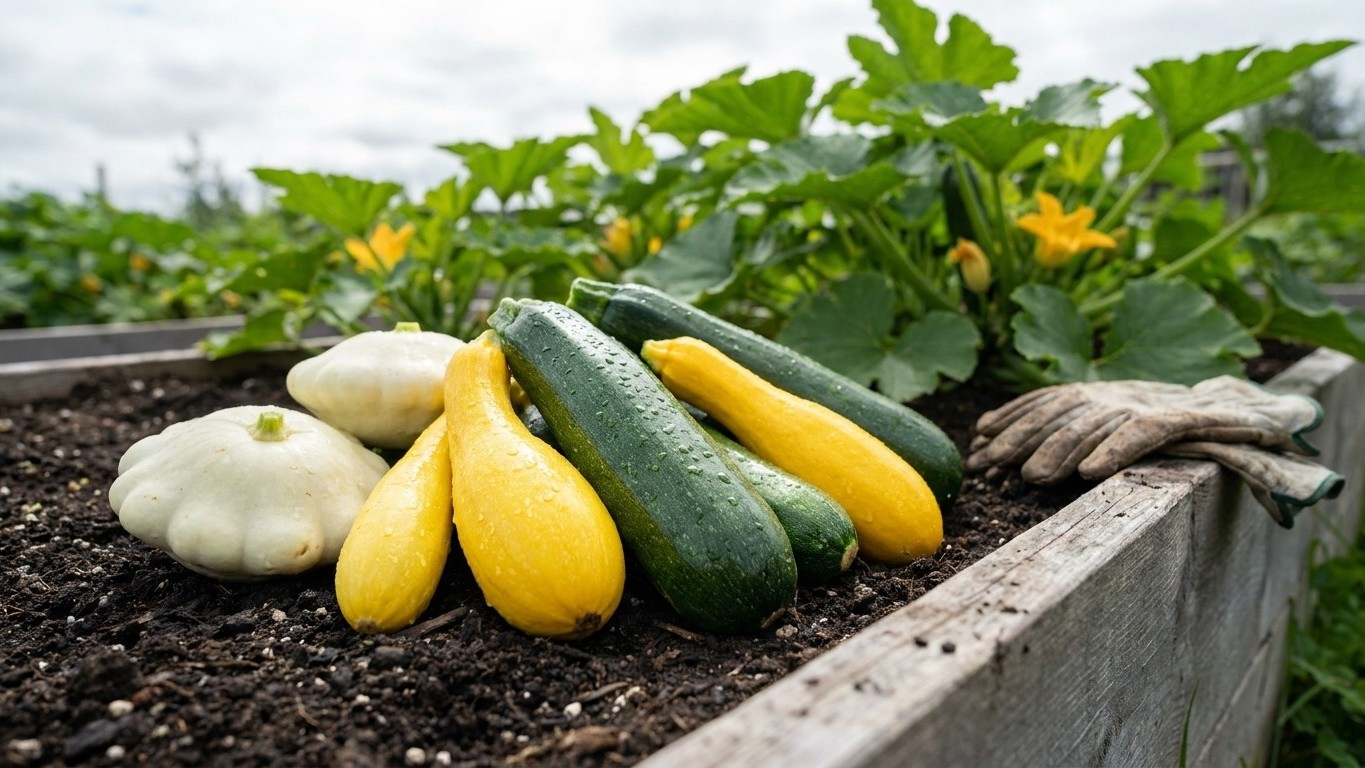

Zucchini and yellow crookneck varieties bred for early maturity are the strongest choice across Wisconsin, because the state’s frost-free window varies enough from north to south that a fast finisher is the one type that works everywhere. Scallop (patty pan) types earn a place too, but they want every extra week they can get. The line that actually separates a good pick from a disappointing one here isn’t heat. It’s speed to harvest.
The short answer for Wisconsin
Start with the numbers that actually govern this decision. Wisconsin’s last spring frost falls somewhere between April 16 and April 29, and the first fall frost lands between October 17 and October 29, both drawn from 1991-2020 NOAA normals at the state’s reference station. Pair the earliest last frost with the latest first frost and a garden gets roughly 196 frost-free days. Pair the latest last frost with the earliest first frost, the pairing a shorter-season county might actually see, and that same garden gets about 171 days. Either way, that’s a long runway for a crop that typically needs 45 to 65 days from seed to first squash.
That’s the detail that should drive variety choice. Because even the shorter end of Wisconsin’s frost-free season comfortably outlasts the maturity window of nearly every summer squash on the market, the decision isn’t really about whether a variety has enough time. It’s about how many harvests a gardener can stack into that time, and how well a plant tolerates the state’s particular mix of moderate heat and wet-then-dry summer rainfall.
On heat: Wisconsin averages just 7.0 days a year at or above 90F, measured at the Milwaukee reference station. That’s a mild heat load compared to states where summer squash pollination stalls out in prolonged high heat. Flowers here are more likely to open, get visited, and set fruit without the heat stress that shuts bees down elsewhere. That favors bush-type zucchini and yellow straightneck varieties, which set fruit reliably in moderate conditions and don’t need a long hot stretch to ripen fast.
Scallop types are the next best fit. They handle the state’s rainfall pattern (about 11.4 inches across June, July, and August) reasonably well once they’re established, but they tend to lag a week or two behind a fast zucchini in first harvest, which matters more in a shorter-season county than a longer one. Vining summer squash types can work too, but they ask for more square footage than most home gardens want to give a crop that a bush type handles in a third of the space.
The practical read: pick a bush zucchini or yellow crookneck as the primary planting anywhere in the state, add scallop types where there’s room and a bit more season to spare, and treat vining forms as a specialty pick rather than a default.
What will not work here
Wisconsin’s numbers rule out a few habits that work fine elsewhere. The first is stacking long-season, novelty summer squash (varieties rated 70 days or more to maturity) into a second succession planting late in the season. In a county sitting at the short end of the frost-free range, roughly 171 days, a squash sown in mid-July that needs 70 days plus a couple of weeks to size up is racing an October frost it may not beat. That’s a real risk in the north and at higher elevations, not a hypothetical one.
The second habit that fails is watering on a fixed weekly schedule. It sounds reasonable given that Wisconsin gets a healthy 11.4 inches of rain across the summer months, but that total hides an uneven pattern: June averages 4.38 inches, July drops to 3.4 inches (the driest of the three), and August climbs back to 3.65. A once-a-week watering plan built around June’s rainfall will leave a squash bed short in July, especially on sandy soil where that inch of rain moves through within a day rather than lingering the way it would in clay. Add in the state’s 7 days a year above 90F, which push evaporation harder than the rainfall total alone suggests, and a fixed schedule quietly under-waters the crop during the exact stretch when fruit is sizing up fastest.
The third failure point is close spacing, particularly the tight in-row distances printed on some seed packets meant for drier climates. Wisconsin’s summer rainfall keeps foliage damp longer after a storm than a dry-summer state would, and near Lake Michigan the lake itself adds humidity that lingers into the growing season. Crowded plants with poor airflow are the ones that come down with powdery mildew first, usually visible as a pale dusting on the upper leaf surface by mid-to-late summer. Wider spacing than the package suggests, with room for air to move between plants, matters more here than in a drier state where the same spacing would be fine.
What changes across Wisconsin
Wisconsin isn’t one growing zone, it’s a spread of four: the USDA Plant Hardiness Zone Map places the state between 3b and 6a, built from the average annual extreme minimum temperature. That’s a wide range for a single state, and it means there’s no single sowing date or variety recommendation that fits Superior the same way it fits Beloit. A gardener in the far north, working within zone 3b conditions, is dealing with a meaningfully shorter and cooler season than one near the Illinois border in a 6a pocket.
The practical shift for a northern or higher-elevation garden is toward the fastest-maturing bush varieties available, and toward treating a second succession planting as unlikely to finish rather than assuming it will. The frost-date range itself reflects this: a county at the late end of the last-frost window (closer to April 29) and the early end of the first-fall-frost window (closer to October 17) is working with something closer to that 171-day season, not the 196-day version.
There’s a second wrinkle worth flagging. Lake Michigan delays the first fall freeze along the shoreline, sometimes meaningfully, while inland southern Wisconsin typically sees its first freeze in early October and the north far earlier still. That means two gardens at similar latitude, one near the lake and one 40 miles inland, can have noticeably different fall harvest windows for a crop like summer squash that keeps producing right up until frost.
None of this is something to guess at from a state-level map. The USDA hardiness zone tool lets a gardener look up their specific location rather than estimate from a statewide range that spans three full zones.
Where to check this for your own county
The Wisconsin numbers in this article come from a single reference station and describe the state in general terms. A county-level answer will always beat a state-level one, and Wisconsin’s land-grant extension system is built to give exactly that. The University of Wisconsin-Madison Division of Extension, at extension.wisc.edu, is the state’s official land-grant extension service and the place to look for anything more specific than what’s covered here.
Two things are worth pulling up there specifically. The first is a local planting calendar built around the actual frost dates for a specific county rather than the statewide 30-70% probability band used above. Frost timing in Bayfield County and frost timing in Kenosha County are different enough that a single statewide date range, while accurate as a range, isn’t precise enough for deciding exactly when to put seed in the ground.
The second is any list of summer squash varieties that county extension offices or master gardener programs have actually trialled locally. Wisconsin’s counties run their own demonstration gardens and variety trials in many cases, and those results reflect the real soil, rainfall, and pest pressure of that specific area, not a national seed catalog’s general description of how a variety performs. A variety that shows strong powdery mildew resistance in a humid Green Bay-area trial carries more weight for a gardener in that county than a general resistance rating printed on a seed packet.
This page is deliberately the state-level version of that information: useful for narrowing down variety types and understanding the broad forces at play, but not a substitute for what a county extension office can say about a specific ZIP code.
Checking this against your own garden
Every date and average on this page describes Wisconsin in general. A gardener’s own observations describe one specific plot, and that beats any statewide figure every time. Three things are worth watching directly.
Soil warmth by feel is the first. Summer squash seed germinates poorly in cold soil no matter what the calendar says, so pressing a hand a few inches into the bed before sowing tells a gardener more about that spot’s readiness than a frost-date range does. Soil that still feels cold and heavy in mid-May in a spot that gets afternoon shade is running behind the state’s general timeline, regardless of what the last-frost window suggests.
The first flush of male flowers is the second signal. Summer squash typically produces several rounds of male flowers before the female flowers (the ones with a tiny fruit already visible at the base) start opening in numbers. A garden that’s slow to produce that first male flush compared to a neighbor’s plot, planted the same week, is showing a real microclimate difference, whether that’s less sun, cooler soil, or a sheltered spot that warms slowly.
The first true leaves are the third. Seedlings push up two rounded seed leaves first, then the first set of true, notched squash leaves follows. How quickly that second set appears is a rough read on how favorable conditions have been since germination, faster in a warm, sunny spot, slower in a shaded or cool corner of the yard. None of these require a thermometer or any tool a home gardener wouldn’t already have on hand, just a habit of checking the bed rather than the calendar.