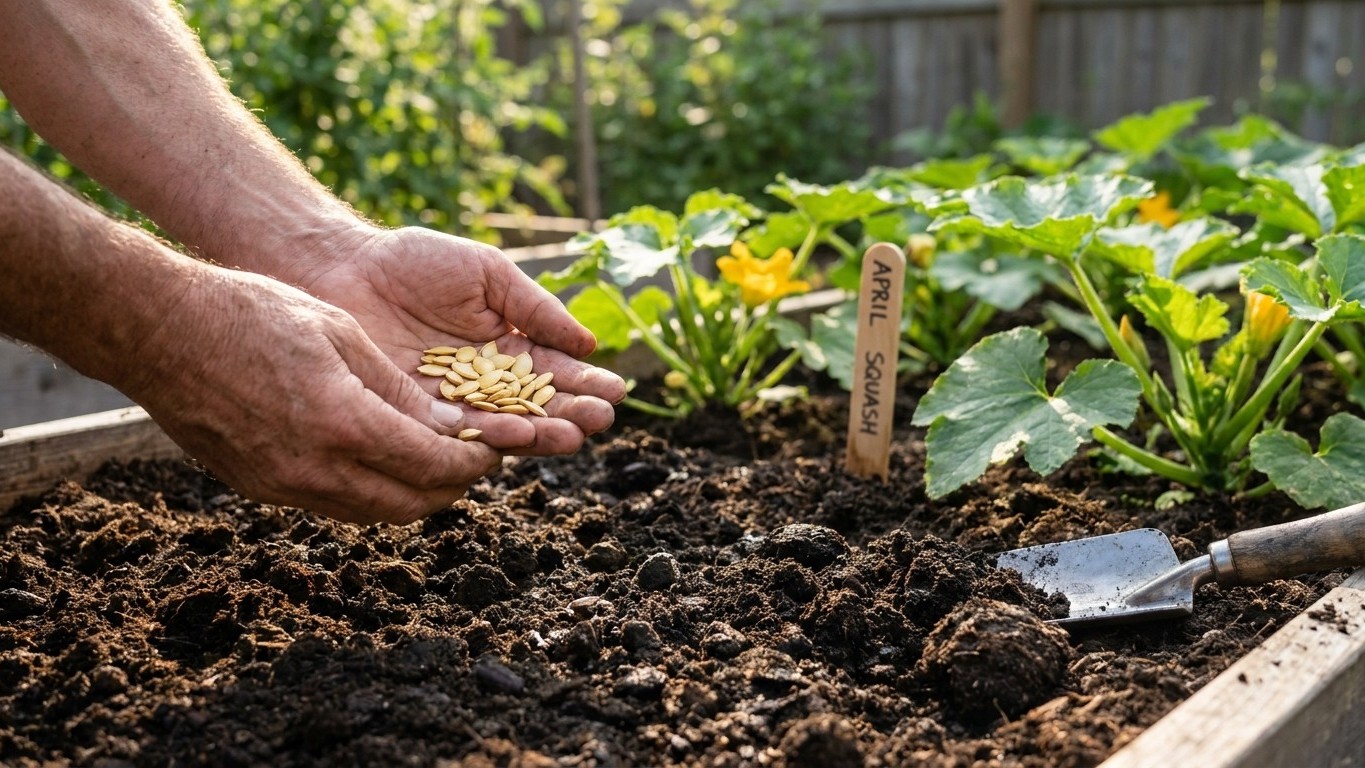

Summer squash goes into Wisconsin soil after the last spring frost has passed and the ground has actually warmed, not on a fixed calendar date. In most of the state that lands from mid-May into early June, later near the northern border and earlier along the Lake Michigan shore. The safer marker is soil temperature, not the date on a seed packet.
The short answer for Wisconsin
NOAA’s climate normals put Wisconsin’s last spring frost, a 32°F reading, somewhere between April 16 and April 29 at the reference station near Milwaukee (USW00014839, 1991-2020 normals). That’s not a single date. It’s a 30 to 70 percent probability band, meaning even by April 29 there’s still roughly a 30 percent chance of a freeze in a given year. Summer squash won’t tolerate that. Direct-seed after this window closes, then add another two to three weeks so the soil itself has warmed, since squash seed sitting in soil below roughly 60°F tends to rot before it germinates rather than sprout slowly.
Fall works from the other end. First fall frost falls between October 17 and October 29 at the same station. Summer squash matures in roughly 45 to 65 days from seeding, so even a late-May planting clears harvest well before that window opens. The frost dates aren’t really the limiting factor for summer squash the way they are for a slow winter squash or a melon. The plant’s real constraint in Wisconsin is spring soil temperature and the mean summer heat load, which sits at 7.0 days a year at or above 90°F at the Milwaukee reference station. That’s a modest number. Summer squash sets fruit reliably in cooler air than that, but it also means the crop won’t race the way it does in a hotter state, so an early, warm-soil start still pays off.
Put together, the practical sowing window for most of southern and central Wisconsin is mid-May through early June, direct-seeded or transplanted once the risk of frost has cleared and soil has held warm for several days running. This page gives that as a state-level window built from one reference station. It is not the same as a date for a particular county, which the sections below cover.
What will not work here
Planting on a fixed date rather than a soil condition is the first way summer squash struggles here. Wisconsin’s spring frost window closes anywhere from April 16 to April 29 depending on the year, but that only clears the air, not the ground. Squash seed dropped into soil that’s still cold and wet from spring rain and snowmelt sits and rots rather than germinates, and a rotted first sowing often gets blamed on the seed rather than the timing. Waiting those extra two to three weeks after the frost date, until the soil itself has warmed, costs nothing and avoids a second planting.
A watering routine built around a single weekly soak also runs into trouble. Wisconsin’s three summer months bring about 11.4 inches of rain on average, but that total isn’t spread evenly: July, the peak month for flowering and fruit set on most summer squash, is also the driest of the three at 3.4 inches, against 4.38 in June and 3.65 in August. A dry stretch in July, paired with the state’s humid-continental swings, can stall fruit set even though the season-long rainfall number looks generous on paper. The fix isn’t more water on a fixed schedule; it’s checking the soil during that specific stretch rather than trusting the summer average, since the same inch of rain drains within a day on a sandy patch and sits for a week on clay.
Tight spacing is the third failure, and it’s a humidity problem more than a heat one. Wisconsin doesn’t run especially hot in the broad sense, with only about 7 days a year reaching 90°F at the Milwaukee reference station, but its air holds moisture through most of the growing season. Summer squash planted at spacing meant for a drier state keeps leaves wet longer after rain or dew, and that’s exactly the condition powdery mildew needs. Wider spacing than the seed packet’s minimum, plus airflow between rows, matters more here than in a state where the same variety dries out within an hour of a storm.
What changes across Wisconsin
Wisconsin’s USDA hardiness zones run from 3b up to 6a, built from the average annual extreme minimum winter temperature, which is a different measure than a frost date but tracks the same north-south divide. A state spanning nearly two and a half zones doesn’t have one summer squash calendar; it has several, and the spread between them is wide enough that a planting date that works in the south can sit weeks too early for the north.
The mechanism holds even without naming a specific zone: colder winter extremes generally track with a shorter frost-free season and a slower spring soil warm-up. A gardener working land toward the colder end of that 3b-6a range should expect the last-frost side of the window, April 16 to April 29 at the reference station, to run later on their own ground, and the first fall frost, October 17 to October 29 at the same station, to arrive earlier. That squeezes the safe sowing period from both ends, which matters more for a slow-maturing summer squash variety than a fast one, even though most summer squash matures well within either version of the season.
Lake Michigan complicates the picture further. Its water mass delays the first fall freeze right along the shoreline, so a garden within a few miles of the lake can pick up extra weeks in autumn that an inland garden at the same latitude doesn’t get, while inland southern Wisconsin typically sees its first freeze in early October and the north far earlier still.
None of this adds up to a single statewide date, and this page won’t manufacture one. A gardener toward the state’s northern edge, or working land that reads consistently colder than the neighbors’, should shift sowing later and lean toward faster-maturing varieties. One near the southern border or close to the lakeshore has more room to experiment with slower ones. Finding out which end of the 3b-6a range applies to a specific plot means checking the USDA Plant Hardiness Zone Map directly, rather than guessing from a state average.
Where to check this for your own county
Everything above is a state-level picture, built from normals at a single reference station. Wisconsin has 72 counties spread across roughly two and a half hardiness zones, and county-level advice from the University of Wisconsin’s Cooperative Extension will beat this page every time it’s available, because it accounts for local frost records and local soil rather than a statewide average.
Extension’s site is extension.wisc.edu. Once there, look for two specific things. First, a county or regional vegetable planting calendar, which will give a narrower sowing window than the state-wide April-to-June range described here, built on frost data closer to that particular county than the single reference station used above. Second, look for summer squash variety trial results conducted under Wisconsin conditions. Extension programs regularly trial varieties for yield, disease resistance and days to maturity against the state’s specific humidity and season length, and those results say more about what will do well in a given county than a seed catalog description does.
A county office also knows things this page can’t: local soil texture, whether that county runs consistently earlier or later than the state normal, and which pests or diseases, squash vine borer and powdery mildew both show up regularly in Wisconsin, have been active locally in recent seasons. This page is the state-wide starting point. The county page, where one exists, is the final word for anyone gardening in Wisconsin.
Checking this against your own garden
Every date on this page is a normal built from decades of station data, and a reader’s own plot will run ahead of or behind that normal depending on slope, soil, and how much sun a particular bed gets. Three signs from the plant and the ground itself outrank any calendar date, once frost risk has genuinely passed.
Soil warmth by feel is the first check. Cold, damp soil that feels chilly to the back of a hand held a couple of inches down, even on a sunny afternoon, is still too cold for squash seed no matter what the calendar says; soil that feels warm and dries within a day of rain is ready. This gap matters more in Wisconsin than in a milder state, because the stretch between air temperature clearing frost and soil temperature actually warming can run two to three weeks here.
The first flush of male flowers is the second signal, and it tells a different story: it shows the plant has settled in and shifted from establishing roots to reproducing. Male flowers typically open before female ones on summer squash, so seeing them isn’t yet a sign of fruit on the way, but their timing relative to when the seed went in the ground is a rough measure of how favorable that particular spring turned out to be, compared with a normal year.
The first true leaves, the ones that appear after the initial rounded seed leaves and actually look like squash foliage, mark the point where a seedling has moved past its most vulnerable stage. If they’re slow to appear, or come in pale rather than deep green, that’s usually the soil or the light in that specific spot, not a mistake in the sowing date. It’s the kind of local detail a state-wide window like this one can’t account for, only that plot’s own owner can.