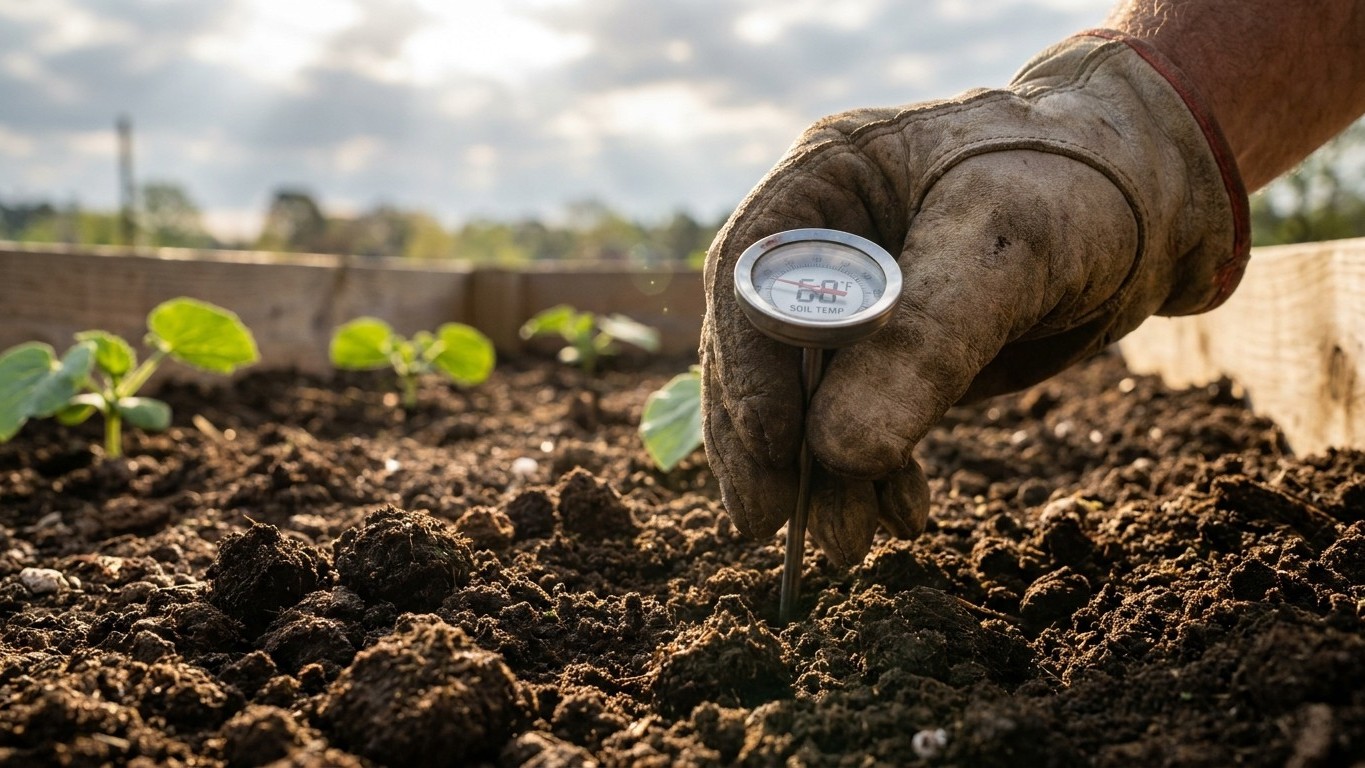

Melons need transplanting or direct-seeding after the soil has warmed past 65F, roughly two to three weeks after the last spring frost window closes, and they need a stretch of hot, humid summer weather to size up and sweeten before the first fall frost arrives. Illinois offers both, but unevenly across the state, and the reference dates below only describe one station.
When the soil is warm enough in Illinois

The question every melon grower asks first isn’t really “when’s the last frost,” it’s “when can I stop worrying about it.” Those are different things. At the reference station used for these normals, the last spring frost falls somewhere between April 11 and April 22 (NOAA NCEI 1991-2020 Climate Normals, 32F freeze probabilities, 30-70% band). That’s a probability band, not a promise: it means the chance of a freeze drops from 70% to 30% across those eleven days, and a cold snap outside that window is entirely possible.
Frost dates are a proxy, and a slightly misleading one for melons specifically. Melon seed germinates poorly below 65F soil, and the plant stalls (or rots) if nights stay cool even after the air itself is technically frost-free. So the real planting signal isn’t the calendar date above, it’s a soil thermometer pushed two inches down, read for several consecutive mornings. In most years that point arrives two to three weeks after the tail end of the frost window, once nighttime lows have settled into the 55-60F range.
Working around a station that isn’t your yard
The frost dates above come from an airport weather station, and airport stations tend to run warmer than the gardens around them. Suburban lawns, low-lying fields, and rural properties away from that runway’s heat island typically see their own last frost arrive later, sometimes by a week or two. If your garden sits in a frost pocket, a low spot where cold air pools, add a buffer rather than trusting the station date outright.
Warming the soil artificially, with black plastic mulch or a cold frame removed once temperatures stabilize, buys real time in a state where the window is already tight. That’s a practice worth learning from your local extension office rather than a technique this page can specify with a brand or a product name attached. What matters is the principle: get the root zone warm before the seed or transplant goes in, not after.
For gardeners further north in the state, where the hardiness zone runs cooler, starting melon seed indoors three to four weeks ahead and transplanting once soil warms is often the more reliable path than direct-seeding and hoping.
How long the season lasts here
Stack the two frost dates and Illinois’s frost-free window runs from roughly April 11-22 in spring to October 24-November 3 in fall, both figures from the same NOAA reference station. That’s a span of somewhere around six months at its longest reading and closer to five and a half at its shortest, depending on which end of each band actually plays out in a given year.
That length matters because it decides whether melons get one shot or two. A six-month window is generous enough that a gardener who gets an early type into the ground in mid-May can, in a favorable year, still put in a second, faster-maturing sowing in early July and have it finish before the fall frost risk climbs back up. A five-and-a-half-month window, on the other hand, makes the first planting the only one that counts: there’s no real margin for a failed first attempt or a delayed transplant.
Transplant or direct-seed?
This is where the window length changes the actual decision at the potting bench. In a shorter-season year or in the cooler northern reaches of the state’s hardiness range, transplanting (started indoors, then moved out once soil is warm) shaves two to three weeks off the time to first fruit compared to direct-seeding, which matters when the back end of the season is the tight part. Melons resent root disturbance, though, so that transplant has to be handled as a rootball, not bare-root, and checked for circling roots before it goes into the ground.
Anyone weighing whether their own window supports a second sowing, and what to plant for it, should look at the succession sowing guide on this site, which walks through timing a second round of a quick-maturing crop behind a first melon planting.
Heat and water in Illinois

Melons don’t count days so much as they bank heat, and that distinction matters a lot in a state where the numbers are middling rather than extreme. The reference station at Chicago logs an average of 14.0 days a year at or above 90F (NOAA NCEI Climate Normals 1991-2020). That’s a modest heat load, nowhere near the heat-belt totals of the Deep South or the desert Southwest, and it means Illinois isn’t a territory where melons cruise on ambient warmth alone.
With only 14 days of genuine heat stress on the calendar, the plant spends most of its season in warm-but-not-hot conditions, and that shifts the job onto two things a gardener controls directly: the type chosen and the soil-warming technique used at planting. Black plastic mulch, raised beds, and south-facing slopes all push the root zone a few degrees warmer than open ground, and in a 14-day-heat-year climate, those few degrees are often the difference between a melon that ripens on schedule and one that limps to the fall frost unfinished.
What the rain numbers change
Summer rainfall at the same station averages about 12.1 inches across June, July and August, broken down as 4.1 inches in June, 3.71 in July (the driest of the three), and 4.25 in August. That’s a reasonably wet summer by melon standards, wetter than the bone-dry stretches growers deal with in parts of the Southwest, and it changes the risk profile from drought stress to disease pressure.
A cool, damp Illinois summer is exactly the setup that favors powdery mildew on melon foliage, slows fruit ripening, and gives fungal disease more of a foothold than heat stress ever would here. That reshuffles the priority list: airflow between plants, morning watering instead of evening, and vine spacing that lets leaves dry out matter more in this climate than the irrigation scheduling a hot, dry territory would need. The two figures together, mild heat and moderate rain, point toward disease management and soil warming as the two levers worth pulling, not drought defense.
None of this reads the same on every soil type. Clay ground holds that 12.1 inches for days, while a sandy bed lets it drain within hours, which means the same rainfall total can mean watering every other day on sand and barely at all on clay in the same month.
Which melons suit Illinois
Everything above points toward a specific shape of melon, described by type rather than name. A modest 14-day heat count and a five-and-a-half to six-month frost-free window favor early-maturing types over the long-season varieties bred for hotter, longer climates further south. Given the disease pressure that comes with 12+ inches of summer rain, disease resistance, particularly against powdery and downy mildew, deserves to be the first filter applied, ahead of flavor or size.
Beyond that, this page stops short of naming a cultivar, and that’s a deliberate choice rather than an oversight. Variety performance in melons swings hard based on local disease pressure, soil, and microclimate, and a name that performs well in one county can struggle two counties over. The only recommendation worth trusting is the one built from actual local trial data, and that lives with the University of Illinois Extension service, which tracks which types hold up against the specific mildew and moisture pressures found across the state’s growing zones.
What to bring to that conversation
Knowing the shape of the problem before calling or visiting a local extension office makes the recommendation more useful. Worth having ready:
- Whether the garden sits in the cooler or warmer end of the state’s 5a-7b hardiness range
- Soil type (sandy, loam, or clay) and how it drains after a heavy summer rain
- Whether the plan is a single sowing or a succession attempt behind an early crop
- Any history of mildew or vine disease on the same ground in past seasons
The state’s hardiness zone spans 5a to 7b, which is a wide range built on winter minimum temperatures rather than summer growing conditions, and it means a gardener in the northern part of the state is working with a meaningfully shorter, cooler season than one near the southern tip. That gap alone is reason enough to treat any statewide variety recommendation with suspicion and lean on the county-level trial data instead.