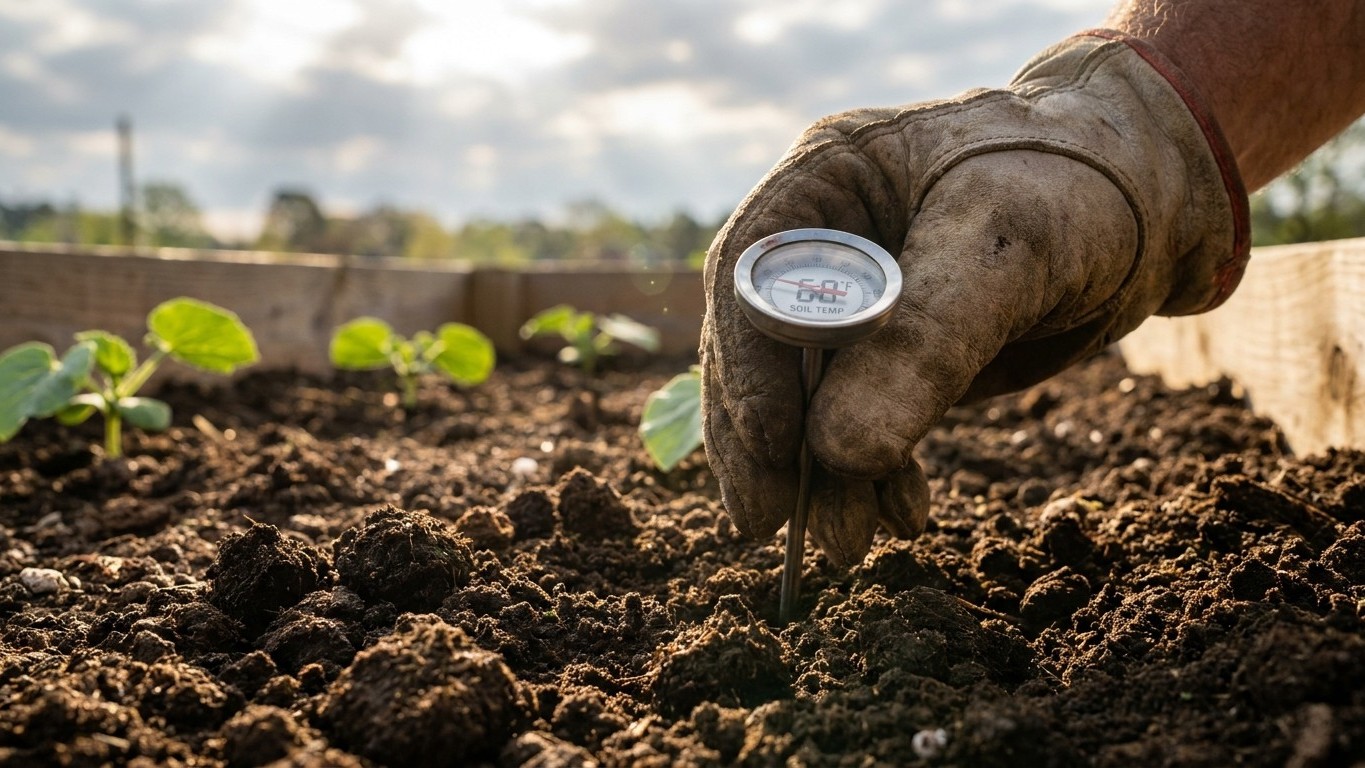

In most of Louisiana, melons go into the ground once the soil sits reliably above 65°F, which in the southern parishes can happen as early as February and in the north closer to March. Frost dates barely matter here compared to other states: the real gatekeeper is soil temperature, and the real challenge later on is surviving the state’s long, wet, humid summer without losing the fruit to disease.
When the soil is warm enough in Louisiana
The instinct is to check the last frost date and plant the week after. In Louisiana, that instinct leads you astray. According to NOAA NCEI 1991-2020 Climate Normals, the 32°F freeze probability band for the reference station puts the last spring frost somewhere between January 18 and February 8. That is an unusually early window by national standards, and it comes with an important caveat: a 32°F freeze occurs in only 86.8 percent of years at that station. Roughly one year in seven, south Louisiana never freezes at all.
That statistic matters more than it looks. A frost date is a probability, not a promise, and in a state where the probability of freezing is already this thin, treating the date as a hard planting trigger misses the point. Melon seed does not care whether frost has passed. It cares whether the soil several inches down has warmed enough for the seed to germinate quickly instead of rotting in cold, damp ground. Frost risk fading is a rough proxy for that warmth, nothing more, and in Louisiana the proxy and the reality can drift apart by weeks.
Soil warms unevenly across the state. A sandy, sun-exposed bed in the southern parishes can reach planting temperature well before the calendar says winter is over, while heavier clay soils, or beds that sit in shade part of the day, lag behind even when the air temperature says otherwise. Gardeners who push a thermometer a few inches into the bed and track it for a week get a far better answer than any date on a chart. Black plastic mulch or a temporary row cover laid down a week or two ahead of sowing speeds that warming along, which is a bigger lever in Louisiana than in colder states, because the window before summer heat arrives is what you are racing against, not frost.
North Louisiana is a different story from the coastal parishes near the reference station. It freezes far more reliably, and gardeners there should treat the frost date with more of the caution a Midwestern gardener would use, checking conditions against their own parish through the LSU AgCenter rather than assuming the coastal numbers apply. What holds statewide is the underlying logic: watch the soil, not just the sky, and treat the frost date as one input among several rather than the finish line.
How long the season lasts here
Put the two frost dates from the same NOAA NCEI normals next to each other and something unusual shows up. Last spring frost falls between January 18 and February 8; first fall frost falls between December 17 and January 8. That means the frost-free window, at its shortest reading (from the latest spring date to the earliest fall date), still runs roughly ten months. At its longest reading, it stretches close to a full year. Either way, this is one of the longest frost-free growing windows anywhere in the melon-growing states covered on this site.
A window that long changes what “planting season” even means. In a state where frost cuts the calendar down to four or five usable months, the spring sowing is the only shot, and every decision, including whether to start seed indoors and transplant, gets built around not wasting a single week. Louisiana does not force that trade-off. With frost risk this rare and this compressed into a narrow stretch of deep winter, gardeners have room for a spring sowing well before the heat peaks, and, in many years, a second sowing timed to mature after the worst of the summer humidity has broken but before the December frost risk returns.
That second sowing is not automatic, and it is not free of risk. The real constraint on a second Louisiana melon crop is rarely frost, it is timing the fruit to size up and sweeten during a stretch of weather that is not still brutally hot and not yet reliably damp with early winter rain. Getting that timing right is exactly what a succession sowing plan is built to solve, and the general mechanics, spacing sowings out so a heat wave or a wet spell does not wipe out the whole crop at once, are covered in this site’s guide to succession sowing for melons.
The practical takeaway for Louisiana specifically: frost is not the variable deciding whether you get one crop or two. Heat is. A gardener who plans around the ten-to-twelve month frost-free window without accounting for the mid-summer heat wall in between will end up with a spring crop that either finished too early to matter or a fall sowing that never got established before summer’s worst weeks arrived.
Heat and water in Louisiana
This is the section where Louisiana stops resembling a typical Southern melon state and starts looking like its own case. The reference station near New Orleans logs an average of 70.7 days a year at or above 90°F, per NOAA NCEI Climate Normals 1991-2020. That is a serious heat load, not a marginal one, and it means melons here accumulate the warmth they need for sugar development quickly. The days-above-90 count is a measure of heat load at that one station, not a blanket description of every parish, but it signals the kind of summer the whole state is built around.
Where Louisiana diverges from a hot, dry Southwestern melon territory is rainfall. Summer rain across June, July and August averages about 21.3 inches at the same reference station, with June bringing 7.62 inches, July 6.79 inches (the driest of the three), and August 6.91 inches. That is a lot of water falling from the sky during exactly the months melons are sizing up. In a hot, dry state, irrigation is the variable that decides fruit size and the final two weeks of dry weather decide sugar concentration. In Louisiana, the water is often already there, arriving whether the gardener wants it or not, usually in the form of heavy, fast summer thunderstorms rather than gentle steady rain.
That distinction matters because rain that runs off in a downpour behaves nothing like the same total delivered slowly. Combined with 70-plus days above 90°F driving fast evaporation, and with Louisiana’s clay-heavy soils in many parishes holding surface moisture for days after a storm, the practical result is a garden that can be simultaneously humid at the leaf and short on usable moisture at the root. That combination is what invites mildew, fruit rot at the point where melon touches wet soil, and slow, uneven ripening if plants are left to sit in damp shade. Raised beds, mulch that keeps fruit off bare wet ground, and pruning for airflow do more work here than in a drier climate, because the disease pressure, not the water supply, is usually the bigger threat to a Louisiana melon crop.
None of the rainfall figures above are a forecast for any one backyard. They are 1991-2020 normals for one reference station, and a slope, a stand of trees, or a spot in town can shift the real number considerably. A rain gauge on the actual plot, watched over a season, tells a gardener more than any regional average.
Which melons suit Louisiana
Everything above points toward the same set of priorities, and none of them is a variety name. Louisiana’s combination of heavy heat load, generous but unevenly delivered rain, and high humidity means disease resistance should be the first thing a gardener checks when choosing what type to grow, ahead of days to maturity or fruit size. A melon that resists the fungal pressure common in hot, humid climates has a real shot at finishing well here; one bred for a dry Western climate, however well regarded elsewhere, is fighting the state’s weather from the start.
Because the frost-free window runs close to a full year in the southern parishes, the usual pressure to pick the earliest-maturing type just to beat frost mostly disappears here. That freedom should go instead toward types that tolerate heat stress through the worst of the summer, and toward garden setups, raised mounds, mulched beds, staked or trellised vines, that give the fruit airflow and keep it off damp soil. North Louisiana, with its more reliable freeze, is closer to a conventional planting calendar and benefits more from an early type timed to dodge a real frost risk.
This page will not name a specific variety, and that is a deliberate choice rather than an oversight. Variety trials run by university extension services test dozens of melon types against the exact humidity, soil, and pest pressure of a given state, year after year, and their recommendations reflect results this page has no way to reproduce. Naming a cultivar without that local trial data is a good way to send a Louisiana gardener toward a plant that performs well somewhere else and struggles at home.
The LSU AgCenter publishes exactly that kind of locally trialled guidance, parish by parish in many cases, and it is the resource worth checking before buying seed. What this page can offer instead is the reasoning: in Louisiana, choose for disease resistance first, heat tolerance second, and let the extension service’s current trial results settle the rest.