
Melons can be grown across nearly all of Texas, but there’s no single answer to “when” or “which kind” because the state spans four USDA hardiness zones. What decides the outcome isn’t a calendar date so much as three local numbers: how early the soil warms, how many months separate the last and first frost, and how much heat and rain the summer actually delivers where you garden.
When the soil is warm enough in Texas
At Houston’s Bush Intercontinental Airport, the reference station used in NOAA’s 1991-2020 Climate Normals (station USW00012960), the last spring frost falls somewhere between February 4 and March 1, based on the 32°F freeze probability band. That’s the number worth writing on a calendar, but it isn’t the number that actually starts a melon crop.
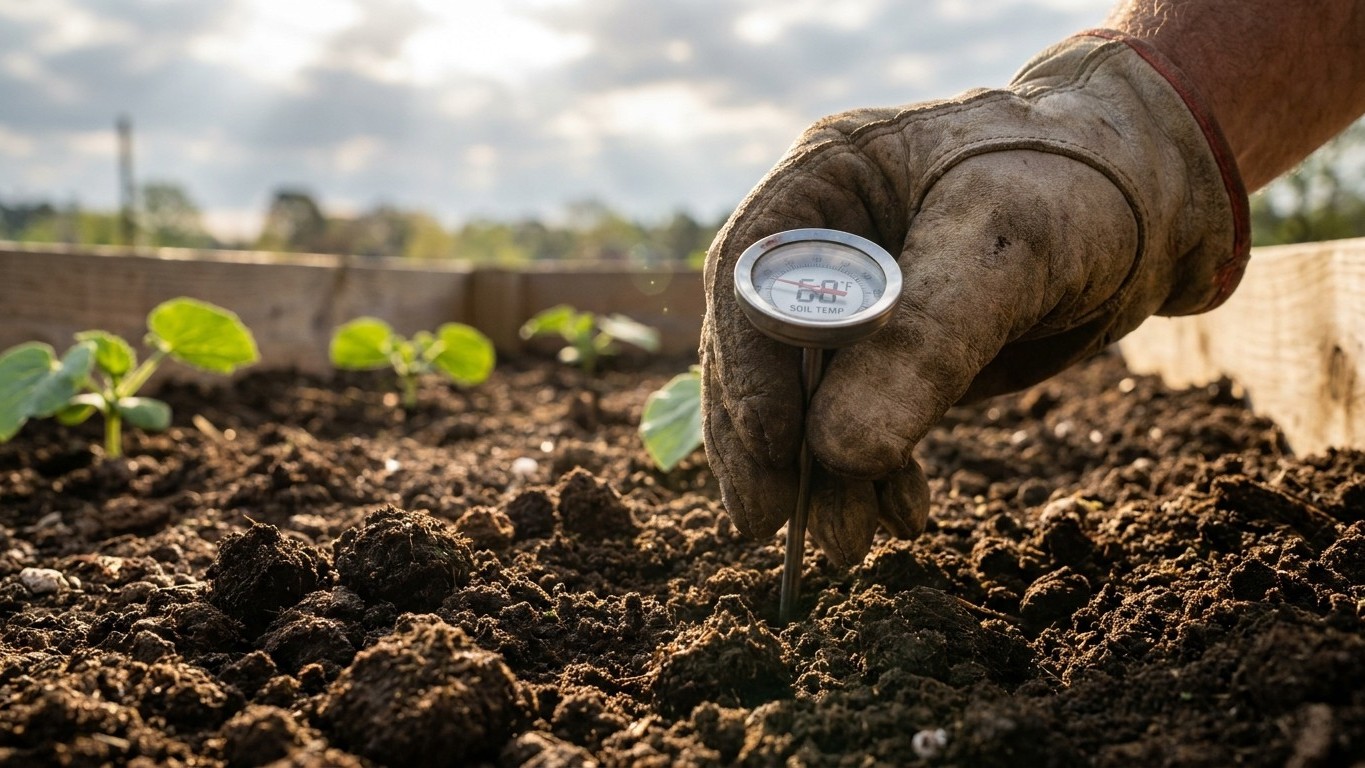
Frost dates track air temperature. Melons germinate and grow according to soil temperature, and soil lags behind the air by two to four weeks depending on how much sun the bed gets and how heavy the ground is. A gardener who plants the week the frost risk ends is often planting into soil still too cold for melon roots to do much of anything. The safer read of that Houston window is this: treat late February to early March as the point where frost risk fades, then wait for the soil itself, not the sky, to confirm it’s ready. A soil thermometer pushed a few inches down tells you more than any frost table.
It also matters where in Texas you’re standing. Houston sits at the mild Gulf end of the state’s climate range, and even within Houston, the Hobby Airport station runs about two weeks milder than IAH. The Texas Panhandle freezes months earlier in fall and thaws months later in spring; Hill Country and North Texas fall somewhere in between. A frost date from Houston is not a statewide planting calendar, and treating it as one is the single most common mistake made with this crop in Texas. And even at IAH, that February 4 to March 1 window is a probability band, not a guarantee: some years break warm early, others send a late cold snap right through it.
What this means for sowing decisions
Because the frost window is wide and the soil-warming lag is real, most Texas gardeners get better results starting melons indoors or under cover a few weeks before the soil is expected to be workable, then transplanting once the ground itself has caught up. Direct-sown melons on cold clay tend to sit and sulk rather than grow. Rather than picking a fixed date off this page, check with your state extension service, listed at the Texas A&M AgriLife Extension site, for the county-level guidance that reflects your actual zone rather than Houston’s.
How long the season lasts here
At the same Houston reference station, the first fall frost arrives between December 1 and December 19. Stacked against a last spring frost of February 4 to March 1, that leaves a frost-free window running from roughly nine months, in the tightest reading (March 1 to December 1), to about ten and a half months in the loosest reading (February 4 to December 19). Either way, that’s an unusually long season by national standards, and it’s a Gulf Coast number, not a Texas-wide one.
A window that long changes the whole planning conversation. In territories with a short six-to-eight-week frost-free season, gardeners get one shot at melons and every decision, including whether to transplant at all, gets built around not wasting a single week. Along the Texas Gulf Coast, the math is different. There’s enough season to sow a spring crop, harvest it, and still have summer and early fall left over for a second sowing timed to mature before the December frost risk rises. That second window also tends to dodge some of the worst of the mid-summer disease pressure that builds in humid heat, since a later sowing ripens as humidity and rainfall patterns shift into fall.
Transplanting matters more in a long season too, since it makes the root check that comes with moving young melon plants a smaller share of the total growing time available. A few days of transplant shock barely registers against a nine-to-ten-month window; it’s a much bigger cost in a short one. Gardeners weighing whether a second sowing is realistic on their own plot, and how to space it against the first, will find the mechanics covered in this site’s succession sowing guide, which walks through timing a follow-on crop against a region’s actual frost dates rather than a generic rule of thumb.
Heat and water in Texas
Houston’s reference station logs a mean of 102.4 days a year at or above 90°F, per NOAA’s 1991-2020 Climate Normals. That’s a heavy heat load, and it changes what melons need from a gardener more than it changes when they get planted. Melons respond to accumulated warmth over the season more than to any single sowing date, and a territory logging over a hundred days above 90°F has warmth to spare. The limiting factor along the Gulf Coast isn’t heat scarcity, it’s managing the surplus: shading roots, keeping vines from stalling under midday stress, and timing harvest before extreme heat pushes fruit past its peak sugar window.
Rainfall is the other half of the equation, and here the Houston numbers cut against the reflex assumption that a rainy state doesn’t need irrigation. Summer rainfall across June, July and August averages about 14.6 inches at the same station, month by month running 6.0 inches in June, 3.77 in July (the driest summer month), and 4.84 in August. That’s a moderate total, but it rarely arrives as steady, useful moisture. It tends to fall as thunderstorms, and on the area’s clay-heavy soils a heavy downpour runs off nearly as fast as it lands, rather than soaking down to root depth the way a slow soaking rain would. Combine that with 102.4 days of 90°F-plus evaporation pressure, and the practical result is that irrigation, not rainfall totals, ends up deciding fruit size in most seasons, while the final two weeks before harvest, when water is often eased back deliberately, decide how much sugar concentrates in the flesh.
None of this describes the whole state. West Texas and the Panhandle run drier and see less humidity pressure, which shifts the disease risk down but raises irrigation dependence further. Gardeners outside the Gulf Coast should read these figures as the wet, hot, humid end of the Texas range, not as their own backyard’s forecast; a rain gauge on the actual plot is the only reliable substitute.
Which melons suit Texas
Given a long frost-free window and heavy summer heat, the Gulf Coast region can generally support a wider range of melon types than a short-season territory could, but humidity changes the priority order. In a climate logging over a hundred days above 90°F alongside regular summer rain, disease resistance, particularly to the fungal and mildew pressures that build in humid heat, becomes the first filter to apply before anything else. A melon type bred for airflow and resistance to leaf disease will outperform one chosen purely for size or earliness once August humidity sets in.
Earlier-maturing types still have a role, especially for a spring sowing meant to finish before the worst of mid-summer disease pressure builds, or for a fall sowing racing the December frost window. Longer-season types have more room to work with here than they would in a shorter northern window, since the nine-to-ten-month frost-free stretch leaves margin even for slower-maturing choices, provided the plant is given the airflow and root shading that heavy heat demands.
This page won’t name specific varieties, and that’s a deliberate choice rather than an oversight. Variety trials run by state extension programs test named cultivars against the specific disease pressures, heat loads and soil types found in a given county, and those results shift from year to year as new resistant lines come through. A variety name printed here would be a guess dressed up as a recommendation. The genuinely useful step is checking current trial results and locally adapted variety lists through Texas A&M AgriLife Extension, which tracks what’s actually performing well county by county, something no general climate page can substitute for.