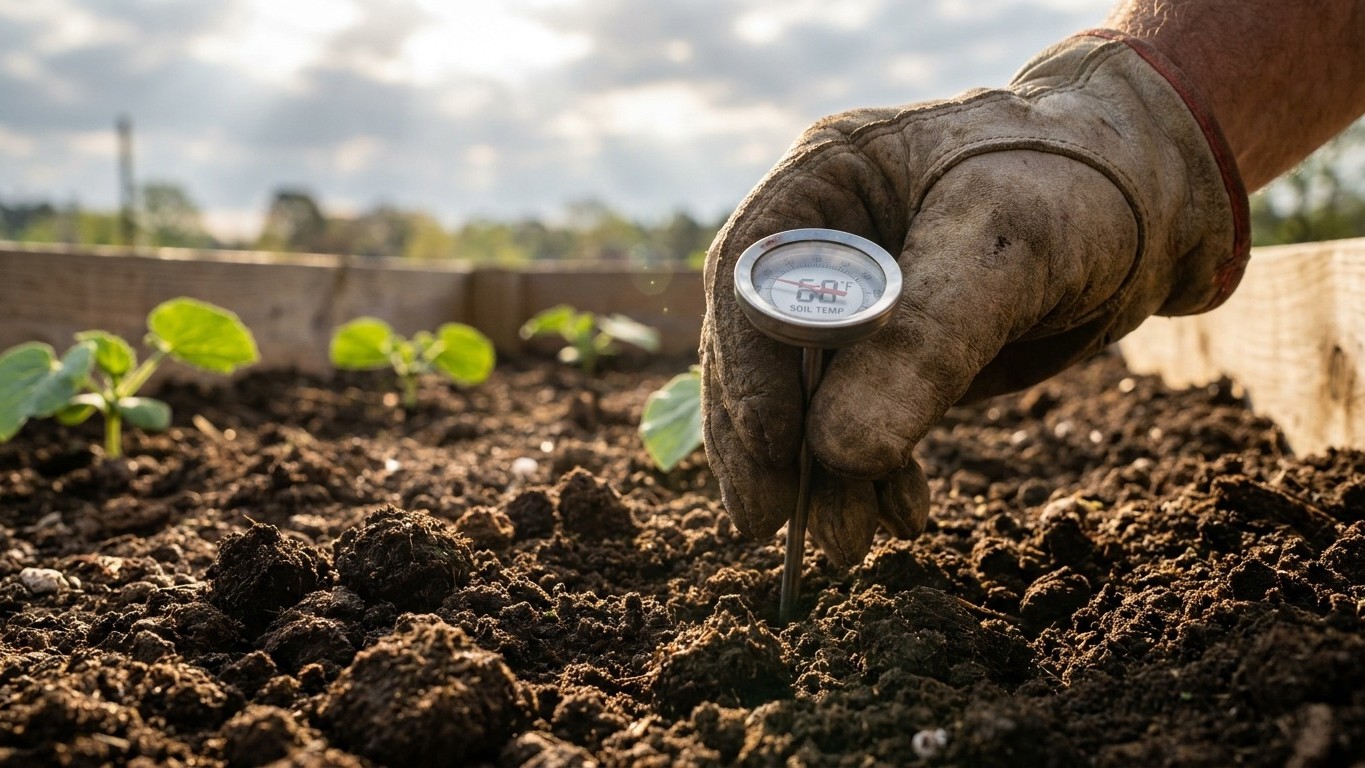

In most of Mississippi, melon seed goes into the ground after the last spring frost has passed and soil temperatures climb into the mid-60s and hold there, generally from late March through April depending on the county. The state’s Zone 7b-9a climate (USDA) gives melons a long, hot growing season, but the trigger isn’t the calendar frost date alone. It’s soil warmth, summer heat accumulation, and how reliably water reaches the root zone.
When the soil is warm enough in Mississippi
The frost math starts with a range, not a single day. At the reference station in Jackson (USW00003940), NOAA’s 1991-2020 Climate Normals put the last spring frost (32°F) somewhere between March 6 and March 22, the window where freeze probability drops from 70% down to 30%. That’s a probability, not a promise: some years slip earlier, some hang on later, and the figure is a starting point for planning, not a guarantee for any single spring.
Melons don’t actually care about the calendar frost date. They care about soil temperature, and that’s where the confusion starts. Frost is a proxy for warming, not the trigger itself. Even after the last freeze risk has passed, cold soil left over from winter can sit in the 50s for another week or two, and melon seed sown into cold ground simply rots or sulks rather than germinating. The safer marker is soil that has warmed into the mid-60s and holds there, which in most of Mississippi trails the last frost date by roughly one to three weeks, depending on how much direct sun the bed gets and whether it’s covered with dark mulch or plastic.
Gardens outside the Jackson city limits should expect the frost window to shift later in spring and earlier in fall than the airport figures show, sometimes by one to two weeks, more in low-lying or elevated pockets. A creek-bottom garden in a rural county can hold frost risk into early April even when the nearest weather station has already cleared its 30% threshold.
The state sits in USDA Hardiness Zone 7b-9a, a range built entirely on average annual extreme minimum winter temperature, not on spring warming speed. It’s useful for choosing perennials that need to survive winter, but it says nothing about when melon seed is safe in the ground. For that, a soil thermometer pushed two inches into the bed tells a gardener more than the zone number on a seed packet.
Waiting an extra week after the frost window closes costs little in Mississippi, given how long the frost-free season runs here. Rushing seed into cold soil, on the other hand, tends to mean a re-sowing in April anyway. Checking with Mississippi State University Extension for local planting calendars, calibrated county by county, is the most reliable way to pin the date down beyond the state-wide range.
How long the season lasts here
Run the two ends of the frost calendar together and Mississippi’s frost-free window looks generous. Using the same Jackson station, the last spring frost falls between March 6 and March 22, and the first fall frost arrives between November 7 and November 22. Taken at their most conservative (planting only after March 22, expecting frost risk back by November 7), the window still runs about 230 days. Taken at the wider ends of each range, it stretches past 260 days, close to eight and a half months of frost-free growing.
That’s a long season by national standards, and it changes the calculus for melon growers in a specific way: a single spring sowing is rarely the only option. With well over 200 frost-free days on the table, there’s enough time for an early sowing to mature, get cleared, and be followed by a second planting timed to finish before the fall frost window opens in November. Growers further north, working with 150-day windows, don’t get that luxury. A Mississippi gardener effectively does, provided the bed is refreshed and the second sowing is timed to still finish fruit-fill before high summer’s worst heat, or after it, ahead of the return of fall frost risk.
The length of the season also changes whether starting melon indoors and transplanting is worth the trouble. In short-season Territories, a head start under lights is often the only way to get fruit before frost. In Mississippi, direct-seeding once the soil has warmed is realistic across most of the state, since there’s little urgency to shave two or three weeks off the front end. Transplants still have a place, mainly to dodge early-season pest pressure or get a jump on a second succession, but they’re a convenience here, not the necessity they are in a shorter-season garden farther north.
The trade-off worth weighing before committing to a second sowing is mid-summer heat stress, since a July sowing has to survive the hottest weeks of the year before it reaches the cooler ripening stretch of early fall. For the mechanics of staggering sowings, from bed prep to timing the gap between plantings, the site’s succession sowing guide walks through the general method that applies to any long-season territory.
Heat and water in Mississippi
Heat load, not day length, separates a melon-friendly territory from a marginal one, and Mississippi’s numbers lean firmly toward the hot side. At the Jackson reference station, the 1991-2020 normal counts 71.1 days a year at or above 90°F. That’s not a handful of scorching afternoons; it’s roughly ten weeks’ worth of days pushing evaporation rates up and stressing any plant with a shallow root system. Melons, which evolved for exactly this kind of heat, generally handle it well once established. What suffers under 71 days above 90°F is the seedling stage, and any planting given no room for airflow around the leaves.
Rain doesn’t offset that heat as much as the raw total suggests. Summer rainfall across June, July and August averages about 14.1 inches at the same station, out of 57.4 inches for the year. Broken down month by month, the pattern isn’t flat:
| Month | Average rainfall |
|---|---|
| June | 4.43 inches |
| July | 5.02 inches |
| August | 4.69 inches |
June, the driest of the three and typically the month when young melon vines are establishing their root systems, is also when a gap between waterings matters most. And 14 inches spread across three months rarely arrives evenly. Mississippi summer rain tends to come as thunderstorms, dumping an inch in an afternoon and then nothing for a week and a half, which means much of it runs off rather than soaking down to where melon roots are working. Combined with 71 days of 90°F-plus heat driving evaporation, the rainfall total looks more comfortable on paper than it behaves in a real garden.
What that means in practice is that irrigation, not rainfall, ends up deciding how large the fruit gets, and the final two to three weeks before harvest are where soil moisture consistency shapes sugar content, since irregular watering late in ripening is a common cause of bland or split fruit. Soil type changes the math further: a sandy bed drains that June rain within a day and needs watering on a tight rotation, while a clay soil holds moisture for a week but can also stay too wet after a heavy storm, inviting the root rot and mildew that thrive in humid heat. A rain gauge on the actual plot, checked weekly through the season, tells a gardener more than any regional average ever will.
Which melons suit Mississippi
With a frost-free window running 230 to 260-plus days and 71 days a year above 90°F, Mississippi removes some of the pressure that shapes melon choice farther north. A short-season territory forces gardeners toward the earliest-maturing types simply to beat frost; that constraint barely applies here, since even a full-season type has months of margin before the first fall frost risk in November. That opens the door to choosing melons by other criteria: airflow tolerance, root-zone heat handling, and above all, disease resistance.
Humidity paired with heat, the exact combination Mississippi summers deliver, is where powdery and downy mildew take hold, along with fungal leaf spots that spread fastest on wet foliage in still air. In this climate, a type’s disease resistance profile matters more than how many days it takes to mature, because a vine that succumbs to mildew in August never gets the chance to finish ripening anyway, no matter how much season remains on the calendar. Spacing vines for airflow, keeping foliage dry through drip irrigation rather than overhead watering, and mulching to keep the root zone from overheating do more for a Mississippi melon crop than picking based on a maturity date.
This is also the point where naming a specific variety would do more harm than good. Every seed catalog markets dozens of cultivars, and which ones actually perform against Mississippi’s particular mix of heat, humidity and disease pressure changes from year to year and even county to county, as new resistant lines get trialled and older ones fall out of favor. A page like this one, working from climate normals rather than local trial data, has no way to know which cultivar is holding up this season in Hinds County versus the Delta versus the Gulf Coast counties. That’s a job for people running actual variety trials on the ground.
Mississippi State University Extension publishes exactly that kind of trial data, updated as new disease-resistant lines come through, and its county offices can point to what’s performed well in a specific area recently. Starting there, with the type of melon decided by this territory’s heat and humidity, and the specific variety decided by current local trials, is the combination that actually holds up in a Mississippi garden.