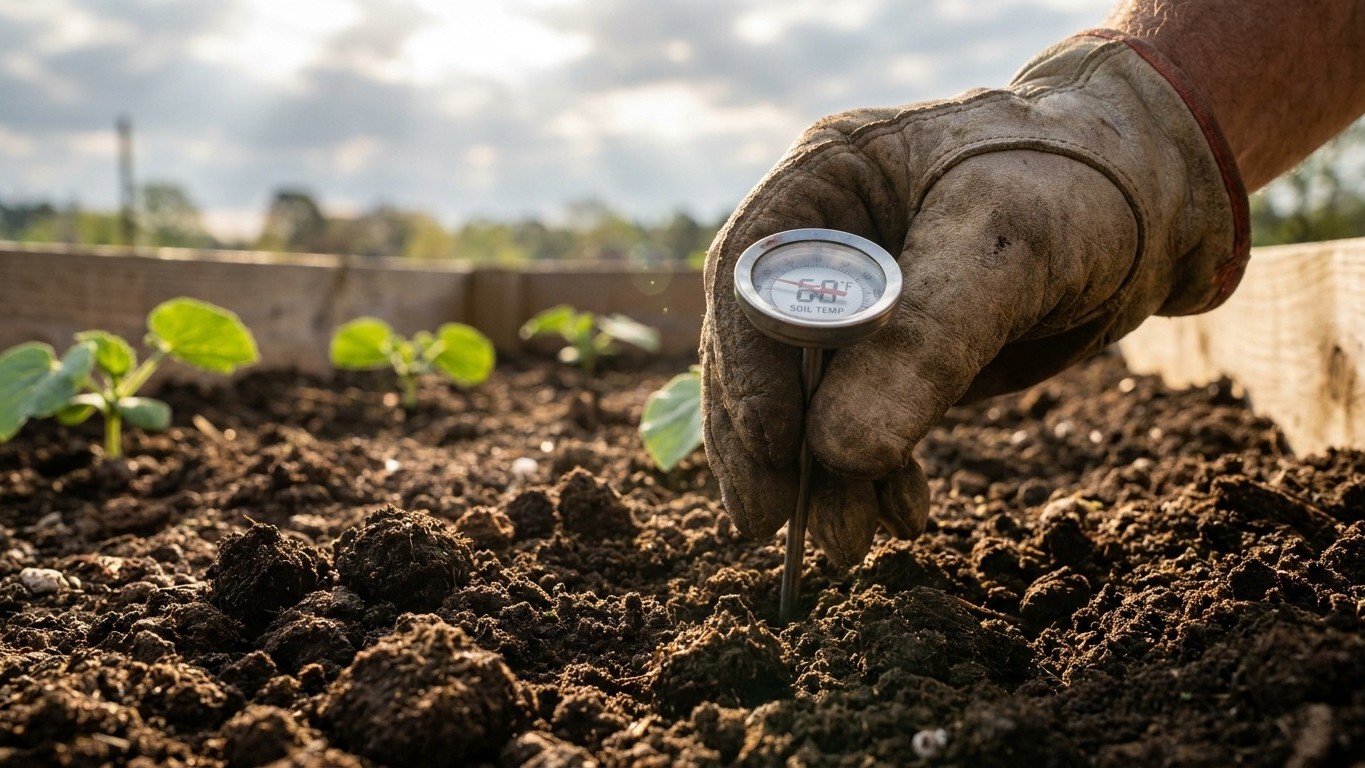

Melons need soil in the mid-60s Fahrenheit and a long stretch of warmth to ripen, and Virginia’s growing window runs from around late March in the Tidewater lowlands to well into November, though the exact dates shift by weeks depending on where in the state you’re standing. Coastal gardeners have the easiest run; mountain gardeners need to adjust everything that follows.
When the soil is warm enough in Virginia

At Naval Air Station Oceana, the reference station NOAA uses for coastal Virginia, the last spring frost falls somewhere between March 20 and April 3, based on 1991-2020 climate normals. That’s a probability window, not a guarantee, built from three decades of freeze data, and it only tells you when the 30 to 70 percent freeze risk clears, not when your soil is actually ready for melon seed.
That distinction matters more for melons than for almost any other garden crop. Melon seed germinates poorly, if at all, in cold ground, and the seedlings sulk and yellow if they’re set out too early. The frost date is a proxy people reach for because it’s easy to remember, but the real trigger is soil temperature holding in the mid-60s Fahrenheit or higher, several inches down, for a run of days. In practice that means waiting two to three weeks past the last frost date in most of the state, even in the mild coastal zone, before direct-seeding or transplanting melons outdoors.
Why the frost date misleads more inland
The Oceana station sits in Virginia Beach, the mild end of the state’s climate spread. The Blue Ridge and southwest Virginia run weeks later in spring, which means both the frost clearance and the soil-warming lag stack up later there. A gardener in the Shenandoah Valley or the far southwest shouldn’t borrow the coastal date at all; they should treat it as a floor, not a target, and expect their own safe planting window to open well into April or even early May depending on elevation.
Virginia’s USDA hardiness zones span 5a to 8b across the state, a range built entirely on average annual extreme minimum winter temperature, which is a different measurement from frost timing but tells the same story: this is not one climate, it’s several stacked on top of each other by elevation and distance from the coast. Warming the soil artificially, with black plastic mulch or row cover laid down a week or two before planting, is the one practice that works everywhere in the state regardless of which end of that zone range a garden falls in. It doesn’t move the calendar, but it lets a gardener use the earlier part of their window with less risk of a stalled stand.
Type matters here too, though not by name. Faster-maturing types tolerate a slightly cooler start better than the long-season types, simply because they have less ground to make up if the first few weeks run cool. That distinction becomes more useful once the length of the whole season is on the table, which is the next question.
How long the season lasts here
Subtract the two ends of the frost-free window and coastal Virginia’s growing season runs from roughly March 20-April 3 on the early side to November 10-24 on the late side, both drawn from the same Oceana station normals. That’s somewhere in the neighborhood of seven and a half months at the outside edges, though the usable warm-season stretch for melons, which need real heat rather than just frost-free air, is shorter than that raw span suggests.
A window that long changes what’s worth attempting. In coastal and Piedmont Virginia, a gardener who gets an early-type melon into the ground in April has enough season left to consider a second sowing in early-to-mid summer, timed so the fruit matures well before the first fall frost risk in November. That’s a real option here in a way it isn’t in states with a six-week shorter season. It also means transplanting is worth the effort and the root disturbance risk: starting seed indoors three to four weeks before the safe planting date gives a head start without eating into the back end of the season, since there’s slack to spare.
Where the mountains change the math
Inland and mountain Virginia doesn’t get that same slack. With a later spring and an earlier fall, the effective window shrinks, and a second sowing becomes a gamble rather than a bonus. In those areas, the first sowing needs to be the reliable one, which raises the case for transplants over direct seeding, since a transplant buys back two to three weeks that a struggling southwest Virginia gardener can’t otherwise recover. It also argues for choosing types on the earlier end of the maturity spectrum, since there’s less room to absorb a slow start or a cool stretch mid-summer.
Anyone planning a second sowing, or weighing whether their local window supports one, should work through the succession sowing guide on this site, which lays out the timing math in more detail than a single-territory page can. The short version for Virginia: coastal and central gardeners have room to stagger plantings, mountain gardeners generally don’t, and the frost dates above are the numbers to build that decision around, not a rounded estimate.
Heat and water in Virginia

Virginia Beach averages 26.0 days a year at or above 90 Fahrenheit, based on 1991-2020 NOAA climate normals. That’s a moderate number, not the kind of relentless summer heat load you’d see further south or further inland in the Southeast, and it matters because melons ripen on accumulated warmth over the season more than they do on any single hot week. Twenty-six days above 90 is enough heat to finish a melon crop, but it isn’t so much that heat management becomes the gardener’s main job the way it is in hotter territories.
What that moderate heat count means in practice is that timing and soil warmth do more of the work here than shade cloth or heat mitigation. A gardener in a cooler part of the state, further from the coast or at higher elevation, sees fewer of those 90-degree days than the reference station records, and for them the earlier-maturing types and the soil-warming techniques from the first section carry even more weight, because they can’t count on a long hot stretch to bail out a slow start.
What the rain numbers add
Summer rainfall averages about 15 inches across June, July and August at the same station, out of 46.6 inches for the year, with June the driest of the three months at 4.15 inches, July the wettest at 5.76, and August in between at 5.09. That’s a meaningfully wet summer compared to the arid melon-growing regions of the country, and it changes the whole risk profile: Virginia’s melon problem isn’t usually keeping vines alive through drought, it’s managing the fungal disease pressure that comes with regular rain landing on warm, humid soil.
Powdery and downy mildew, along with slower fruit ripening in a stretch of overcast, rainy weather, are the realistic risks in a Virginia summer, more than the water-stress problems a Southwestern or High Plains grower deals with. That argues for spacing vines generously for airflow, watering at the soil line rather than overhead when supplemental irrigation is needed, and treating disease resistance as a real selection criterion rather than an afterthought. None of the 15 inches of summer rain arrives on a fixed schedule either; it comes as thunderstorms that can run off a clay soil or a sloped bed rather than soak in, so a rain gauge on the actual garden bed is worth more than the regional average for deciding when to water.
Which melons suit Virginia
Given a shorter, cooler start in much of the state and a wet, moderately hot summer once things get going, the case in Virginia leans toward earlier-maturing types, especially anywhere outside the immediate coastal plain. A short effective season, particularly in the Blue Ridge and southwest, rewards the type that finishes fastest rather than the one that produces the largest fruit; there’s simply less margin to let a slow-ripening type catch up if June or July run cooler than average.
The moderate heat load, 26 days above 90 at the reference station, means airflow and root-zone conditions matter more than shade or heat-blocking measures. Raised beds or ridges that keep roots from sitting in saturated soil after a summer thunderstorm do more good here than anything aimed at blocking sun. And because the state’s summer rain arrives reliably enough to keep humidity up through July and August, disease resistance, particularly to the mildews, deserves to be the first thing a gardener checks, ahead of size or flavor claims, when comparing types.
None of that points to a specific variety. The types trialled and recommended for Virginia’s conditions change from year to year as new disease-resistant lines come through university trials, and what performs well in Virginia Beach’s sandy, mild coastal soil isn’t necessarily what does best in southwest Virginia’s shorter, cooler season. The Virginia Cooperative Extension Service, run through Virginia Tech, publishes current variety recommendations by region at ext.vt.edu, and that’s the source worth checking before buying seed, because it reflects trial results specific to Virginia’s soils and climate rather than a general national list. Naming a variety on a page like this one, without that local trial data behind it, would be a guess dressed up as advice, and melon growers notice that kind of guess the moment their vines don’t perform.