
Nevada’s answer depends less on a fixed date than on elevation: melons wait for warm soil, not just for the calendar, and this state stretches from low desert basins to mountain valleys with wildly different soil-warming timelines. Before sowing anything, the surest move is checking with your county’s University of Nevada Cooperative Extension office, because a statewide date simply doesn’t exist here.
When the soil is warm enough in Nevada
The only frost data available at reference-station precision for this state comes from Las Vegas: NOAA’s 1991-2020 Climate Normals put the last spring frost (32F) in a probability band running from January 7 to February 1, recorded at station USW00023169. That’s an oddly early window, and it needs a flag before anyone acts on it: this is a desert urban-heat-island reading from an airport tarmac in the hottest, lowest corner of the state. It describes almost no frost season at all, which is exactly the kind of extreme that makes it useless as a stand-in for Nevada as a whole.
Reno, Carson City, and pretty much anywhere above valley-floor desert elevation freeze months later in spring and months earlier in fall than that Las Vegas figure suggests. A frost date, even a good one, is a probability rather than a promise, and Nevada’s range of hardiness zones, 4a to 10a on the USDA Plant Hardiness Zone Map, tells the real story better than any single station can: this is one state holding both near-frost-free desert floor and mountain-valley cold pockets that behave more like the northern Rockies.
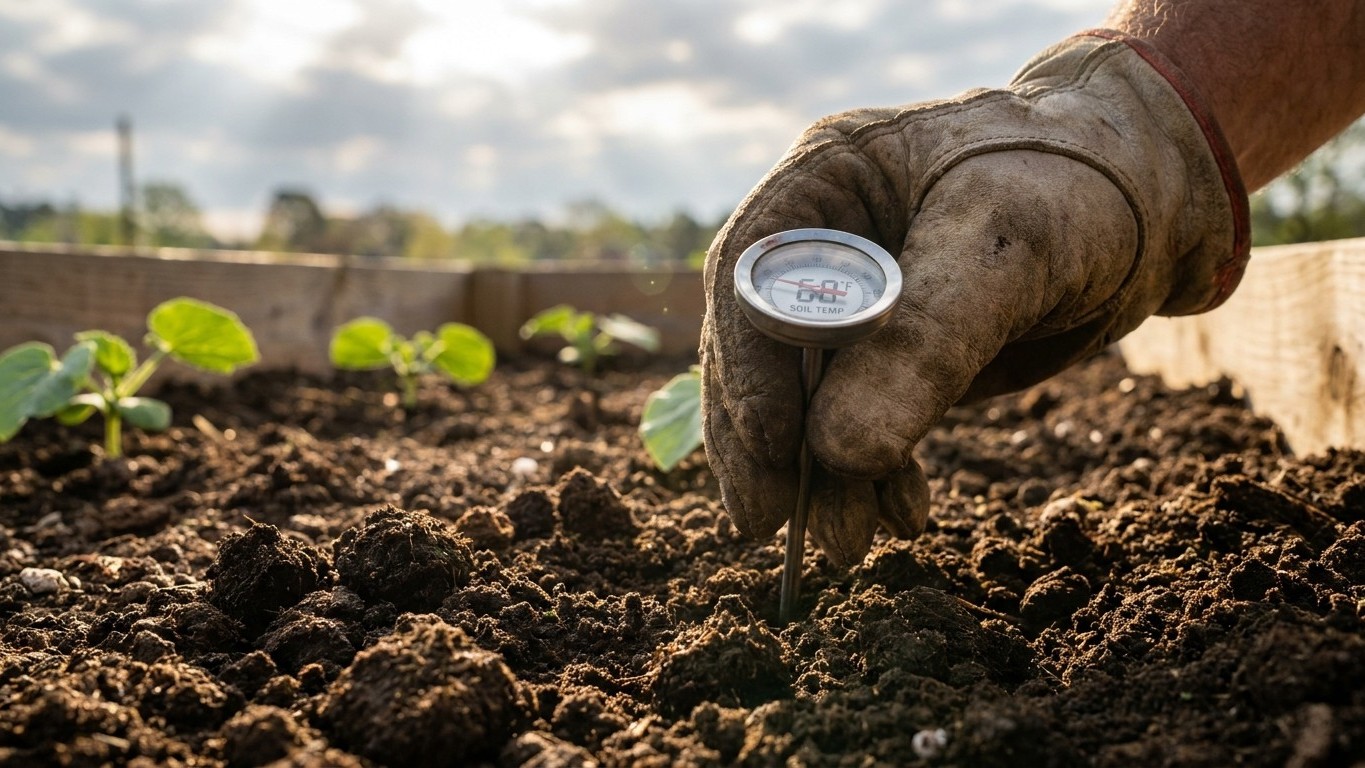
What actually determines melon-sowing day isn’t the frost date anyway, it’s the soil a few inches down. Melon seed germinates poorly in cold ground regardless of what the air is doing, and soil in sandy desert basins warms faster than soil in higher, heavier-textured mountain valleys. That gap between “frost risk has passed” and “soil is actually warm” can run two to four weeks depending on your ground and your aspect, longer if you’re gardening on clay or in shade.
Rather than borrow the Las Vegas date for a Reno or Elko garden, or the reverse, check with your county’s UNR Extension office at extension.unr.edu for soil-temperature guidance specific to your elevation. Extension staff track local soil warm-up better than any national normal can, and they’ll know which melon types have actually been trialled in your part of the state, since a name that thrives in Clark County isn’t necessarily one worth planting in Washoe County.
How long the season lasts here
At that same Las Vegas reference station, the first fall frost falls in a band from December 8 to December 23. Paired with the spring band of January 7 to February 1, the arithmetic gives a frost-free stretch running somewhere between 310 days (measuring from the latest spring date to the earliest fall date) and 351 days (from the earliest spring date to the latest fall date). Either way, that’s close to a full calendar year without a hard freeze, which is a striking number, but again: it belongs to one desert airport, not to Nevada.
Everywhere else in the state, the window is shorter, in some mountain valleys considerably shorter, because those same freezes arrive earlier in fall and linger later in spring. Nevada doesn’t have one growing season length; it has a spectrum running from that near year-round low-desert window down to something much tighter at elevation.
The length that applies to your actual garden decides how you plant. Where the frost-free stretch runs long, as it does across the low desert basins, there’s room for melons to go in as both an early planting and a second, later sowing, spacing out harvest and hedging against a rough first batch. Where the window is short, as it is at higher elevation, the first sowing effectively becomes the only sowing, and transplanting young plants rather than direct-seeding starts to matter more, since it buys back some of the weeks a short season otherwise costs. Anyone weighing whether a second round is realistic for their own plot should work through the succession sowing guide on this site, matching it against their county’s actual frost dates rather than the desert extreme cited above.
Heat and water in Nevada
Summer heat load at the Las Vegas reference station runs to 131.3 days a year at or above 90F, a NOAA 1991-2020 normal that measures accumulated heat stress rather than an average temperature. That’s a heavy count, and it matters more for melons than the calendar date they go in the ground, since these plants respond to accumulated warmth far more than to days elapsed. In territory carrying a heat load like this, the sowing date is almost secondary; irrigation and shading decisions do the heavier lifting.
Rainfall doesn’t offset any of that. Summer precipitation across June, July, and August averages about 0.7 inches, out of roughly 4.2 inches for the entire year, at that same reference station. June is the driest month of the three at just 0.04 inches, July brings 0.38 inches, and August 0.32 inches. Read together, those numbers describe a summer where almost nothing falls from the sky and the air is actively pulling moisture out of the soil on well over a hundred days.
That combination, heavy heat and negligible rain, hands irrigation the deciding role in how large the fruit gets, and hands the final two weeks before harvest the deciding role in how sweet it turns out. Consistent watering through the bulk of the growing period builds fruit size; easing off in that last stretch is what concentrates sugars rather than diluting them with excess water. None of this happens on its own here, since a summer thunderstorm arriving as a single downpour on parched, heat-baked ground mostly runs off instead of soaking in, so a rain gauge on your own plot tells you less than a soil moisture check does. Where elevation trims that 90F+ count, the calculus shifts: less heat load means less evaporative demand, but it also raises the risk of slower ripening, so the emphasis moves from managing water stress to managing patience.
Which melons suit Nevada
Choosing a melon type for this state means reasoning from those two extremes rather than reaching for a specific variety name, and there’s a real reason for that restraint: the varieties actually trialled and known to perform in Nevada conditions are tracked by University of Nevada Cooperative Extension, not by this page, and a name picked at random risks steering a reader toward something that’s never been tested against Las Vegas heat or a Carson City short season.
Still, the type-level logic holds regardless of which part of the state you’re gardening in:
- In the low desert, where the 90F+ day count runs past 130, types that tolerate sustained heat and benefit from airflow around the vine and some shade at the root zone hold up better through the peak of summer.
- At elevation, where the frost-free window shortens well below the desert-floor extreme, the earliest-maturing types within a category give the best shot at a full ripening period before fall frost arrives.
- Anywhere rainfall stays as thin as the summer normals here suggest, drought tolerance and irrigation compatibility matter more than any other single trait when weighing one type against another.
Working through those trade-offs with your county Extension office, reachable through extension.unr.edu, gets you a variety list that’s actually been grown and observed in your part of Nevada. That’s not a dodge; it’s the honest answer for a state where the growing conditions in one county can look almost nothing like the next.