
Melons can produce in Wyoming, but only with deliberate help: black plastic or row cover to warm the soil, a short-season type, and irrigation through a summer that gives less than six inches of rain. Skip those three and the vines simply run out of time before a single fruit ripens.
When the soil is warm enough in Wyoming

Gardeners always ask for a date, so here it is: the last spring frost at station USW00024018 falls somewhere between May 7 and May 18, according to NOAA NCEI’s 1991-2020 Climate Normals, calculated from the 30-70% probability band for a 32F freeze. That is not a promise. It is a probability window built from thirty years of records, which means some years the last frost lands earlier, and some years it lands later, sometimes well past May 18 at higher elevations.
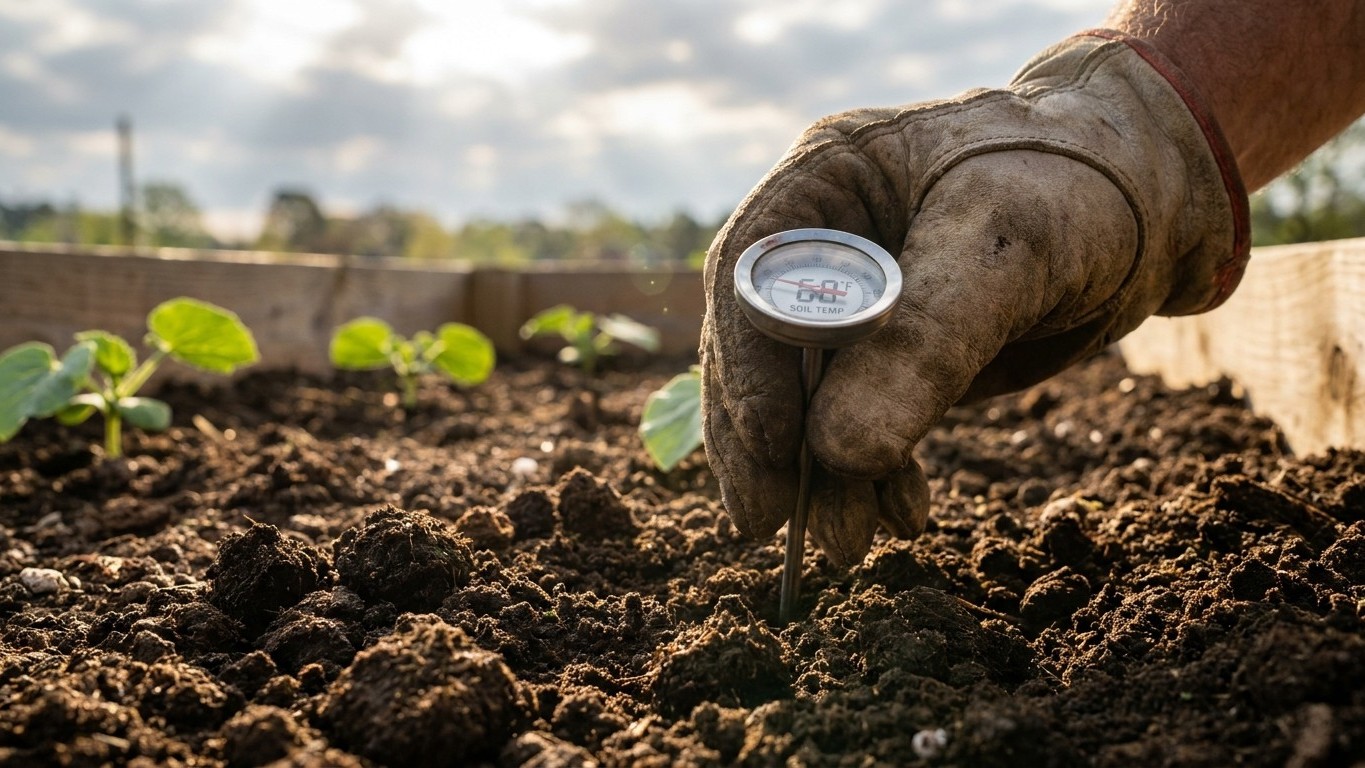
That date matters less than gardeners think, though, because melons do not care about frost. They care about soil temperature, and soil warms on its own schedule, usually two to three weeks after the frost risk has cleared. A melon seed dropped into 55F soil will sit and rot before it germinates. It wants soil pushing past 70F, ideally with warm nights to match, because a cold night can stall growth even when the daytime reading looks fine. In much of Wyoming, at elevations near 6,000 feet, that combination doesn’t arrive reliably until deep into May or even early June.
This is also useful context: the USDA Plant Hardiness Zone Map (2023 edition, based on 1991-2020 normals) places Wyoming across a wide band, from zone 3a to zone 6a, built on one variable only, the average annual extreme minimum temperature. That range tells you almost nothing about frost-free days or summer heat, but it does confirm what any gardener here already suspects: conditions swing hard between a valley floor and a benchland a few hundred feet higher, and the zone number for the state as a whole is close to useless for a planting decision. The reference city tied to the same weather station cited above is Cheyenne, and that’s the number worth anchoring to if you garden near there.
Practically, this means the calendar date is a starting point, not a trigger. Black plastic mulch laid two to three weeks before the expected transplant date can raise soil temperature several degrees, and clear or slitted row cover does the same for air temperature around young plants. Given roughly 130 frost-free days at 6,000 feet, and the fact that frost is possible in any month at higher elevations, season extension in Wyoming isn’t a bonus technique. It’s close to mandatory for melons to have any real shot.
How long the season lasts here
Run the two frost dates from the same NOAA NCEI normals together and the frost-free window at station USW00024018 stretches from somewhere between May 7 and May 18 in spring, to somewhere between September 24 and October 5 in fall. Depending on which end of each range you land on in a given year, that’s a season running from roughly 129 days, on the short end, to about 151 days on the long end. NOAA’s own note for this station backs that up in plain terms: roughly 130 frost-free days at 6,000 feet, with frost possible in any month at the higher elevations across the state.
A window that size changes the strategy, not just the math. Melons typically need somewhere in the range of 70 to 90 days from transplant to harvest depending on type, so at the low end of Wyoming’s frost-free window, there’s little margin left over once you account for the two to three weeks of soil-warming lag described above. That rules out a second sowing for almost anyone gardening here. One planting, timed as early as row cover and black plastic allow, is the realistic target, and transplants started indoors under lights typically buy more usable time than direct-seeding, since melons dislike root disturbance and need a careful hardening-off before they go in the ground.
At the higher end of the range, closer to 150 days, there’s slightly more breathing room, enough that a gardener who loses an early planting to a late cold snap might still get a second attempt in before the fall frost risk climbs back up. That’s the exception, not the rule, though. For most Wyoming gardens, the frost-free window is the single constraint that shapes every other decision, from which type of melon to grow to whether transplanting is worth the risk to the roots. Gardeners weighing a second sowing anywhere with more room to work should look at the site’s succession sowing guide, which lays out how to judge whether a shorter window still leaves space for a follow-up crop.
Heat and water in Wyoming

Melons ripen on accumulated warmth, not on the calendar, and Wyoming’s numbers are modest on that front. At the Cheyenne reference station, NOAA’s 1991-2020 Climate Normals put the average at just 10.4 days a year reaching 90F or higher. That’s a fairly low heat load compared to melon-growing regions further south, and it means the days-to-maturity figure a seed packet lists elsewhere often runs longer here, because the accumulated warmth those numbers assume simply doesn’t build as fast.
With a heat load that light, the type of melon and the soil-warming technique matter more than the exact sowing date. Black plastic mulch, row cover, and siting the planting against a south-facing wall or slope where the sun concentrates all do real work in a territory where the sun alone won’t push soil and air temperatures fast enough on its own. This is not a hot-climate garden problem where the challenge is protecting fruit from scorch. It’s the opposite: coaxing enough cumulative heat out of a short, moderately cool summer to finish the crop before fall frost arrives.
Rainfall runs light too. Summer precipitation at the same reference station averages about 5.8 inches across June, July and August, out of roughly 15.4 inches for the whole year. June brings about 2.16 inches, July about 2.11, and August, the driest of the three, drops to 1.52 inches. That’s not the profile of a wet, humid summer where mildew and slow ripening are the main threat. It’s dry enough that irrigation, not rainfall, will decide how large the fruit grows, and a rain gauge on the actual garden plot matters more than any regional average, since a rain shadow, a slope, or a nearby town can shift the local figure meaningfully.
Consistent watering through fruit set and sizing, then easing back in the final couple of weeks before harvest, is the practice most likely to affect sugar content at the end. Sandy soils here will need watering more often than clay, since the same inch of rain or irrigation moves through sand within a day but lingers in clay for closer to a week. Given the combination of a light heat load and dry summers, drip irrigation or soaker hoses generally outperform overhead watering, both for conserving a scarce resource and for keeping foliage dry in a state where disease pressure is otherwise not the primary threat.
Which melons suit Wyoming
The frost-free window and the modest heat load both point the same direction: the earliest-maturing types of melon give a Wyoming garden its best odds, since anything requiring a long, hot stretch to finish is racing a calendar that rarely cooperates here. Within that category, gardeners generally choose between compact, fast-finishing muskmelon types and smaller-fruited types bred for shorter, cooler seasons, both of which ask less of a summer that averages just 10.4 days above 90F.
Airflow around the vines and warmth at the root zone matter more than shade here, since Wyoming’s heat load doesn’t threaten scorch the way it does in hotter states. Black plastic mulch under the vines, row cover removed once flowering begins to allow pollinators access, and a planting site that catches full sun and some wind protection all help close the gap between what the season offers and what a melon needs to ripen.
Seed catalogs list dozens of melon cultivars, and which ones actually perform at 6,000 feet in a given Wyoming county depends on local trial results. The University of Wyoming Extension runs exactly those trials, tracking which types hold up against the local frost dates, heat load, and soil conditions county by county. That local trial data, not a generic list of cultivar names, is the recommendation actually worth following.
What generalizes safely across the state is the shape of the decision: shortest maturity window available, disease resistance as a secondary filter given how dry the summers run, and soil-warming techniques treated as standard practice rather than an optional extra. Beyond that, the county extension office is the source that knows what’s actually been tested on ground like the reader’s own.