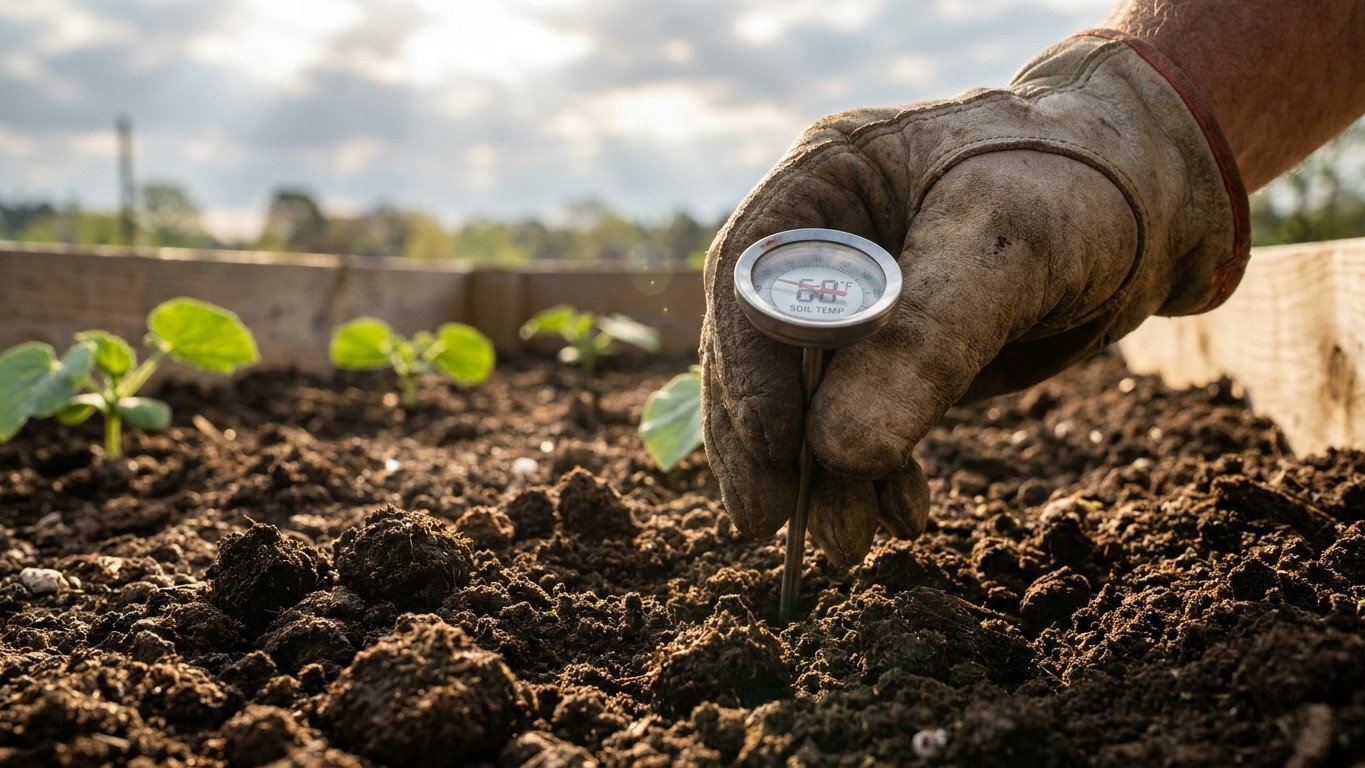

Melons can be grown in Saskatchewan, but the approach differs sharply from a Georgia or Texas garden: the season is short, heat is scarce, and success depends on soil-warming tricks and transplants rather than direct seeding. Pick an early-maturing type, warm the ground before planting, and treat every extra week of heat as a bonus, not a given.
When the soil is warm enough in Saskatchewan
Gardeners always ask for a date, so here is the one the record actually gives: the average last spring frost at Saskatoon SRC runs May 18, according to Environment and Climate Change Canada’s Canadian Climate Normals for 1981-2010. That’s a mean, not a guarantee. Half the years on record saw frost arrive after that date, sometimes well after. Treat May 18 as the midpoint of a window, not a green light.
Frost dates matter for melons only as a rough proxy. What actually decides planting day is soil temperature, and soil lags behind the air by days to weeks. A patch of clay soil that was frozen solid in April doesn’t just thaw the moment frost risk ends, it needs sustained warmth to reach a temperature where melon roots will grow instead of sulk. In a province where the reference station sits at Canadian hardiness zone 3a (this is the Canadian system, built on seven climate variables, and it does not translate to a USDA zone number), that lag is longer than gardeners moving from a milder region expect.
Warming the ground before the seed goes in
Because air temperature and soil temperature part ways so clearly here, most successful melon growers in this province skip direct seeding altogether. Common practice includes:
- Starting seedlings indoors three to four weeks ahead, then hardening them off before transplanting
- Laying dark plastic mulch over the bed for a week or two before planting to pull soil temperature up
- Using raised beds or mounded rows, which drain and warm faster than flat, heavy ground
- Covering young plants with row cover or cloches for the first few weeks after transplanting
None of these are exotic techniques, and none require naming a specific product or brand to matter. What they share is a single goal: closing the gap between when frost risk fades on the calendar and when the soil actually behaves like a place a melon root wants to live. Skip that step in a zone 3a location and a transplant can sit stalled for two or three weeks, time this province’s season can’t spare.
How long the season lasts here
Subtracting the two mean dates from the same Saskatoon SRC record gives a frost-free window of roughly 123 days: last spring frost on May 18, first fall frost on September 18, both from ECCC’s 1981-2010 Canadian Climate Normals. That’s the number to plan around, and it’s shorter than what a melon grown from seed in a warmer state gets to work with.
A window that size changes the strategy, not just the dates. In regions with a five- or six-month frost-free stretch, gardeners can sow a first melon crop, harvest it, then sow a second round for a fall picking. Saskatchewan’s roughly four-month window doesn’t leave room for that. One planting, timed as tightly as the soil allows, is realistically the only shot most years. That single-shot reality is also why transplants earn their keep here: starting indoors effectively buys back two to three weeks that direct seeding would burn waiting for soil warmth outdoors.
What the short window means for technique
With no room for a second sowing, the checks that matter shift. Root health at transplant time becomes worth inspecting closely, since a stressed or rootbound seedling loses days it cannot recover in a 123-day season. Spacing and airflow decisions also carry more weight, because there’s no fallback planting to correct a bad stand later in the summer.
| Milestone | Date (Saskatoon SRC average) |
|---|---|
| Last spring frost | May 18 |
| First fall frost | September 18 |
| Frost-free window | About 123 days |
Gardeners weighing whether a second sowing is worth attempting anywhere near this province should read the site’s guide to succession sowing timing, which lays out how much frost-free length a second planting actually needs before it pays off.
Heat and water in Saskatchewan
Melons are built to chase heat, and this is the section where the local numbers push back hardest against that instinct. The Saskatoon reference station records an average of 0.0 days a year above 90°F, per ECCC’s Canadian Climate Normals for 1981-2010. That is not a typo and not a rounding artifact. Effectively no days in an average year cross that threshold. Melons accumulate the heat units they need over the whole season rather than on any single hot day, but a summer that almost never touches 90°F is one where heat accumulation, not calendar timing, becomes the real limiting factor.
That changes which paragraph applies to this territory. In a hot, dry province, the conversation would center on irrigation deciding fruit size and the final couple of weeks before harvest deciding sugar content. That’s not this province. Saskatchewan’s summer rainfall runs about 6.6 inches across June, July and August (13.9 inches over the full year), with June at 2.59 inches, July at 2.38 inches, and August, the driest of the three, at 1.68 inches, all per ECCC’s Canadian Climate Normals for 1981-2010 at the Saskatoon Diefenbaker Int’l A station. That’s a moderate amount of rain landing during a cool summer, and the combination brings a different set of problems: powdery mildew on leaves that stay damp too long, slow ripening because heat units build gradually rather than in bursts, and fruit that can rot at the point where it touches wet soil.
Managing a cool, moderately wet summer
The practical response leans on airflow and drainage rather than on rationing water. Spacing plants further apart than a seed packet from a warmer climate suggests gives leaves a better chance to dry between rain events. Setting fruit up on something that lifts it off damp soil, straw, an overturned tile, even a scrap board, reduces rot at the contact point. None of this requires naming a fungicide or a rate; the practice itself, keeping foliage dry and fruit lifted, does most of the work in a climate where mildew pressure comes from humidity lingering rather than from a downpour overwhelming the soil.
Which melons suit Saskatchewan
Given a roughly 123-day window, essentially no days above 90°F, and a cool damp summer that favors mildew over sunburn, the reasoning points toward the earliest-maturing melon types available, chosen for how quickly they set and finish fruit rather than for size or storage life. Types bred or selected for short, cool-summer regions consistently outperform the varieties built for a Deep South growing season, because they ask for fewer accumulated heat units to reach ripeness.
This is deliberately where this page stops naming names. Which specific variety within that early-type category performs best changes from region to region and year to year, and the only recommendation worth trusting is one built on local trial data. Saskatchewan’s provincial agriculture service, reachable through Saskatchewan’s Ministry of Agriculture, tracks which varieties have actually performed in provincial trials and local demonstration plots. That list changes as new varieties come through testing, while a name printed on this page would not. Inventing or guessing at a cultivar here would be the one mistake an experienced gardener would catch immediately, and a wrong guess costs a reader a full season in a province that only gets one planting window a year.
What can be said without a name attached: prioritize the earliest maturity ratings within whatever type is being considered, favor disease resistance given the mildew pressure from a cool wet summer, and treat any variety description mentioning “long season” or bred for extreme heat as a poor match for this province’s climate, regardless of how well it performs elsewhere.