
Melons can ripen in Alberta gardens, but the province gives growers almost no margin for error. The Calgary region averages zero days above 90°F a year and a frost-free window of roughly four months, so success here depends less on the calendar and more on trapping heat in the soil, choosing early types, and watching the sky for that first September chill.
When the soil is warm enough in Alberta

Environment and Climate Change Canada puts the average last spring frost at the Calgary Int’l A station at May 21 (1981-2010 Canadian Climate Normals). That date gets repeated in garden calendars across the province, but it’s worth being precise about what it actually means: it’s a mean, not a guarantee. In roughly half of all years, frost arrives after May 21, sometimes well after. Treat it as the midpoint of a risk window, not a green light.
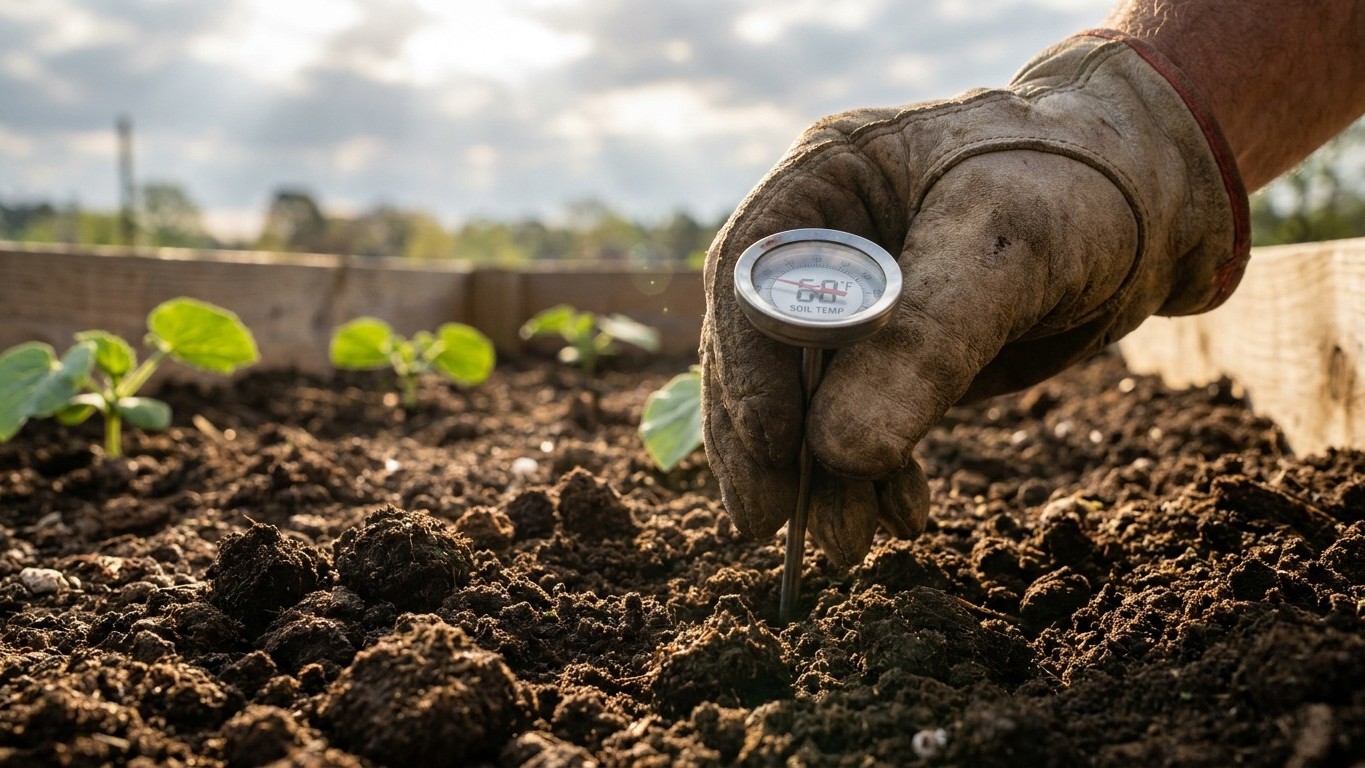
Melons don’t actually care about frost dates. They care about soil temperature, and soil warms up on its own schedule, usually a couple of weeks behind the air. A calendar can tell you the frost risk has passed; only a soil thermometer pushed a few inches down can tell you the ground is ready. Melon roots stall in cold, wet soil even when the air feels pleasant, which is a common trap for gardeners moving north from milder provinces.
This is also where Alberta’s hardiness rating matters. Natural Resources Canada lists the Calgary area at zone 4a under the Canadian plant hardiness system, a seven-variable model that has no direct equivalent on the USDA scale used elsewhere on this site. NRCan is explicit that a single Canadian zone can span nine different USDA zones, so a gardener comparing notes with someone south of the border needs to compare growing seasons and heat, not zone numbers.
Techniques that move the date up
Because Calgary’s soil warms slowly, most successful melon growers in the region don’t wait passively for nature. Common practices include:
- Laying black plastic mulch over the bed two to three weeks before planting, to pull heat into the soil ahead of time
- Using raised beds or mounded rows, which drain faster and warm quicker than flat ground
- Choosing a south-facing spot sheltered from wind, where soil temperature climbs faster in spring
- Covering young plants with row cover or cloches through the first few cool nights after transplanting
None of these tricks change the frost date itself. What they change is how quickly the soil catches up once the frost risk has genuinely passed, which in a short-season province is often the difference between a melon that ripens and one that doesn’t.
How long the season lasts here
Subtracting the two averages from the Calgary Int’l A station, an average last spring frost of May 21 and an average first fall frost of September 16, gives a frost-free window of about 118 days. That’s the working season for anything that can’t tolerate cold, melons included.
A 118-day window is workable but tight. It rules out a second sowing outright: there’s no realistic path to direct-seed a first melon crop, harvest it, and get a second one to maturity before the September frost returns. In provinces with a six-month season, gardeners can gamble on a spring sowing and fall back on a summer one if the first fails. Alberta growers don’t get that safety net. The first planting is effectively the only planting, which raises the stakes on timing considerably.
That single-shot reality is also the argument for starting melons as transplants rather than direct-seeding. A transplant raised indoors for three to four weeks buys back time that the short outdoor season doesn’t offer, provided the root system is checked before it goes in the ground. Melons resent root disturbance, so a transplant grown in a biodegradable or deep cell pot, and hardened off gradually rather than moved straight from a warm windowsill to open ground, tends to handle the transition better than one pulled bare-root from a flat.
Anyone managing this kind of tight window, whether for melons or other warm-season crops, will get more out of a deliberate succession plan than a single guess at planting day. This site’s guide to succession sowing walks through how to sequence plantings when the frost-free period doesn’t leave room for mistakes.
Heat and water in Alberta

Melons ripen on accumulated warmth, not on the number of days that pass. That distinction matters enormously in a region where the Calgary reference station records an average of 0.0 days a year above 90°F. Heat load, not calendar time, is what drives sugar production in melons, and Alberta simply doesn’t generate much of it. A vine can sit in the ground for the full 118-day window and still fall short of ripening if the days never accumulate enough warmth.
This is the single fact that should shape how a grower approaches melons here. In a territory with plenty of hot days, the sowing date is the main lever; irrigation and the final weeks of dry heat decide fruit size and sugar. Alberta is the opposite case. With effectively no days crossing 90°F, the type of melon chosen and the soil-warming technique used matter far more than exactly when seed goes in the ground. Black plastic, row cover, and a sheltered microclimate are doing the job that a hot July would do elsewhere.
Rainfall tells a similar story. Summer rain across June, July and August averages about 8.5 inches at the Calgary station, with June the wettest month at 3.7 inches and August, right when melons are sizing up, the driest at 2.24 inches. That’s not a drought pattern, but it’s also not the kind of dry, irrigation-controlled summer that concentrates sugar in hot-climate melon regions. A cool, occasionally damp Alberta summer brings its own risks: powdery mildew on the leaves, slower fruit set, and vines that simply run out of season before they finish ripening.
None of this means irrigation is irrelevant. Rain that falls as a single thunderstorm often runs off rather than soaking into the root zone, and a stretch of dry August days on shallow-rooted melon vines can still stress the plant even in a province that isn’t hot. A rain gauge on the actual plot, cross-checked against how quickly water disappears into the specific soil there, tells a grower more than any regional average can.
Which melons suit Alberta
Given a 118-day frost-free window and next to no days above 90°F, the honest answer is to favor the earliest-maturing types available, generally the smaller-fruited, quick-ripening categories bred for short, cool seasons rather than the large, slow-ripening types suited to long hot summers. Compact vines or bush-type growth habits also help in a climate where every bit of soil warmth needs to be captured under plastic or row cover rather than spread across sprawling rows.
Airflow becomes a second priority once mildew risk is on the table. Spacing vines a little wider than a seed packet suggests, and pruning back excess foliage once fruit has set, gives leaves a chance to dry between the region’s cooler, damper stretches, which matters more here than in a dry-summer province where mildew is rarely an issue.
What this page won’t do is name a specific variety. Melon trials run by provincial and state extension services test named cultivars against local soil, local pests, and local weather, and those results shift from one growing region to the next in ways a general article simply can’t track responsibly. Naming a variety here, without that local trial data behind it, would be a guess dressed up as a recommendation, and it’s the kind of error a gardener notices the first season it fails to perform as promised.
The reliable next step is Alberta’s agriculture and irrigation service, which tracks which melon types and specific cultivars have actually performed in the province’s short, cool seasons. That local data, refreshed against real trial plots rather than a general climate profile, is the only recommendation worth planting a season around.