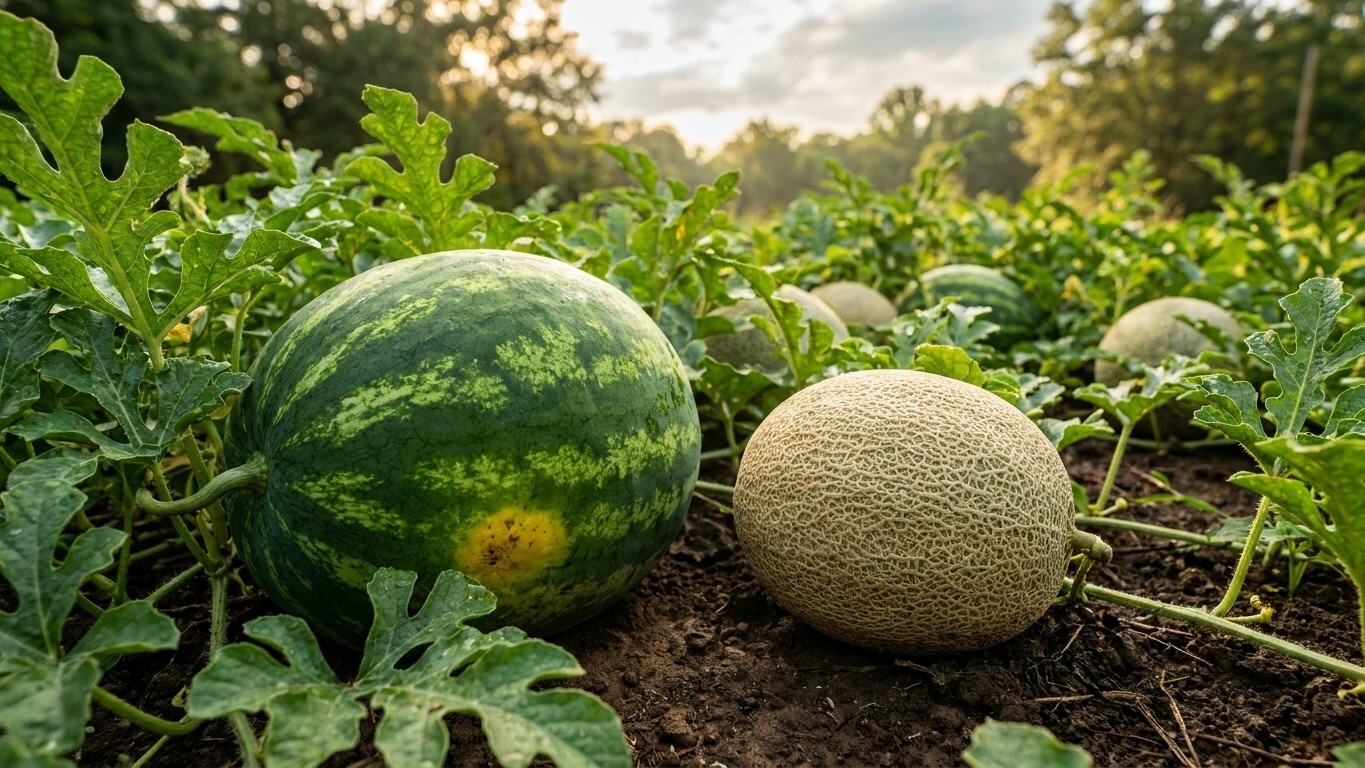

Short-season, cold-tolerant cantaloupe and muskmelon types, started indoors and finished under plastic or in a high tunnel, are the only melons with a realistic shot in Alaska. Full-size watermelons, honeydews, and casabas need heat this state simply doesn’t produce, so the variety choice here is really a choice about season extension.
The short answer for Alaska
Anchorage’s frost-free window runs from roughly May 3 to May 12 on the late-frost end and September 22 to October 1 on the early-frost end, which works out to about 143 frost-free days. That sounds workable on paper, plenty of vegetable crops finish inside 143 days, but melons need more than days on a calendar. They need heat units, and Anchorage averages 0.0 days a year at or above 90°F. Zero. That single number is the reason melon growing in Alaska is a specialty pursuit rather than a routine garden crop.
Given that, the type decision comes down to fast, dwarf, and northern-bred cultivars, not flavor preference. Look for cantaloupe and muskmelon types explicitly marketed as early or short-season, ones bred to set fruit and ripen inside 70 to 80 days from transplant rather than the 85 to 100 days typical of Southern-bred varieties. Compact, personal-size melons (sometimes sold as icebox types) are worth prioritizing because a smaller fruit needs fewer accumulated heat units to finish than a large one, even within the same variety family.
Watermelon is the harder case. Standard watermelon varieties assume long stretches of genuinely hot weather to convert sugars, and with no 90-degree days at all, most large-fruited watermelons simply run out of season before they run out of green rind. Small, early bush-type watermelons exist and occasionally succeed in a warm microclimate or a tunnel, but they should be treated as an experiment, not a reliable crop, anywhere in this state.
What the type decision looks like in practice
| Melon type | Typical days needed | Alaska outdoor prospects |
|---|---|---|
| Early cantaloupe/muskmelon (short-season) | 70-80 days | Possible with black plastic mulch and row cover or tunnel |
| Standard cantaloupe/muskmelon | 85-95 days | Unlikely to finish before first fall frost |
| Icebox/personal watermelon | 75-85 days | Marginal, tunnel strongly recommended |
| Standard watermelon | 90-100+ days | Not realistic outdoors |
| Honeydew, casaba | 90-110 days | Not realistic outdoors, borderline even in a tunnel |
Season extension isn’t optional decoration here, it’s the actual variable that separates a melon harvest from a frozen vine. Black plastic mulch warms the root zone, and a low tunnel or hoop house traps daytime heat that this climate otherwise never supplies on its own.
What will not work here
Any melon variety built around a 90-to-100-day season will lose the race against the calendar in most of this state. Even in the mildest pocket, the frost-free window closes by early October at the latest, and with zero days above 90°F to push growth along, those long-season varieties accumulate heat units far more slowly than they would in a warmer state. A cantaloupe that finishes comfortably in 85 days in Georgia can stall out well short of ripeness here, because the days are cool even when they’re long.
Unprotected, open-field melon growing is the second common failure, independent of which variety gets planted. The heat deficit isn’t a matter of a few degrees, it’s structural: a growing season with no days reaching 90°F cannot supply the warm nights and hot afternoons that trigger fruit set and sugar development in melons bred anywhere south of the Canadian border. Skipping plastic mulch and row cover is the single most common reason a promising short-season variety still fails to produce a ripe fruit.
Watering by a rigid weekly schedule copied from a drier-climate gardening guide is a subtler trap. Summer rainfall here averages about 5.8 inches across June, July, and August, with June the driest month at 1.02 inches and August the wettest at 2.93 inches. That’s a moderate, rising pattern, not the bone-dry summer that forces melon growers elsewhere onto strict irrigation timetables. Watering on autopilot regardless of actual rainfall risks waterlogging roots in a cool soil that already drains and warms slowly, which stresses melon plants just as much as drought does.
Crowding plants tightly under row cover is the last trap, and it matters more here than it might seem. As rainfall climbs toward August, humidity trapped inside a poorly ventilated tunnel or under dense foliage creates ideal conditions for powdery mildew and other fungal problems late in the season, right when the plant needs healthy leaves to finish ripening its fruit. Wide spacing and a tunnel design that can be vented on warm afternoons matter as much as variety choice.
What changes across Alaska
Alaska’s USDA hardiness zone range runs from 1a to 8a, using the USDA Plant Hardiness Zone Map’s single measure, the average annual extreme minimum temperature. That spread is enormous, wider than almost any other state, and it means there is no single melon-growing answer for “Alaska.” The Anchorage-area figures used above (based on reference station USW00026451) describe one of the mildest, most melon-friendly corners of the state, not a statewide norm.
A reader gardening in the Interior, where winter extremes plunge far colder and the growing season compresses even further, should assume a shorter effective window than the 143 frost-free days cited here, and should lean even harder on tunnels, cold frames, or a sunny, wind-sheltered microclimate close to a south-facing wall. Someone in the far north, in the coldest end of that 1a-8a range, is likely outside the realistic range for outdoor melon growing entirely, tunnel or not, and container growing indoors or in a heated greenhouse becomes the more honest option.
At the milder, coastal end of the range, closer to zone 7a or 8a pockets in parts of Southeast Alaska, summers stay cool and often cloudy even though winters are gentler, so the heat deficit that drives the variety decision doesn’t disappear just because the zone number goes up. Hardiness zone measures winter cold, not summer warmth, which is exactly why it can’t be used on its own to judge melon prospects. This page cannot tell an individual reader which zone applies to their own yard. The USDA Plant Hardiness Zone Map, searchable by ZIP code, is the tool for that, and it’s worth checking before choosing how much season-extension effort a given planting deserves.
Where to check this for your own county
The University of Alaska Fairbanks Cooperative Extension Service is the source that goes past what a statewide page like this one can responsibly say. State-level normals, like the Anchorage-based frost dates and heat data cited above, describe one reference station in one part of a state that spans eight hardiness zones. A county-level recommendation from Extension accounts for local elevation, coastal versus interior exposure, and soil conditions that this page has no way to know.
Two things are worth looking for specifically on the Extension site. The first is a local planting calendar, if the county or district office publishes one, since it will reflect actual local frost history rather than the Anchorage-area normals used here as a statewide reference point. The second is any melon or cucurbit variety trial data from a research farm or demonstration garden in or near the reader’s own district, since Extension services occasionally test which short-season melon cultivars actually set and ripen fruit under local conditions, information no general-interest article can substitute for.
A county recommendation beats a state one every time, and this page is deliberately the state one, built to explain the mechanism (short season, no summer heat, wide zone spread) rather than to name a single variety as universally best. Extension offices exist precisely to fill in the local specifics that a statewide climate normal can’t capture, and for a marginal crop like melons in this climate, that local detail is often the difference between a wasted tunnel and an actual harvest.
Checking this against your own garden
Every figure on this page is a regional average, and a reader’s own plot will run warmer, cooler, wetter, or drier than the Anchorage-area station it’s built from. Three direct observations, none requiring any equipment beyond a hand and a pair of eyes, settle the question faster than any date on a calendar.
Soil warmth by feel is the first and most useful. Melon roots stall in cold soil regardless of air temperature, so pressing a bare hand into the planting bed each morning in late spring, rather than trusting a fixed transplant date, tells whether the ground has actually warmed enough to support root growth. Soil that still feels cool to the touch in mid-May, even after the last frost date has passed, means transplanting should wait, black plastic mulch should go down early, or the tunnel needs a few more days closed.
The first flush of male flowers is the second signal worth watching. Melon plants typically produce several male flowers before the first female flower (recognizable by the tiny swelling at its base) appears, and a long gap between the two, or male flowers that drop without any female flowers following, often points to a plant that’s stressed by cool nights or insufficient light, a common issue in a climate with limited summer heat.
The first true leaves, the ones that emerge after the initial pair of rounded seed leaves, mark the point where a seedling shifts from stored-seed energy to its own photosynthesis. Slow, pale, or stunted true leaves under otherwise reasonable care usually mean the microclimate, whether a cold spot in the yard, a tunnel that isn’t warming enough, or a planting date set too early, needs adjusting before more time and seed get invested in that same spot.