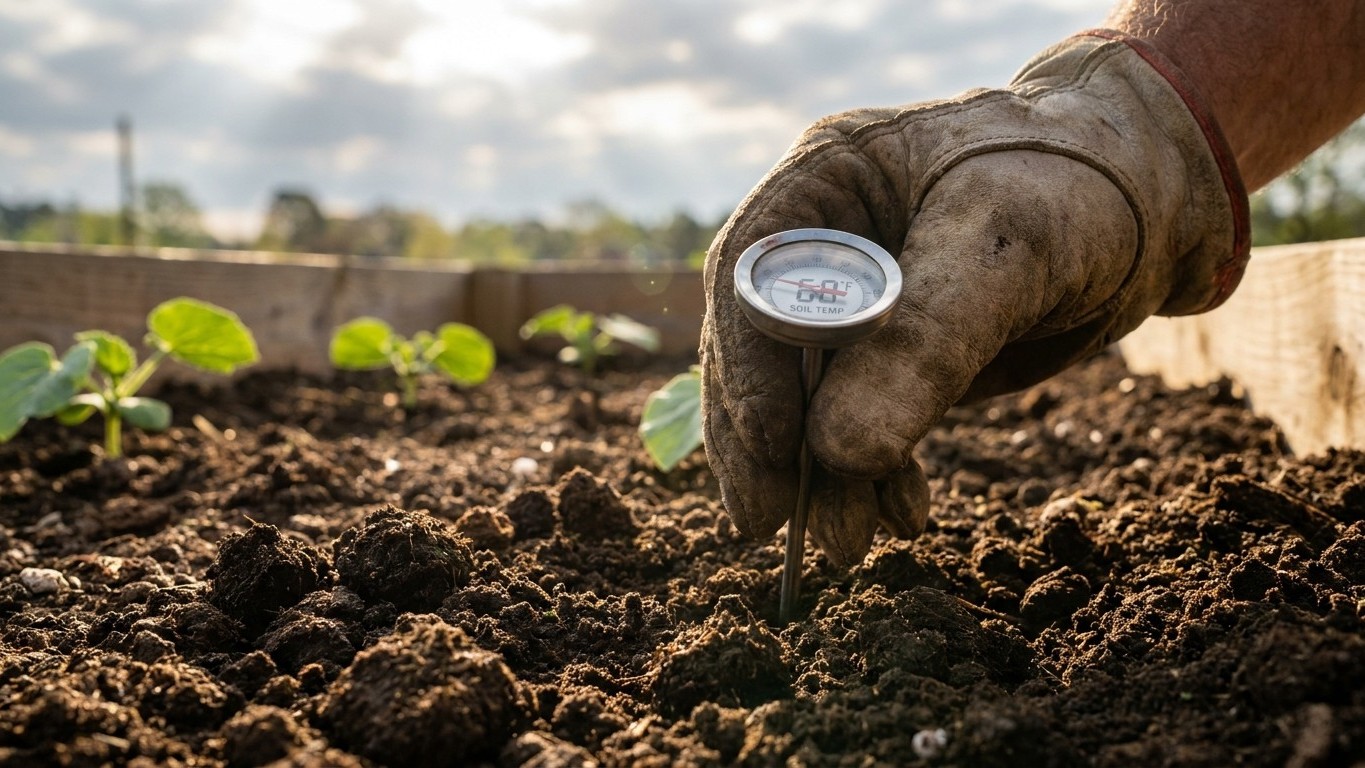

Yes, melons can be grown in Alaska, but only with active season-extension techniques: black plastic or landscape fabric to warm the soil, floating row cover or a low tunnel to hold heat, and a fast-maturing, cold-tolerant type chosen with help from your state extension service. Anchorage’s climate gives growers roughly 143 frost-free days and almost no summer heat load, so the soil-warming step matters more than the calendar date.
When the soil is warm enough in Alaska
The last spring frost at the Anchorage reference station (NOAA station USW00026451) falls between May 3 and May 12, based on the 30-70% probability band in the NOAA NCEI 1991-2020 Climate Normals. That’s the date most gardeners circle on the calendar. But it’s the wrong question for melons. Frost dates tell you when the air stops freezing at night. Melon seed germinates and melon roots grow only once the soil itself has warmed, and soil lags behind air temperature by weeks in a climate like this one.
Treat the frost date as a probability, not a promise. A 30-70% band means frost is still plausible on either side of it in some years, and a single late freeze can undo a week of soil-warming work. That’s the built-in risk of gardening this far north, and it’s worth planning around rather than ignoring.
Warming the soil ahead of the frost date
Because Anchorage soil starts cold and stays cool through spring, most successful melon growers here don’t wait for the frost-free date to act. They warm the bed first, then plant into it. Common practices include:
- Laying black plastic mulch or landscape fabric over the planting bed two to three weeks before the intended transplant date, so solar heat builds in the soil rather than radiating away overnight
- Using raised beds, which drain and warm faster than flat ground because they shed cold, wet soil water more quickly
- Covering young plants with a floating row cover or a low plastic tunnel right after transplanting, to hold daytime heat around the root zone through the cool nights that persist well into June at this latitude
None of this guarantees a melon crop. It shifts the odds. Starting transplants indoors, rather than direct-seeding, is the other half of the equation almost everyone growing melons this far north relies on, since direct-seeded melons simply don’t have time to catch up once the soil finally does warm. For the specific types trialled successfully in Southcentral Alaska conditions, the University of Alaska Fairbanks Cooperative Extension Service keeps trial records that this page doesn’t have and shouldn’t guess at.
How long the season lasts here
With the last spring frost landing May 3 to May 12 and the first fall frost arriving September 22 to October 1 (same station, same NOAA NCEI normals), the frost-free window runs about 143 days. That figure already accounts for both ends of the range, and it’s the number Alaska’s climate summaries cite as the frost-free season length for the Anchorage area.
143 days sounds workable on paper, closer to a mid-length U.S. growing season than most people expect from Alaska. The catch is what fills those days. Early spring soil is cold enough that the effective planting window doesn’t open until well after May 12, and a good chunk of the tail end of the season, from mid-September on, brings cooling soil and shortening light that slows fruit ripening even before the actual frost arrives. In practice, the usable warm-season stretch for a heat-loving crop like melon is shorter than the raw 143-day count suggests.
That reality settles the succession-sowing question before it’s really asked. A long, forgiving season allows a gardener to sow a second round of melons after the first, insuring against a bad start or stretching the harvest. Alaska’s window doesn’t allow that. The first sowing, started indoors and transplanted out once the soil has been warmed artificially, is the only sowing most seasons will support. That also tips the balance toward starting seedlings that transplant cleanly with minimal root disturbance, since there’s no time in the calendar to recover from transplant shock and still finish a melon. Gardeners weighing whether their own climate allows a second planting, or comparing how that decision plays out in a longer-season territory, can see the mechanics laid out in this site’s succession sowing guide.
Heat and water in Alaska
Melons ripen on accumulated warmth, not on the calendar, and this is where Anchorage’s numbers tell the real story. The reference station records 0.0 days a year at or above 90°F, per NOAA NCEI 1991-2020 Climate Normals. That’s not a low heat load, it’s essentially none. Melons in most of the country rely on stretches of hot, dry weather in midsummer to push sugar into the fruit during the final weeks before harvest. That mechanism barely exists here.
This changes what actually decides success. In a hot climate, the sowing date and irrigation schedule do most of the work, because heat is abundant and the grower’s job is managing water. In Alaska, with heat this scarce, the type of melon chosen and the soil-warming technique carry far more weight than timing the planting date precisely. A grower here is manufacturing warmth artificially, through plastic mulch, tunnels, and often a greenhouse or high tunnel, because the climate isn’t going to supply it.
What the rainfall pattern adds to that picture
Summer rainfall at the same station runs about 5.8 inches across June, July, and August, out of 16.4 inches for the year, with a distinct dry-to-wet pattern within the season: June averages 1.02 inches, July 1.82 inches, and August 2.93 inches. That’s a modest, rising rainfall pattern, not a heavy one, and it arrives during the cooler part of the summer when evaporation demand is low. This is a very different problem from the hot, dry Territories where irrigation and the final fortnight of dry heat decide fruit size and sugar content.
The risk profile here runs the other direction. A summer with almost no 90°F days and rain building toward late August is a cool, often damp environment for a crop that actually prefers dry heat and good airflow around its leaves and fruit. That combination favors powdery mildew and other fungal pressure, and it slows fruit ripening even when the plant itself looks healthy. Good airflow between plants, avoiding overhead watering late in the day, and keeping developing fruit up off damp soil (on a board, a piece of mulch, or plastic) matter more here than in a hot, arid growing region where those same practices are optional extras rather than near-requirements.
Which melons suit Alaska
Given a short window, close to zero days of real summer heat, and rainfall concentrated in the cooler half of the season, three qualities matter more than any specific variety name: earliness, cold tolerance during establishment, and resistance to the fungal diseases that a cool, damp summer invites. Short-season melon types bred or selected for northern and high-altitude growing regions are the general category worth asking about, since they’re built to set and ripen fruit on far less accumulated heat than a Southern-grown type needs.
This page won’t name a cultivar, and that’s a deliberate choice rather than an oversight. Seed catalogs list dozens of melon varieties marketed as fast or cold-hardy, but which ones actually perform under Anchorage’s specific combination of long daylight, cold soil, and near-total absence of 90°F days is a question that gets answered by trial plots, not by a general description of climate. The University of Alaska Fairbanks Cooperative Extension Service runs and publishes exactly those local trials, and its recommendations reflect what has actually fruited in Alaska conditions across multiple seasons, something a general gardening article can’t responsibly substitute for.
What to ask the extension service
Worth raising specifically: which melon types have finished ripening reliably outdoors under row cover versus which ones only succeeded in a greenhouse or high tunnel, since Alaska growers use both approaches and the outcomes differ. Also worth asking about disease resistance ratings for powdery mildew, given the cool, rising-rainfall summer pattern described above. USDA Plant Hardiness Zones across Alaska span 1a to 8a, an extreme range for one state, so a recommendation calibrated to Anchorage’s milder coastal conditions won’t necessarily hold for a garden in the Interior, and the extension service is positioned to make that distinction in a way a single article covering the whole territory cannot.