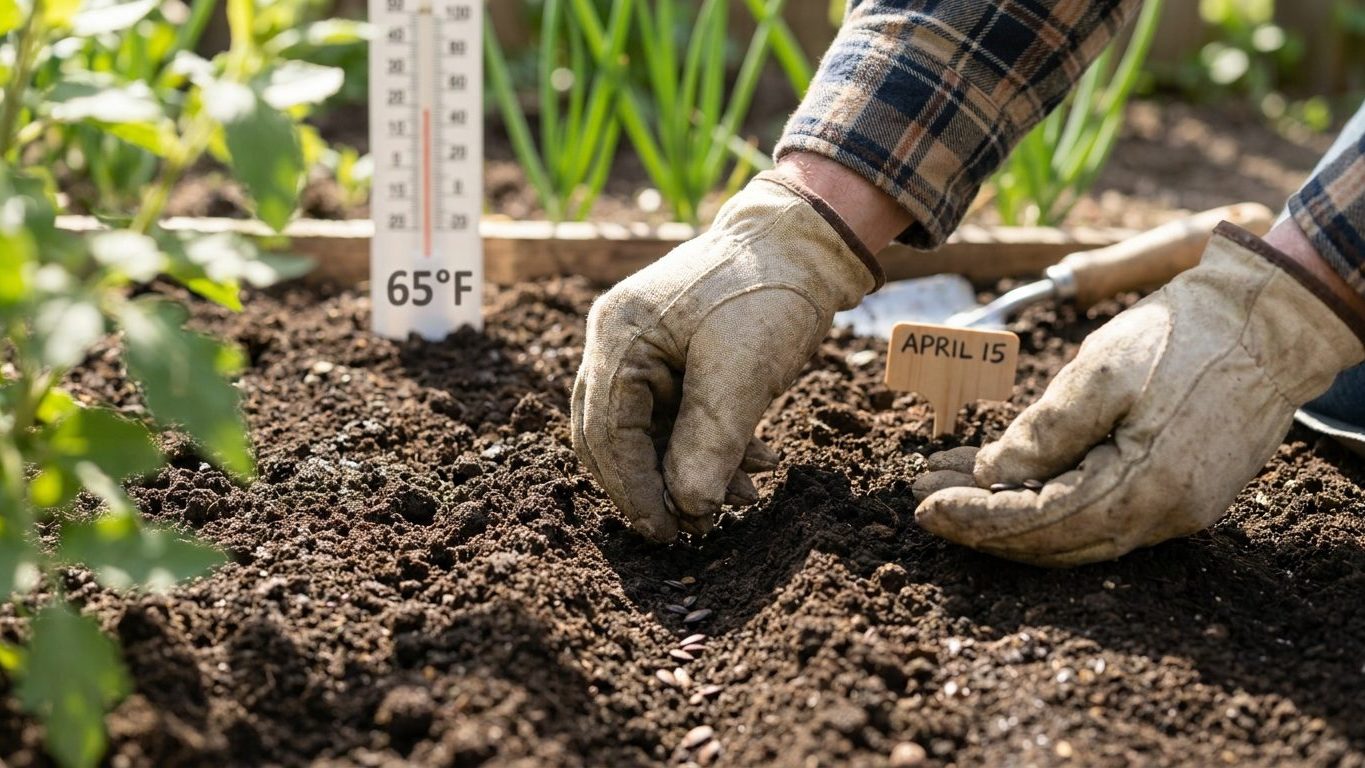

Illinois gardeners can plant melons outdoors once soil temperatures stay reliably above 65°F, which typically lines up with mid-to-late May across most of the state. That’s roughly three to four weeks after the last spring frost window closes, giving the soil time to warm past what melon roots tolerate.
The short answer for Illinois
The reference station used for these normals (Chicago area) reports a last spring frost window of April 11 to April 22, and a first fall frost window of October 24 to November 3. These are probability bands, not fixed calendar dates: they mark the 30-70% chance range for a 32°F freeze, meaning even after April 22 there’s a real chance of a cold snap in a given year, and even before October 24 there’s a chance of an early one.
Melon seed doesn’t germinate reliably in cold soil, and transplants set out too early just sit and sulk, or rot outright if a late frost slips through. So the safe outdoor planting window starts after that spring frost band closes, then adds another two to three weeks for the soil itself to catch up to air temperatures. In practice, that puts direct seeding or transplanting into the ground somewhere between the second week of May and the first week of June for most of the state, depending on how far north or south a garden sits within Illinois’s own spread.
Working backward from the first fall frost window (October 24 to November 3) gives a frost-free growing season of roughly 185 days when using the more conservative dates (April 22 to October 24). That’s a long window by Midwest standards, and it comfortably covers the maturity range of nearly every melon variety sold in the U.S., including slower cantaloupes and watermelons that need 85 to 100 days from transplant to harvest.
The 14.0 average annual days above 90°F at the reference station matter here too. Melons are heat-loving plants, and that heat load is what pushes fruit from green to ripe once the vines are established. It’s a moderate number, not a scorching one, which means Illinois summers give melons enough warmth to finish but rarely so much that growers need to worry about heat stress shutting down pollination the way it can further south.
So the short version: don’t rush the calendar based on the frost date alone. Wait for the soil, not just the air, and count on planting sometime in the back half of May for most locations, using the extension resources below to narrow that down by county.
What will not work here
Planting on the calendar date rather than the soil temperature is the single most common mistake. The last spring frost band closes around April 22 at the reference station, but melon roots stall in soil below 65°F regardless of what the air temperature says. A gardener who plants the last week of April because “the frost date passed” is very likely setting transplants into soil still in the upper 50s, and the plants will sit stunted for two or three weeks waiting for warmth rather than growing.
Long-season melon varieties are the second failure point, though less often than people assume. With a roughly 185-day frost-free window using the conservative dates, most 90 to 100-day melons have plenty of margin. The real risk isn’t the variety’s day count, it’s a late, cool, wet spring that delays planting past the first week of June. Stack a slow start onto a 100-day watermelon and a grower can end up racing the October frost window with unripe fruit still on the vine.
Watering on autopilot fails here
Summer rainfall across June, July and August averages about 12.1 inches, but it isn’t spread evenly: July, the peak fruiting month for most melons, is the driest at 3.71 inches. A grower who waters once a week on a fixed schedule, assuming “it rained this month so we’re fine,” will often find vines wilting in late July precisely when fruit is sizing up and demand is highest. Melons need consistent moisture during flowering and fruit set, then actually benefit from a drier finish as fruit ripens, so a rigid weekly schedule gets both ends backward.
Close spacing is the third trap, and it’s a humidity problem more than a heat one. Illinois summers deliver enough rain and enough humid stretches that melon foliage planted too tightly stays damp long after a storm passes, which is exactly the condition powdery mildew and other fungal diseases need. Vines crowded together with no airflow between them will show mildew symptoms weeks before properly spaced plants, even in the same garden bed, same soil, same water.
What changes across Illinois
Illinois spans USDA hardiness zones 5a to 7b, a spread wide enough that no single planting date works for the whole state. That range, built on the average annual extreme minimum temperature, is the clearest signal that a gardener near the Wisconsin border and one near the Kentucky border are not gardening in the same climate, even though both are technically “Illinois.”
In practical terms, the northern end of that range (zone 5a) sees colder winters, a later spring warm-up, and typically an earlier first fall frost than the reference station figures used here, since those normals come from a station further south in the state’s population center. A grower in the northern tier should expect to push planting later into May, and should also expect the growing season to close sooner in fall than the October 24 to November 3 window suggests.
At the southern end (zone 7b), winters are milder, soil warms sooner in spring, and the frost-free season extends measurably longer than the reference figures. A grower there might be planting in early-to-mid May rather than late May, and could reasonably expect the first fall frost to arrive well after the November 3 end of the reference window, stretching the effective season for slower-maturing melon varieties.
None of this means a reader should guess which end of the zone spread applies to them. The zone range itself shows that one reference station cannot answer for the whole state. The next section covers where to find that answer for a specific county.
Where to check this for your own county
The University of Illinois Extension, at extension.illinois.edu, is the source for a planting date tied to a specific county’s soil and frost patterns rather than one reference station’s normals. State extension services exist precisely because a statewide range like zone 5a-7b hides real differences on the ground.
On the extension site, two things are worth searching for specifically. First, the local or regional planting calendar, which will translate the frost-date probability bands used here into a recommended range for a specific county or growing region within Illinois, often broken down by northern, central and southern zones rather than a single statewide date. Second, the variety trial results, which show which melon varieties have actually been grown and evaluated under local conditions, including yield and disease performance in that region’s specific rainfall and humidity pattern.
A county-level recommendation from extension staff who work with local soil samples, local frost records and local disease pressure will always outperform a state-level page like this one. One reference weather station’s 1991-2020 climate normals are useful as a starting point and a way to understand the mechanics behind a planting date, but not a substitute for county-specific guidance.
Extension offices also typically publish master gardener contacts by county, useful for a grower who wants to ask a direct question about a specific field or garden bed rather than working from published averages alone.
Some gardeners also time melons by the Moon: when to plant watermelon and cantaloupe by the moon, as almanac tradition rather than fact.
Checking this against your own garden
Every date here is an average built from three decades of weather station readings. A grower’s own garden, observed directly, outranks all of it. Three signs are worth checking before trusting any calendar date.
Soil warmth by feel is the first and most direct check. Pushing a hand two to three inches into the planting bed on a sunny afternoon gives a rough but reliable read: soil that still feels cool and slightly damp like early spring hasn’t reached the 65°F melons need, regardless of what the calendar says about frost dates having passed weeks earlier.
The first flush of male flowers is the second signal, and it tells a different story: male flowers typically appear seven to ten days before the female flowers that actually set fruit. Seeing that first flush confirms the plant has moved past establishment and into reproductive growth, a sign the local heat accumulation is on track even if the season started slower than expected.
The first true leaves, the ones that emerge after the initial seed leaves and actually look like miniature melon foliage, are the third check. Their appearance and color say something about whether the transplant is thriving in that specific spot’s soil and drainage, information no regional average can offer. A garden that’s slower or faster than the county calendar on any of these three points is simply telling the grower something true about that particular patch of ground, worth trusting over any printed date.