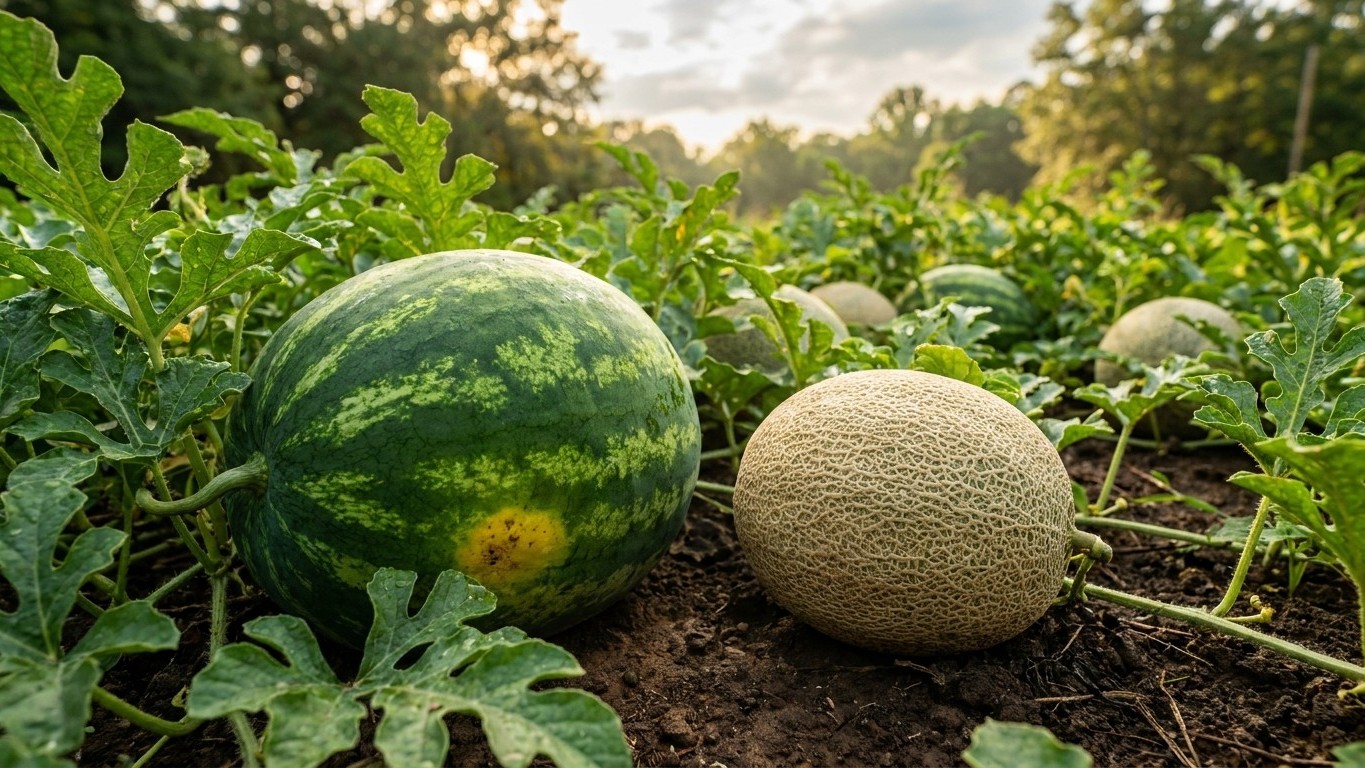

Indiana’s growing season runs long enough for most melon types, but the summer isn’t scorching by national standards. That combination favors quick-to-mid-season cantaloupes, muskmelons, and compact watermelon varieties over the giant, heat-hungry types that need ten or eleven weeks of blazing days to fully sweeten.
The short answer for Indiana
Start with the numbers, because they set the boundaries for every variety choice that follows. Indianapolis sees its last spring frost between April 9 and April 21, and the first fall frost arrives October 21 to October 30. Stack those together and a gardener working from the conservative end of each range (April 21 to October 21) gets roughly 183 frost-free days. Someone gambling on the earlier spring date and the later fall date could stretch that to around 204 days. Either way, that’s enough runway for nearly every melon category sold at a garden center.
Heat is the other half of the equation, and this is where Indiana starts to differ from the Deep South or the desert Southwest. The state averages just 14.6 days a year at or above 90F. That’s moderate heat load, not the sustained triple-digit stretches that push sugar content in the biggest, slowest watermelon cultivars. So the decision by type looks like this: cantaloupes and muskmelons in the 75 to 85 day range are a strong match for Indiana’s season and heat profile. Compact “icebox” watermelons, typically 80 to 85 days to maturity and bred for shorter, cooler summers, also line up well. Honeydews sit in a middle zone, workable but tighter, since many honeydew varieties want both a long season and consistent heat to finish sweet.
Full-size watermelons in the 85 to 90 day range can work across most of the state if they go in the ground promptly after the frost risk passes. Where the math gets uncomfortable is the 95-to-100-plus day watermelons, the kind bred for extended hot climates. Even at the generous 204-day season length, a slow spring or a cool stretch in September eats into the margin fast, and with only 14.6 days above 90F to drive sugar development, those late-maturing giants are working against the climate rather than with it.
This page doesn’t have county-level frost data or soil temperature records, so treat these figures as the Indianapolis reference point, not a promise for every backyard in the state. The pattern holds statewide in broad strokes: match variety maturity length to the season, and don’t expect Indiana’s heat units to rescue a slow-maturing pick the way a Georgia or Texas summer might.
What will not work here
The clearest failure mode in Indiana is a mismatch between a melon’s days-to-maturity number and the actual frost-free window. A 100-day watermelon planted the week after the last frost, using the Indianapolis average of April 21, is aiming for a harvest around July 30, which sounds fine until a wet, cool spring delays transplanting by two weeks, or a September cold snap arrives ahead of schedule. There’s little slack for setbacks with the slowest varieties, and Indiana’s frost dates are averages built from 30 years of data, not guarantees for any single year.
Purdue’s own extension guidance flags something worth repeating here: even after the published spring frost date passes, there’s roughly a 10% chance of a 32F event showing up anyway. That’s not a rare fluke. It means gardeners setting out tender melon transplants at the early edge of the April 9 to April 21 window should have row cover or another frost protection method ready, not stored in the shed for “just in case.”
Summer moisture and spacing
The rainfall pattern creates a second failure point that has nothing to do with drought. Indiana’s summer isn’t dry in total, with about 12.6 inches falling across June, July, and August, but that rain doesn’t arrive evenly. June brings 4.95 inches, July 4.42, and August drops to 3.2, often concentrated in thunderstorms rather than steady soaking rain. That combination of humid air and clustered downpours is exactly the condition that fuels powdery and downy mildew on melon foliage, and it punishes tight spacing. Vines crammed close together with poor airflow hold moisture on the leaves longer after a storm, and in a state with this rainfall rhythm, that’s an invitation to foliar disease that a drier climate wouldn’t punish nearly as hard.
A weekly watering schedule fails for the opposite reason in some years and the same reason in others. Because the summer rain arrives as heavy, spaced-out events rather than gentle regular showers, a gardener relying on a single weekly soak, timed to “top off” whatever fell naturally, can end up either drowning shallow melon roots after a thunderstorm week or leaving the plants dry through a rainless stretch in dry August. The soil under the plants decides which failure shows up first: sandy soil drains that August dry spell into stressed vines within days, while clay holds moisture and compounds the disease risk after a wet June. Neither extreme is solved by a fixed calendar of watering days.
What changes across Indiana
Indiana is not one climate wearing a single hat. The USDA hardiness zone map places the state across a 5b-7a range, which is a wide spread for a state its size, built from average annual extreme minimum temperatures. That range alone tells a northern Indiana gardener and a southern Indiana gardener they’re not working with the same growing conditions, even before frost dates enter the picture.
The frost data cited in this page comes from the Indianapolis station, roughly in the middle of the state, and Purdue’s own caution applies directly here: southern Indiana tends to see its last spring frost earlier and its first fall frost later than the north, by two weeks or more. That’s not a small adjustment. Two extra weeks on each end of the season adds up to close to a month of additional growing time, which is the difference between a 95-day watermelon being a reasonable gamble and being a clear mismatch for the local season.
What that means practically: a reader gardening in the northern part of the state, likely in the cooler end of that 5b-7a zone spread, should lean toward the shorter end of every maturity range mentioned above, and treat the early-spring frost date as the riskier edge rather than the target. A reader in the southern part of the state, closer to zone 7a conditions, has more room to try a longer-season cantaloupe or a full-size watermelon without pushing the calendar as hard.
None of this tells any individual reader which zone sits under their own soil. This page has state-level frost and zone data, not county-level or address-level data, and a hardiness zone range this wide means there genuinely isn’t one answer for “Indiana” as a whole. The right move is checking the current USDA Plant Hardiness Zone Map by entering a specific zip code, which narrows that 5b-7a spread down to the single zone that actually applies.
Where to check this for your own county
Every figure in this article, the frost dates, the heat days, the rainfall totals, comes from a single reference station in Indianapolis. That’s useful for a state-level overview, but it is not a county forecast, and Indiana’s own frost-date spread of two weeks or more between north and south proves why that distinction matters.
Purdue’s Cooperative Extension Service is the resource built to close that gap. It’s reachable at extension.purdue.edu, and it’s organized by county office, each staffed with agents working from local trial data rather than a single statewide station. Two things are worth looking for specifically once there. First, the local planting calendar for the reader’s own county, which accounts for the elevation, water proximity, and microclimate quirks that a single Indianapolis-based normal simply can’t capture. Second, the variety trial results for melons run in or near that county, since Purdue’s horticulture program tests cantaloupe, watermelon, and specialty melon cultivars under actual Indiana field conditions, not laboratory averages.
A county-level recommendation from a local extension office will always outrank a state-level summary like this one, because it accounts for the specific soil, drainage, and season-length quirks of that county rather than a statewide average built from one weather station. This page exists to lay out the state picture, the broad strokes of season length, heat load, and rainfall pattern, and to point toward the tighter, county-specific answer rather than pretend to replace it.
Checking this against your own garden
Every date in this article is a 30-year average, not a promise about this particular spring or this particular patch of ground. The most reliable check a gardener has isn’t a calendar at all, it’s the garden itself.
Soil warmth by feel is the first and most direct signal. Melon seed germinates poorly, or rots outright, in cold soil, regardless of what the calendar says about the last frost having passed. Pushing a bare hand a few inches into the planting bed and feeling for warmth similar to bathwater, rather than cool or cold earth, is a rough but effective gut check that the soil has actually caught up to spring air temperatures.
The first flush of male flowers is the second signal worth watching. Melon vines produce male blossoms before female ones, and a burst of yellow male flowers with no fruit-bearing female flowers yet is normal, not a failure. It tells the gardener the plant has shifted into reproductive growth and that pollinator activity, not calendar dates, now decides how soon fruit sets.
The appearance and vigor of the first true leaves rounds out the picture. Seedlings that push out sturdy, dark green true leaves quickly after the cotyledons open are growing in conditions that suit them, a sign the local microclimate, whatever the county-level averages say, is currently cooperating. Slow, pale, or stalled true-leaf growth is the plant reporting that something, cold soil, poor drainage, or a shaded spot, is working against it right now, regardless of what the frost-date tables predicted for this week of the season.