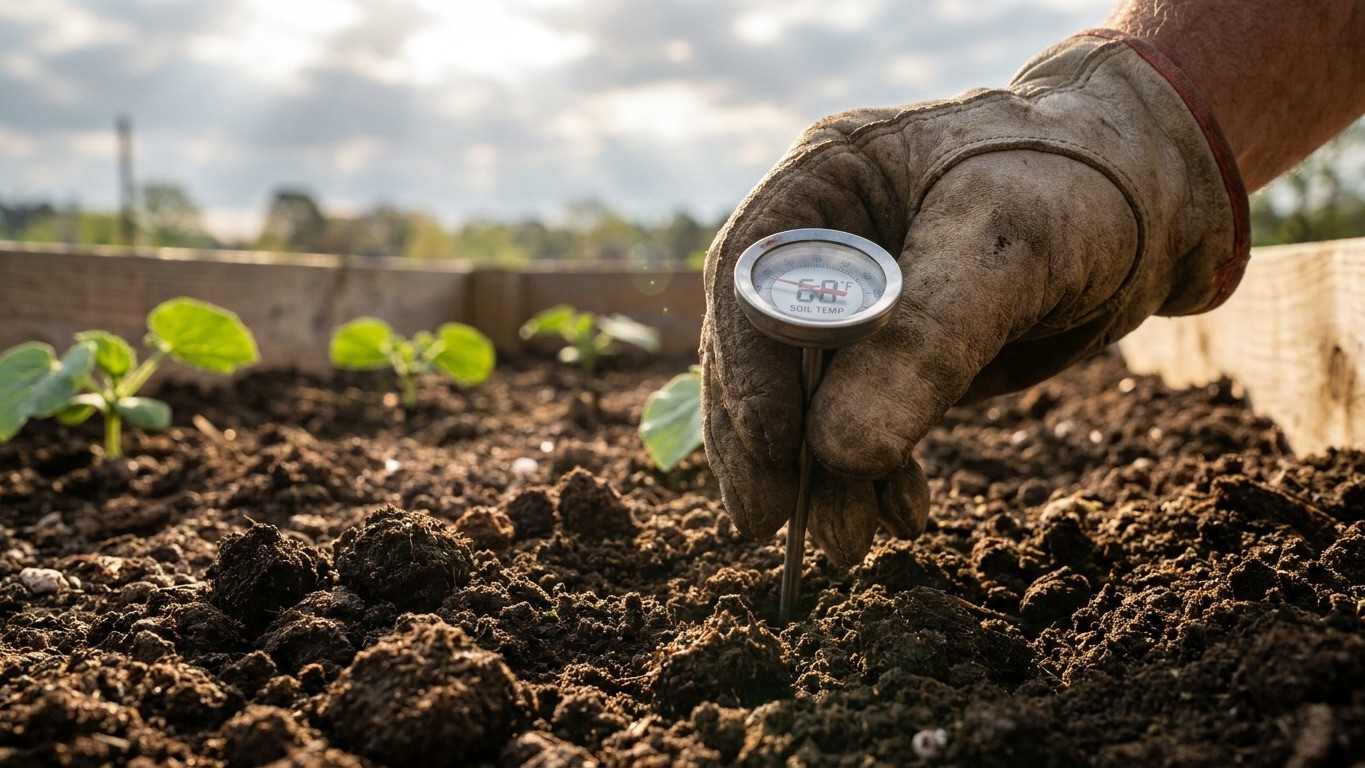

Melons in Indiana go into the ground once the soil itself has warmed, not simply once the calendar clears the last frost. That usually lands somewhere in mid-to-late May across most of the state, with the window shifting earlier in the southern counties and later up north. The real decision hinges on soil temperature, the length of the frost-free stretch, and how much summer heat the plant can actually bank before harvest.
When the soil is warm enough in Indiana
Indianapolis, the reference station for the state’s climate normals, sees its last spring frost land somewhere between April 9 and April 21, according to NOAA’s 1991-2020 Climate Normals for station USW00093819. That’s a 30-70% probability band for a 32F freeze, not a hard cutoff, and Purdue Extension flags something worth taking seriously: there’s still roughly a 10% chance of a freeze event even after that later date passes. Southern Indiana counties typically clear frost risk a couple weeks earlier than this Indianapolis benchmark; the northern tier runs later. Anyone gardening near the Ohio River border or up near the Michigan line should treat the Indianapolis dates as a starting reference, not a local guarantee.
The frost date is a starting gun, not a green light
Frost is the easy number to track, but melons don’t care about air temperature nearly as much as they care about soil temperature. A patch of ground can sit well above freezing for days while the soil six inches down is still cold and wet from spring rain. Melon seed sown into cool soil either rots or sprouts weak and stays stunted for weeks, effectively wasting the early start a gardener thought they’d gained. The frost date matters because it marks when air stops threatening young seedlings, but soil warmth is the separate, slower-moving condition that actually determines when seed or transplant goes in.
Warming the soil faster instead of waiting
Gardeners who want to push the calendar earlier than the natural soil-warming curve have real options: black plastic mulch laid down a week or two ahead of planting, raised beds that drain and warm faster than flat ground, or row cover pulled over the bed on the coolest nights. None of these replace the frost math above; they simply narrow the gap between when the air is safe and when the soil is ready. On the early edge of that April 9-21 window, having row cover on hand isn’t optional caution, it’s the difference between a clean stand and a replant. For the specific varieties trialled in Indiana conditions, and for planting-date guidance tuned to a particular county, Purdue Extension is the source built for that level of local detail, not a general climate page like this one.
How long the season lasts here
Subtracting the two Indianapolis frost dates gives the shape of the growing window: spring frost risk clears between April 9 and April 21, and fall frost risk arrives between October 21 and October 30. That puts the frost-free stretch somewhere in the neighborhood of six months at the Indianapolis reference point, though the exact count shifts depending on where in that spring-to-fall range a given year actually falls. It’s a workable season for melons, but it’s not an unlimited one, and how a gardener uses it changes depending on which end of that range they’re planning around.
What a short window means for transplants
A season on the shorter side of that range rewards starting melons as transplants indoors three to four weeks before the projected soil-warm date, rather than direct-seeding and hoping the whole cycle fits. Transplanting shaves real time off the calendar, but melon roots resent disturbance more than most vegetable transplants do, so a root check before setting out matters: peat pots or soil blocks that go into the ground intact avoid the transplant shock that costs a week of stalled growth right when the season can least afford it. On the longer side of the window, that root-disturbance risk becomes less of a gamble worth avoiding, because there’s enough calendar left to absorb a slow week.
The length of this window also decides whether a second sowing makes sense. A six-month frost-free stretch, on paper, leaves room to follow an early melon crop with a fast-maturing second planting, or to stagger two sowings a few weeks apart as insurance against a bad stretch of weather hitting one batch. Whether that actually pencils out for melons specifically, versus faster crops that recover the calendar more easily, is exactly the kind of trade-off covered in this site’s succession sowing guide, which walks through which crops are worth doubling up and which aren’t.
Heat and water in Indiana
Melons ripen on accumulated warmth, not on the calendar, and Indianapolis logs an average of 14.6 days a year at or above 90F, per NOAA’s 1991-2020 Climate Normals. That’s a modest heat load compared to the country’s hotter growing regions, and it matters more than it sounds like it should. A territory with fewer than fifteen days that hot in an average year isn’t one where a gardener can count on a long stretch of intense heat to force sugar development late in the season. It’s one where the soil-warming techniques discussed above, and the choice of an earlier-maturing type, carry more weight than they would somewhere with a longer hot stretch to fall back on.
Rain that falls, and rain that soaks in
Summer rainfall at the same Indianapolis station runs to roughly 12.6 inches across June, July, and August combined, out of 43.6 inches for the full year. That’s a reasonably wet summer by national standards, but it isn’t evenly spread, and the driest of the three months is exactly when melons are sizing up and starting to ripen.
| Month | Average rainfall |
|---|---|
| June | 4.95 inches |
| July | 4.42 inches |
| August | 3.2 inches |
That drop into August is the month that decides fruit quality most directly, and it’s also where the 14.6 hot days tend to cluster. A modest heat load paired with a summer that isn’t bone-dry doesn’t set up the classic hot-climate melon story, where irrigation determines size and a dry final fortnight concentrates sugar. It sets up something closer to the opposite problem: humidity and lingering soil moisture from June and July rain can slow ripening and invite powdery mildew on the vines, so airflow between plants and morning watering that lets foliage dry by evening matter as much as water volume does. These are 1991-2020 normals for one reference station, not a promise for any particular yard, and soil type changes the picture further: the same rain that soaks into sandy ground within a day sits on clay for a week, so two gardens ten miles apart under the same rainfall can need completely different watering schedules. A rain gauge on the actual plot settles that faster than any regional average can.
Which melons suit Indiana
Given a season in the six-month range, a heat load under fifteen days above 90F a year, and summer rain that’s plentiful but front-loaded into June and July, three things sort out which melon types make sense here rather than fight the climate. Types that mature on the earlier side of the spectrum hedge against a cooler-than-average summer eating into the heat-accumulation window. Types trained or trellised for airflow, or grown on raised, well-drained ground, cope better with the mildew risk that comes from humid air lingering after rain. And disease resistance, specifically to the fungal pressure that thrives in humid Midwest summers, matters here as much as flavor does, because a vine that collapses to mildew in August never gets to the ripening stage where flavor is even a question.
Why this page won’t name a variety
What this page won’t do is hand over a specific variety name, and that’s a deliberate choice rather than an oversight. Cultivar performance shifts year to year and county to county based on exactly the disease pressure, heat accumulation, and soil conditions described above, and a name printed on a general climate page can’t account for a trial plot’s actual results. Purdue Extension runs variety trials tuned to Indiana conditions, and their county offices, reachable through extension.purdue.edu, publish the specific types that performed well in recent seasons, sorted by the same criteria that matter here: days to maturity, mildew resistance, and heat tolerance. That’s the recommendation worth acting on. Indiana’s hardiness zone runs from 5b in the north to 7a in the south on the USDA’s 2023 map, itself built on winter minimum temperatures rather than summer growing conditions, which is one more reason a county-level source beats a statewide guess for choosing what actually goes in the ground.