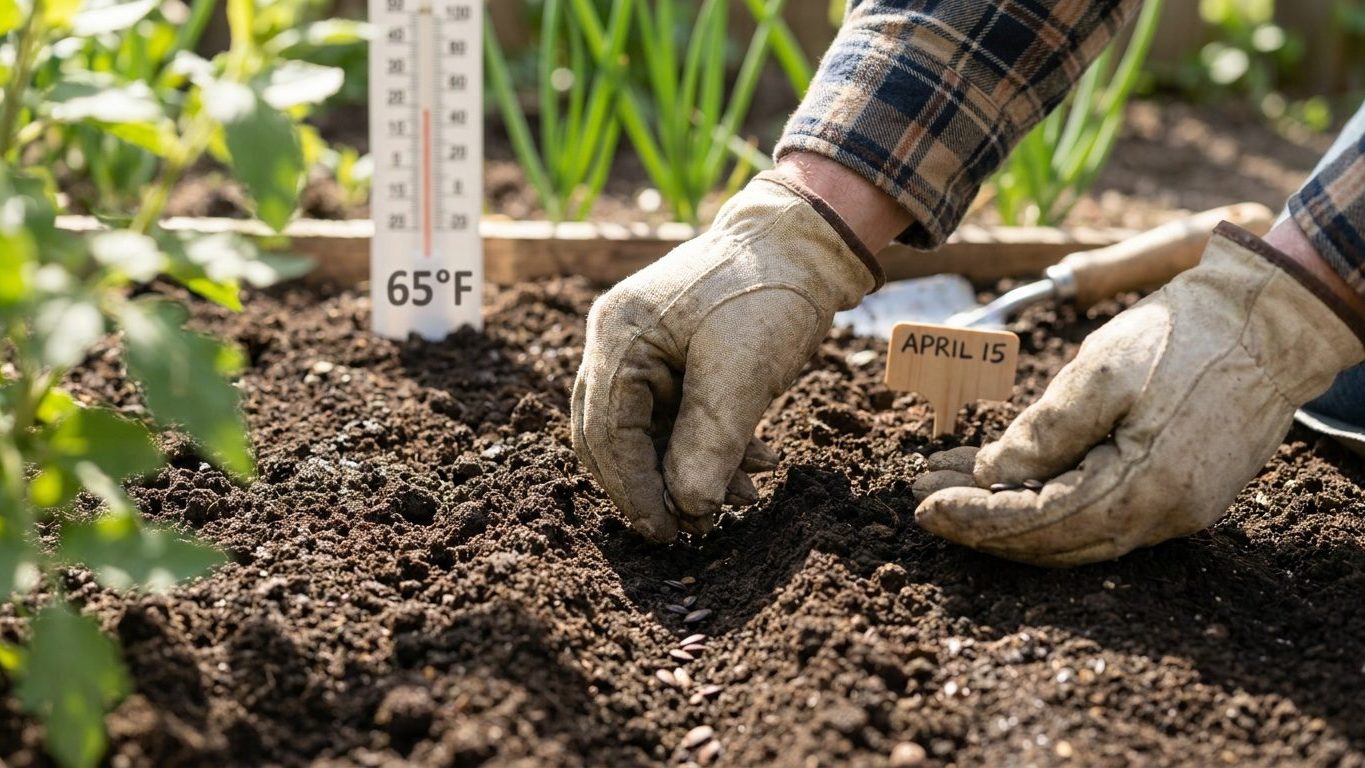

Melons in Indiana go into the ground once the soil itself, not just the calendar, has caught up with spring. That means direct-seeding or transplanting from early May in the south to the last week of May in the north, timed off the region’s frost-free window and confirmed by soil warmth rather than a fixed date.
The short answer for Indiana
Indianapolis, the reference station for Indiana’s climate normals, sees its last spring frost fall somewhere between April 9 and April 21, and its first fall frost between October 21 and October 30 (NOAA NCEI 1991-2020 Climate Normals, 32°F freeze probabilities, station USW00093819). Those two windows are not fixed dates. They are probability bands: the range where a 32°F freeze has a 30 to 70 percent chance of happening. Purdue’s extension specialists add a sharper warning on top of that: even after the published spring date passes, there is roughly a 10 percent chance of another 32°F event. Melons, unlike lettuce or peas, cannot shrug that off. A single freeze at the seedling stage kills the plant outright.
That is why the practical planting window sits later than the frost date alone would suggest. Melon seed germinates poorly, or not at all, in cold soil, and transplants set out into soil that has not warmed sit and sulk rather than grow. Growers working off the Indianapolis frost dates generally wait two to three weeks past the last-frost window before direct-seeding, and closer to three or four weeks if they are setting out started transplants. In practice that lands the safe window in the first half of May in southern Indiana and the last week of May into early June in the north, given the fortnight-or-more spread Purdue notes between the two ends of the state.
Counting forward from there to the first fall frost (October 21 to October 30 at the reference station) leaves a growing season of roughly five and a half to six and a half months. That is enough time for most melon types to reach maturity, but it is not unlimited, and it is the number that should drive every variety decision covered on this page’s sibling articles about which melons actually finish here.
If a reader wants a date more specific than a statewide range, this page does not have it. The Indianapolis station is a reference point, not a substitute for a county-level reading, and the section on where to check locally below explains exactly where that finer detail lives.
What will not work here
Two separate risks stack up against melons in Indiana, and they fail the crop in opposite ways.
Planting too early against the frost window
The temptation every spring is to jump the gun the first warm weekend in April. But with the last frost date landing anywhere from April 9 to April 21 at Indianapolis, and a residual 10 percent chance of frost even after that, a melon transplant set out in mid-April is gambling against real odds. Melons carry no frost tolerance at all; there is no “light frost, might survive” scenario the way there is with kale or spinach. A grower who plants on the early edge of the window without row cover ready is planting to lose the crop roughly one year in ten, and losing three or four weeks of the short season replanting after it happens.
Planting for a season that runs out too soon
The other failure mode sits at the far end of the calendar. With first fall frost arriving October 21 to October 30, and the practical melon-planting window not opening until early-to-late May depending on where in the state a garden sits, the usable frost-free season runs about 150 to 170 days from safe planting to first freeze, not the full 183 to 204 days between the two frost dates. Melon varieties bred for longer, hotter growing regions, the ones that need 100-plus days to reach full ripeness, are cutting it close in a northern Indiana garden that planted in late May. That is a variety question the companion page on best melon varieties for this territory covers in more depth, but the root cause is this state’s frost calendar, not the gardener’s skill.
Watering on a weekly schedule through August
Summer heat compounds both timing risks. Indianapolis averages 14.6 days a year at or above 90°F, concentrated in July and August, which is exactly when melon vines are sizing fruit and need water most. Summer rainfall averages about 12.6 inches across June, July and August, but August itself is the driest of the three at just 3.2 inches, against July’s 4.42 and June’s 4.95. A gardener watering on autopilot once a week, assuming “average” rainfall will fill the gap, is often watering into a August dry stretch that the season’s earlier rain does not cover. On sandy soil that gap shows up as wilted vines within days; on clay it is masked longer, then hits all at once. Either way, a rain gauge, not the seasonal average, is what should set the schedule.
What changes across Indiana
Indiana is not one climate. The USDA Plant Hardiness Zone Map places the state across zones 5b to 7a, based on average annual extreme minimum winter temperature, and that spread of roughly a zone and a half means there is no single planting date that fits the whole state honestly. A zone 7a reading, typically found along the Ohio River in the south, points to a milder winter and an earlier spring warm-up than a zone 5b reading in the state’s northern counties.
That difference shows up directly in the melon calendar. Purdue’s own caution about the frost data notes that southern Indiana runs earlier in spring and later in autumn than the north, by two weeks or more on both ends. Stack that onto the statewide frost window (April 9-21 spring, October 21-30 fall) and the practical range widens further at the extremes: a southern Indiana garden could reasonably expect safe melon planting a full two weeks ahead of a northern one, and a fall harvest window two weeks longer to match.
None of this means a reader should plant by a general rule of thumb like “a week per fifty miles.” Local terrain complicates the zone map further: low-lying frost pockets along river valleys, urban heat-island effects near Indianapolis or Fort Wayne, and elevation changes in the state’s hillier southern counties all shift the effective zone away from what a regional map alone would suggest. Since this page can only speak to the state as a whole, and the zone range itself spans three sub-zones, the honest answer is that there is no single number to give an individual gardener. The next section covers exactly where to find that number for a specific county rather than guessing from a statewide range.
Where to check this for your own county
Every fact on this page comes from a single reference station in Indianapolis. That is useful for setting the outer boundaries of Indiana’s melon season, but it is not a substitute for what applies on a specific piece of ground two counties away. The Indiana state extension service, run through Purdue University, publishes exactly that finer-grained information, and it is worth going straight to the source rather than relying on a statewide estimate.
Purdue Extension offers resources worth checking out. Two things there are worth looking for specifically:
- The county-level planting calendar, which adjusts the statewide frost window for local conditions rather than defaulting to the Indianapolis normals used on this page.
- Variety trial results for melons grown in Indiana conditions, which show which types have actually reached maturity in local trials rather than simply what a seed catalog claims for a national average.
A county extension office, or a county-specific bulletin from the same Purdue system, will beat this page every time on precision. This page works from a statewide range built on one weather station and one hardiness zone band; a county office works from local soil surveys, local frost records, and often a demonstration garden nearby. That is not a knock on the statewide data. It is simply a different resolution, and readers deciding on an actual planting date for an actual garden should treat the county source as the tie-breaker whenever it disagrees with anything written here.
Checking this against your own garden
Every date on this page is a regional average built from thirty years of weather records. A gardener’s own plot, this season, outranks all of it. Three things, checked by hand and eye rather than any instrument, tell more than a calendar can.
Soil warmth by feel. Push a bare hand into the planting bed a few inches down, mid-morning, several days in a row. Cold, damp soil that feels uncomfortable to hold onto for more than a few seconds is still too cold for melon seed or transplants, whatever the calendar says. Soil that feels merely cool but not cold, especially if that feeling holds steady across a run of sunny days, usually means the bed has caught up with the season even if the statewide frost window suggests waiting further.
The first flush of male flowers. Melon vines produce male flowers well before female ones, and a healthy first flush signals the plant has moved past the stress of transplant shock and into active growth. A vine that sits for weeks without producing any flowers at all, well past the point other plants of the same variety are flowering elsewhere, is a sign of a colder or more shaded microclimate than the regional average assumes.
The first true leaves. The seed leaves that emerge first are not the plant’s real leaves; the first true leaves, the ones shaped like the mature plant’s foliage, are the signal that root and shoot growth are underway together. Slow, pale, or stunted true leaves after warm weather has clearly arrived point to a soil or drainage problem on that specific plot, not a timing error, and that is worth fixing before blaming the calendar again next year.